
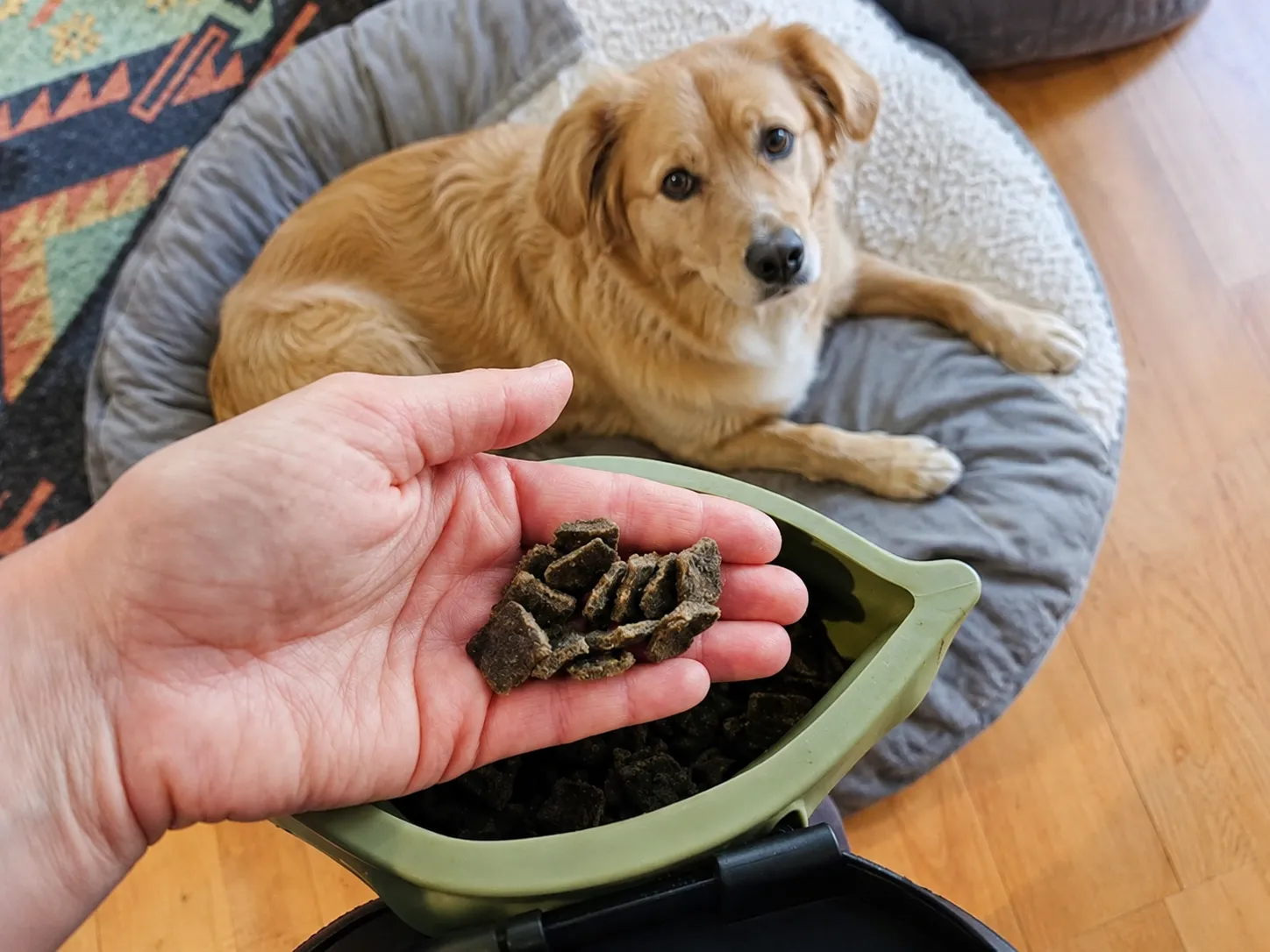
Dog separation anxiety training treats can help support calm, supervised departure-cue practice.
For repeated departure-cue practice, begin with a small soft treat that is easy to divide and fits your dog’s diet. Consider freeze-dried meat when your dog remains calm but needs a more motivating reward.
Which Training Treat Should You Choose?
Start with a soft treat containing approximately 1–2 calories per reward. Soft pieces are usually easier to divide and faster to deliver during short practice involving keys, shoes, coats, bags or door movement.
“High-value” does not mean one specific ingredient or brand. It means a reward your dog prefers in that situation.
If your dog normally eats the treat but refuses it when you reach for your keys or approach the door, make the exercise easier. Treat refusal can mean the cue is already producing too much stress. [1] [2]
This guide does not recommend leaving loose treats or an unfamiliar chew with an unattended dog.
Choose a Treat Based on Your Situation
Match the reward to your dog’s needs and the difficulty of the exercise.
| Your situation | Better starting option |
|---|---|
| Many repetitions in one short session | A small soft treat containing approximately 1–2 calories |
| Dog ignores soft treats but remains calm | Try a tiny freeze-dried meat piece |
| Prescription or elimination diet | Veterinarian-approved reward or measured diet kibble |
| Dog refuses food when departure cues appear | Make the exercise easier instead of changing products |
| Weight control is important | Measured kibble or very small divided portions |
| High-risk person lives in the household | Consider a cooked soft treat instead of raw freeze-dried food |
How the Products Were Selected
The comparison includes two soft treats and two single-ingredient freeze-dried treats with publicly listed ingredients and calorie information. Inclusion does not mean these are the only suitable options.
We compared calories, texture, portioning, ingredients and suitability for repeated reward delivery. We did not purchase or personally test the products, so this guide does not assess odor, bag durability, drying, real-world crumbling or acceptance by individual dogs.
Soft and Freeze-Dried Treats Compared
Soft treats are generally easier to divide during frequent training. Freeze-dried products may have shorter ingredient lists but can crumble and may require raw-food handling precautions.
| Product | Calories and ingredients | Best use | Main limitation |
|---|---|---|---|
| Zuke’s Mini Naturals Beef Recipe Dog Treats | 2 kcal; soft multi-ingredient formula | Frequent repetitions and easy tearing | May not suit a restricted diet |
| Cloud Star Tricky Trainers Soft & Chewy with Liver | 3 kcal; pork-liver-led multi-ingredient formula | Dogs that prefer a liver-led soft treat | Full pieces use calories quickly |
| Mini-PureBites Beef | Average 1 kcal; beef liver only | Small rewards and simple protein tracking | Raw freeze-dried and may crumble |
| PureBites Chicken Freeze-Dried Dog Treats | Average 3 kcal; chicken breast only | Dogs that tolerate and prefer chicken | Natural pieces may need dividing |
The ingredient must still be appropriate for your dog. Dogs on a prescription or elimination diet should receive rewards approved by their veterinary team.
Four Products to Compare
Check the exact flavor, formula, calorie label, package size and seller before ordering.
Zuke’s Mini Naturals Beef Recipe Dog Treats
Zuke’s lists a soft, chewy texture and 2 calories per piece. The pieces can be divided before a session when smaller rewards are needed. [6]
Cloud Star Tricky Trainers Soft & Chewy with Liver
Cloud Star lists pork liver first and 3 calories per treat. Divide the soft pieces before training when a full piece is larger than needed. [7]
Mini-PureBites Beef
PureBites lists freeze-dried beef liver as the only ingredient and an average of 1 calorie per mini piece. [8]
PureBites Chicken Freeze-Dried Dog Treats
PureBites lists chicken breast as the only ingredient and an average of 3 calories per piece. Prepare smaller portions before training. [9]
Choose a Treat Based on Your Dog’s Needs
Age, dental comfort, weight goals and dietary restrictions should guide the choice.
Puppies and small dogs
Use very small pieces and count every reward toward the daily food total.
Senior dogs or dental problems
A soft treat may be easier to eat than a large or hard freeze-dried piece.
Weight-control needs
Use measured kibble, one-calorie pieces or small divided portions.
Sensitive stomach or restricted diet
Choose only ingredients that already fit the dog’s veterinary feeding plan.
How Should Treats Be Used During Departure-Cue Practice?
Pair one easy cue movement with a small reward while your dog remains relaxed. Do not increase the difficulty after pacing, panting, trembling, vocalizing or food refusal begins. [1] [2]
-
Prepare small portions first.
Divide larger pieces before touching the keys, shoes or door. -
Start with one small cue.
Touch the keys, move one shoe or approach the door without leaving. -
Reward relaxed behavior.
Give one small piece while your dog remains comfortable. -
Pause between repetitions.
Put the item down and allow your dog to settle. -
End before stress appears.
Do not continue until your dog reacts.
- tries to break through doors, windows, crates or gates;
- damages teeth, nails, paws or skin;
- cannot tolerate even a small departure cue;
- shows prolonged panting, drooling, pacing or vocalizing;
- has a sudden behavior or appetite change.
How Many Training Treats Can Your Dog Have?
Treats and other foods outside the main complete diet should generally provide no more than about 10% of total daily calories unless your veterinarian recommends another plan. [3] [4]
Maximum daily treat calories = established daily calorie target × 0.10
Use the daily calorie target provided by your veterinarian or feeding plan. Do not calculate it only from body weight.
Measure the full day’s training portion into one container. Kibble used during training should be taken from the normal meal ration.
Raw Freeze-Dried Treat Handling
FDA guidance states that raw pet food is more likely than processed pet food to contain harmful bacteria. Wash your hands after handling raw freeze-dried treats and keep them away from human food-preparation surfaces. [5]
- Follow the storage instructions on the package.
- Keep the product away from young children.
- Clean surfaces and pouches that contact the treats.
- Check current animal-food recall notices.
Frequently Asked Questions
What treat should I try first for separation-anxiety training?
Begin with a small soft treat that your dog already tolerates. Choose a clearly stated calorie count and divide the piece when possible.
Are freeze-dried liver treats better than soft treats?
Not automatically. Freeze-dried liver may motivate some dogs, while soft treats are generally easier to divide and deliver quickly.
What if my dog refuses treats when I pick up my keys?
Can I use regular kibble during departure-cue practice?
Yes. Measured kibble can work during easy practice when your dog finds it rewarding. Take it from the normal daily ration.
How many treats can I use in one session?
Are single-ingredient treats safe for dogs with allergies?
Only when that ingredient suits the dog. A chicken-only treat is not suitable for a dog avoiding chicken. Dogs on prescription or elimination diets should receive veterinarian-approved rewards.
Which Option Should You Start With?
Start with a soft, easily divided reward whose ingredients suit your dog. Use freeze-dried meat when the protein is appropriate and your dog needs more motivation while remaining calm.
When a normally preferred treat is refused, reduce the training difficulty. The goal is relaxed learning, not simply getting the dog to eat.
About This Guide
This guide was prepared by the PetPlanetPro Editorial Team using published veterinary behavior guidance, nutrition guidance, FDA food-safety information and official manufacturer specifications.
The products were not personally tested, and this version is not presented as reviewed by a named veterinarian or certified behavior professional.
Sources
Behavior, Nutrition and Safety Guidance
-
ASPCA — Separation Anxiety.
Used for departure cues, food refusal during anxiety and gradual practice.
View the ASPCA guide -
VCA Animal Hospitals — Separation-Related Distress in Dogs.
Used for cue practice, stress monitoring and reducing exercise difficulty.
View the VCA guide -
VCA Animal Hospitals — Using Food and Treats for Training Dogs.
Used for reward selection, portion size and calorie guidance.
View the VCA treat guide -
American Animal Hospital Association — Weight Management.
Used for the approximate 10% daily treat-calorie guidance.
View the AAHA guidance -
U.S. Food and Drug Administration — Safe Handling of Pet Food and Treats.
Used for raw-product handling and bacterial-risk guidance.
View the FDA guidance
Official Product Specifications
-
Zuke’s — Mini Naturals Beef Recipe Dog Treats.
Used for ingredients, texture and calorie information.
View the official product page -
Cloud Star — Tricky Trainers Soft & Chewy with Liver.
Used for ingredients and calorie information.
View the official product page -
PureBites — Mini-PureBites Beef.
Used for the beef-liver ingredient and average calorie information.
View the official product page -
PureBites — Chicken Freeze-Dried Dog Treats.
Used for the chicken-breast ingredient and average calorie information.
View the official product page
Editorial note: Manufacturer pages were used for ingredients and calorie specifications, not as proof that a product treats separation anxiety.
Medical disclaimer: This article provides general educational information and does not diagnose or treat an individual dog. Discuss severe stress, sudden appetite changes, medical conditions and prescription diets with a veterinarian.
 ✓
✓