

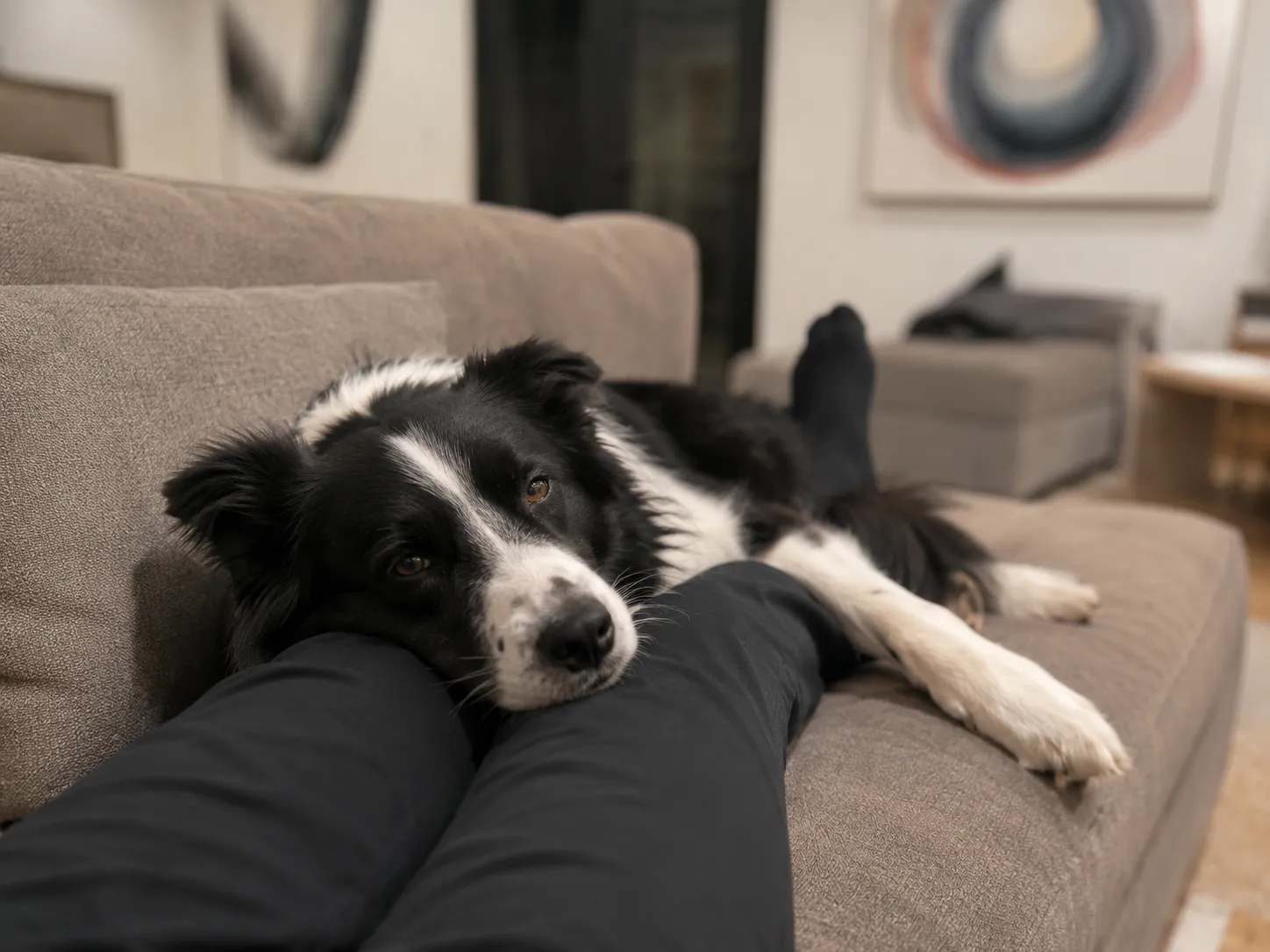
Yes your puppy can still learn to be alone, even if you work from home and spend almost the whole day together.
Being around you all day does not automatically cause separation anxiety.
But if your puppy sleeps beside your desk, follows you to the bathroom, and gets worried every time you stand up, you may be thinking: “Have I made my puppy too dependent on me?”
You do not need to suddenly leave for hours. You need to help your puppy learn that you can be busy, move away, or leave briefly and they can still feel safe.
The important question is not “Am I home too much?”
It is: “Can my puppy relax when they do not have constant access to me?”
Your answer to that question tells you exactly what to work on next.
What Should I Do Based on My Puppy’s Behavior?
Find the pattern that looks most like your puppy, then use the next step beside it.
| What You See | What to Do Next |
|---|---|
| Follows you but can still settle | Low concern: build small periods of independent rest into your normal WFH day. |
| Wakes every time you move | Start at your desk: help your puppy stay settled while you move around. |
| Gets upset mainly when a door closes | Do not assume separation anxiety: the barrier itself may be part of the problem. |
| Fine with another trusted person, but not alone | Complete isolation may be harder: treat that as an important clue. |
| Already panics during very short separations | This is no longer only prevention: look more closely at separation distress. |
| You are returning to the office soon | Prioritize real departures now: do not wait for the first office day. |
Am I Making My Puppy Too Dependent by Being Home All Day?
Probably not. Being home is not the main problem never learning how to feel comfortable apart can be.
There is no single proven cause of separation anxiety. But the ASPCA notes that sudden schedule changes such as going from being home most of the time to leaving for long workdays can be linked with separation problems in some dogs. [1]
If your puppy can stay settled, you may not need to change much. If they need to follow every movement, start building small moments where they can stay relaxed without you.
The easiest place to start is usually your work desk.
Should My Puppy Stay Beside My Desk All Day?
No need to ban desk naps just make sure your puppy can also relax somewhere else.
Your goal is not: “Keep my puppy away from me.”
Your goal is: “My puppy does not need to follow every time I move.”
A bed a few feet away, a gated area, or another puppy-safe resting place may be enough. VCA recommends helping puppies learn comfortable time alone rather than relying on constant access to family members. [2]
If your puppy already settles comfortably without following you, do not create a problem that is not there.
How Do I Build Independence Into a Normal WFH Day?
Use moments that already happen meetings, coffee breaks, lunch, and short errands.
| Your WFH Moment | What Your Puppy Practices |
|---|---|
| You start work | Settling without constant attention. |
| You join a meeting | You can be busy and they can still relax. |
| You get coffee | You can move away and come back. |
| Short errand | You can leave the house and return. |
This is not a strict schedule. Your puppy’s potty, sleep, food, exercise, and supervision needs still come first.
AKC also recommends teaching puppies alone time gradually rather than expecting them to jump from constant company to a long absence. [3]
Practicing while you are home helps but eventually your puppy also needs to learn what happens when the front door closes.
Do I Need to Actually Leave the House?
Eventually, yes but only when your puppy can handle an easier separation comfortably.
If your puppy already stays relaxed while you move to another room, try a very short real departure.
If your puppy cannot handle you leaving the room yet, do not jump to leaving the house.
The useful question is not: “How many minutes should I leave?”
It is: “Can my puppy stay comfortable while I am gone?”
What If My Puppy Gets Upset When I Leave the Room?
Make the situation easier instead of making the separation longer.
Your starting point may be sitting farther away, moving behind a gate, or stepping briefly out of sight.
If the main trigger is a closed bathroom or bedroom door, the barrier itself may be part of the problem.
Use our separate guide: Why Does My Dog Bark When I Leave or Close the Door?
This helps you avoid treating every closed-door reaction as separation anxiety.
My Puppy Follows Me Everywhere Should I Be Worried?
Not just because they follow you. The bigger clue is whether they can relax when following is not possible.
Ask yourself:
- Can my puppy stay resting when I stand up?
- Can they settle while I move around?
- Can they relax with another familiar person?
If yes, following you may simply be normal puppy behavior or preference.
If you need help separating clinginess from a wider problem, read: Velcro Dog vs Separation Anxiety .
What If I Have to Go Back to the Office Soon?
Then real departures should move higher on your priority list now.
Do not let your first office day become your puppy’s first real day without you.
- Let some naps happen away from your desk.
- Practice calm periods while you are in another room.
- Add short real departures.
- Gradually change parts of your morning routine.
- Introduce a trusted caregiver before you urgently need one.
If office return is months away, focus first on calm independence during normal WFH life.
If office return is close, prioritize real departures.
Am I Accidentally Making Alone Time Harder?
Possibly but you usually need to change only a few habits, not spend less time with your puppy.
Watch for these patterns:
- Every nap happens under your desk.
- Your puppy follows every movement.
- Every small request gets immediate attention.
- You almost never leave home without your puppy.
- You expect a long absence after almost no practice.
Choose the easiest habit to change first. You do not need to fix everything at once.
What If My Puppy Already Panics When I Leave?
Then stop treating this only as a prevention problem.
Repeated intense barking or howling, frantic escape attempts, heavy drooling, or strong distress around departures can be part of a wider separation-related problem. [1]
One difficult moment does not prove separation anxiety.
But if your puppy repeatedly cannot cope with very short separations, use: Puppy Separation Anxiety: Normal Crying or a Real Problem?
Severe, sudden, worsening, or injury-producing behavior should be discussed with a veterinarian or qualified behavior professional.
Which Step Should I Start With Today?
Choose the line that sounds most like your puppy:
- Always under your desk? Start with one comfortable rest period a little farther away.
- Follows every movement? Practice one tiny moment where you move and your puppy stays settled.
- Fine inside the house but never home alone? Try one very short real departure.
- Office return coming soon? Prioritize real departures before the schedule changes.
- Already panics? Do not increase the absence just to test them. Move to the separation-anxiety guide.
You do not need to spend less time loving your puppy. You need to help them learn that being apart from you can feel safe too.
Quick Questions WFH Puppy Owners Ask
Do I need a crate to teach independence?
No. Independence and crate training are different skills. Use a safe setup where your puppy can actually relax.
Should my puppy nap away from my desk?
Sometimes. Your puppy does not need every nap away from you, but being able to rest in different places can build flexibility.
How do I know if I am moving too fast?
Watch your puppy, not the clock. If calm settling disappears and distress increases, make the next step easier.
What if my puppy is fine with another person but not alone?
That is an important clue. Losing access to you and being completely alone may be different challenges.
Do I have to practice leaving every day?
There is no universal daily rule. Use manageable practice that fits your puppy’s age, needs, and current comfort.
What if my puppy cries the second I leave?
Do not automatically stay away longer. First work out whether distance, a closed door, confinement, or the actual departure is the difficult part.
Sources and Further Reading
-
ASPCA Separation Anxiety.
Used for schedule-change context and separation-related behavior.
View ASPCA source -
VCA Animal Hospitals Separation Anxiety in Dogs.
Used for guidance on puppies learning comfortable alone time.
View VCA source -
American Kennel Club When Can Puppies Be Left Home Alone?
Used for gradual puppy alone-time guidance.
View AKC source
 ✓
✓