

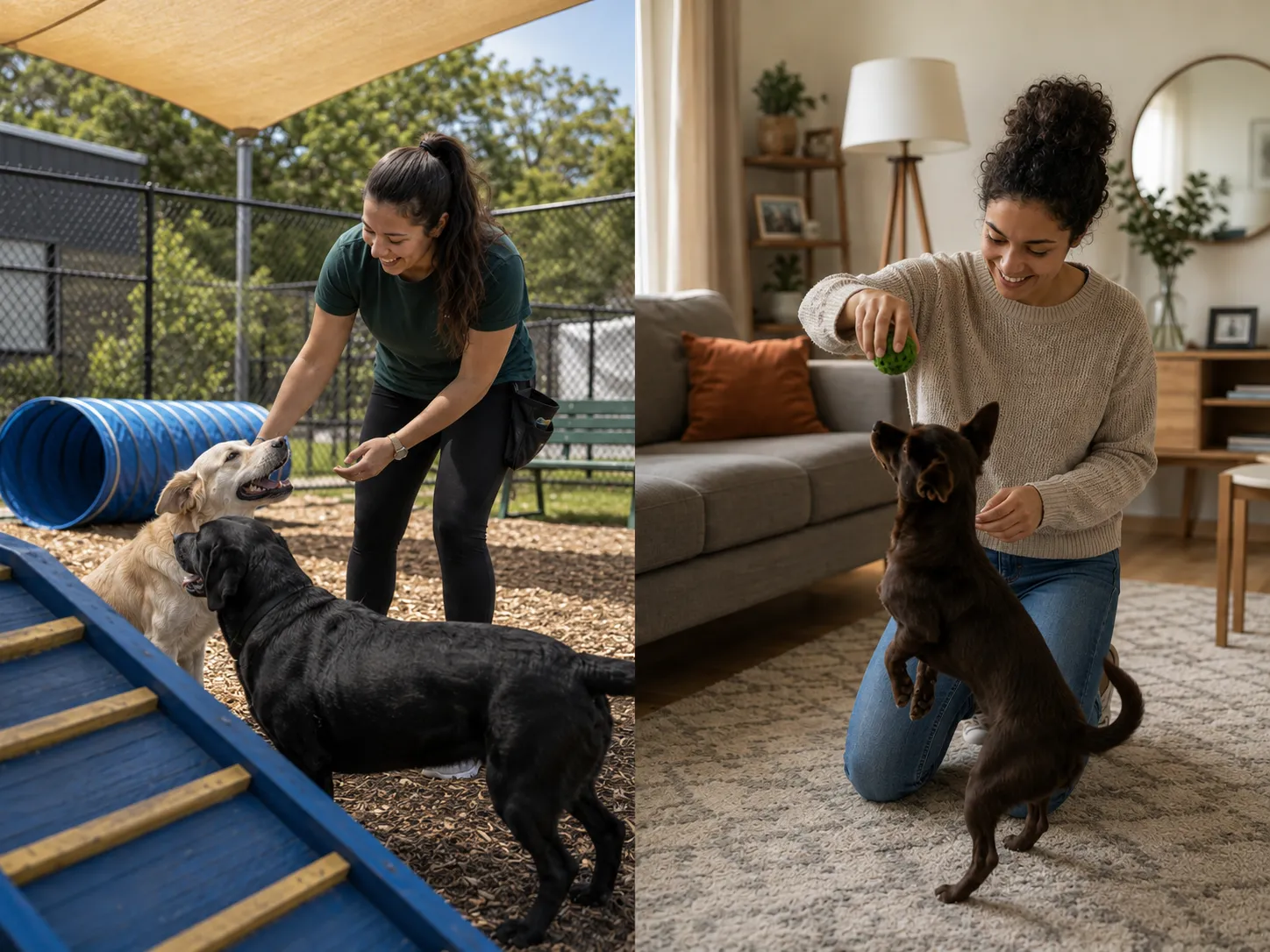
Is boarding or an in-home sitter better for a dog with separation anxiety? Neither is automatically better. An in-home sitter may be worth testing when your dog can settle with another trusted person but struggles with unfamiliar places, confinement, noise, or other dogs. Boarding may also work when your dog accepts unfamiliar caregivers and can eat, rest, and remain safe in the facility.
The most important question is what actually triggers your dog’s distress. If another person’s presence changes the response, our guide to separation anxiety vs isolation distress explains why that distinction can matter. Merck Veterinary Manual notes that some dogs become distressed when a particular caregiver is absent, while others are distressed mainly when they are completely alone. [1]
There is no strong head-to-head clinical study proving that boarding or in-home sitting is universally better for dogs diagnosed with separation anxiety. Your dog’s response to the actual setup matters more than the service label.
What Is the Difference Between Boarding and an In-Home Sitter?
Boarding changes your dog’s environment, while an in-home sitter keeps your dog at home but changes the caregiver. Human supervision, alone time, medical support, noise, routine, and cost vary within both options.
| Factor | Boarding Facility | In-Home Sitter |
|---|---|---|
| Familiar environment | No | Yes |
| Other dogs and facility noise | May be present | Usually easier to avoid |
| Human presence | Depends on facility staffing | Depends on the sitter’s schedule |
| Routine | Facility schedule applies | Home routine may be easier to preserve |
| Continuous supervision | Facility-specific | Must be specifically agreed |
| Cost | Varies by location, dates, facility and add-ons | Varies by location, hours and required supervision |
| Medical capability | Depends on facility; veterinary boarding may offer additional medical support | Depends on sitter experience and care instructions |
This is practical decision support, not a clinical ranking.
Does House Sitting Mean Someone Stays With My Dog 24/7?
No. Do not assume “house sitting” or “overnight sitting” means continuous presence. Ask exactly when the sitter will be in the home and how long your dog may still be left alone.
Practical service comparison| Care Type | Typical Setup | Important Question |
|---|---|---|
| Drop-in visits | Short scheduled visits | How long will my dog be alone between visits? |
| Overnight sitter | Sitter sleeps in the home | How much will the sitter leave during daytime? |
| House sitting | Care takes place in your home | What exact hours are included? |
| Near-continuous care | A custom arrangement limiting agreed alone time | What is the maximum time the sitter may leave? |
| Home boarding | Your dog stays in another person’s home | Who else, including pets, will be present? |
How Do I Know Whether Boarding or a Sitter Fits My Dog Better?
Look at what happens after you leave. If your dog settles with another trusted caregiver, an in-home sitter may be worth testing. If your dog handles unfamiliar caregivers and environments comfortably, boarding may also be realistic.
Practical guidance — not a diagnostic test| What You Observe | Option Worth Testing | Next Step |
|---|---|---|
| Settles after you leave when another trusted adult stays | In-home sitter | Do a short trial with you actually away. |
| Remains severely distressed even with another caregiver | Do not assume either option solves the problem | Discuss the travel plan with your veterinarian. |
| Panics during kennel-style confinement | Home care may be worth testing | Ask what housing the facility actually uses. |
| Comfortable with unfamiliar people and environments | Boarding may be realistic | Try a short stay before a long trip. |
| Highly reactive to unfamiliar dogs | Individual or home-based care may be easier to assess | Ask whether group contact is required. |
Does an In-Home Sitter Usually Cost More Than Boarding?
It can, especially when your dog needs very limited alone time, but there is no single reliable U.S. price that applies everywhere. Compare quotes for the exact level of care your dog needs.
Cost factors to compare- base nightly rate
- city or local market
- holiday dates
- additional pets
- medication or higher-needs care
- transportation
- special boarding arrangements
- maximum unattended time
How Do I Screen a Boarding Facility or Pet Sitter?
Ask about safety, supervision, behavior experience, emergency planning, and exactly who will care for your dog.
Questions for a boarding facility
- Where will my dog sleep?
- Is group play optional?
- Is anyone present overnight?
- How frequently are dogs checked?
- How are escape-risk dogs managed?
- Can prescribed medication be administered?
- What happens if my dog cannot settle?
- Which veterinarian or emergency hospital is used?
AKC recommends assessing boarding facilities, health requirements, daily care, and behavioral suitability. [5]
Questions for a pet sitter
- What exact hours will you be in the home?
- What is the longest my dog will be alone?
- Have you managed separation-related distress before?
- Do you have appropriate insurance?
- Can you provide references or verified client history?
- Is there a written service agreement?
- Who provides backup care if you are unavailable?
- How are keys and home-access information protected?
Professional pet-sitting standards emphasize written agreements, appropriate insurance, emergency procedures, backup planning, and client security. [6]
What Red Flags Should Make Me Reconsider the Provider?
Reconsider a provider that cannot clearly explain supervision, safety, emergencies, or how serious anxiety will be handled.
Boarding red flags
- Housing and supervision are unclear.
- Health-record requirements are vague.
- Staff show little interest in behavior history.
- Every dog is expected to use the same group setup.
- Escape procedures are unclear.
- No clear emergency veterinary plan exists.
Sitter red flags
- The sitter cannot state the maximum unattended time.
- No meaningful questions are asked about anxiety or escape behavior.
- The actual caregiver is unclear.
- No emergency or backup plan exists.
- Medication instructions are handled casually.
- Promises of continuous care conflict with other scheduled work.
What Should I Prepare Before Boarding or House Sitting?
Prepare health records, medication instructions, identification, emergency contacts, and your dog’s normal routine before you leave. Facility requirements vary, so confirm them directly.
Pre-trip checklist- required vaccination or health records
- food and feeding instructions
- medications and written dosing instructions
- regular veterinarian details
- emergency veterinary hospital
- local emergency contact
- current ID tag and microchip details
- written sleep, bathroom, and exercise routine
- escape risks and behavior triggers
- a familiar item if the caregiver allows it and it is safe for your dog
AKC recommends providing boarding facilities with vaccination records and preparing identification, medications, feeding information, and emergency contacts. [5]
What Updates Should I Ask for While I Am Away?
Agree on useful updates before the trip instead of relying only on photos. Ask the caregiver to report how your dog is eating, resting, toileting, taking medication, and coping with your absence.
Practical communication plan- Agree on normal update frequency.
- Ask whether your dog ate and drank normally.
- Ask about bathroom habits.
- Ask whether your dog slept or settled.
- Confirm important medication doses.
- Agree which anxiety behaviors require an immediate call.
Should I Do a Trial Before a Long Trip?
Yes, when practical, test the actual care arrangement before making a long vacation the first experiment. AKC specifically recommends trial boarding stays as one way to assess how a dog responds to the facility. [5]
Practical trial plan- For a sitter, have the sitter stay while you actually leave.
- For boarding, use a shorter stay first if the facility offers one.
- Ask whether your dog ate, drank, rested, slept, vocalized, paced, or tried to escape.
- If the trial shows serious distress, reconsider the setup instead of assuming a longer stay will automatically fix it.
A pet camera can help document home-based trial absences when you are testing whether a sitter’s presence changes the behavior.
What Does Research Show About Dogs in Boarding Kennels?
Kennel environments can change dogs’ behavior and physiology, but research does not prove that all boarding is harmful or that an in-home sitter is universally better.
| Evidence | What Was Studied? | Useful Finding | Limitation |
|---|---|---|---|
| Part et al., 2014 [3] | 29 privately owned dogs assessed at home and in boarding kennels | Behavior and some physiological measures differed in kennels, with substantial individual variation | Not a boarding-vs-sitter trial in dogs diagnosed with separation anxiety |
| Rooney et al., 2007 [4] | 31 young male Labrador Retrievers introduced to a novel kennel environment | Researchers studied behavioral and glucocorticoid responses and prior habituation | The study population does not represent every pet dog with separation anxiety |
What Is the Bottom Line?
Choose the care setup your individual dog can tolerate and that the provider can realistically deliver. Neither “boarding” nor “house sitting” is automatically the better choice.
- If your dog settles with another trusted person, test an in-home sitter.
- If your dog handles unfamiliar people and places well, boarding may also be realistic.
- Confirm the actual unattended time rather than relying on service labels.
- Screen the caregiver or facility for safety and emergency planning.
- Use a trial before a long trip when practical.
- Involve your veterinarian when anxiety is severe or creates injury risk.
Frequently Asked Questions
Can a dog with separation anxiety be boarded?
Some dogs can tolerate boarding. Separation anxiety alone does not predict how a dog will respond to a specific facility. Consider unfamiliar caregivers, confinement, noise, other dogs, and the result of a short trial. [5]
Is boarding or house sitting better for a dog with separation anxiety?
Neither is automatically better. House sitting may be worth testing when your dog settles with another caregiver, while boarding may work when your dog is comfortable with unfamiliar environments and people.
Does house sitting mean the sitter stays with my dog 24/7?
No. Do not assume house sitting means continuous physical presence. Confirm the sitter’s exact schedule and the longest period your dog will be left alone.
How much does constant care cost compared with boarding?
There is no single U.S. rate. Cost depends on location, dates, supervision requirements, medical needs, additional pets, and the provider. Ask for quotes based on the maximum alone time your dog can tolerate rather than comparing service names alone.
What vaccinations does my dog need before boarding?
Requirements vary by facility and location. Ask the boarding provider for its current health and vaccination requirements and confirm any questions with your veterinarian. AKC recommends bringing complete vaccination records when boarding. [5]
How often should a sitter or boarding facility update me?
There is no universal schedule. Agree on one before the trip. For an anxious dog, useful updates include eating, drinking, bathroom habits, rest, medication, and significant stress behavior—not photos alone.
Sources & references
- Merck Veterinary Manual. Behavior Problems of Dogs — Separation Distress Disorder.
Open source ↗ - American Animal Hospital Association (AAHA). Separation Anxiety in Pets.
Open source ↗ - Part CE, Kiddie JL, Hayes WA, et al. (2014). Physiological, physical and behavioural changes in dogs when kennelled. Physiology & Behavior. PMID: 24866912.
Open source ↗ - Rooney NJ, Gaines SA, Bradshaw JWS. (2007). Behavioural and glucocorticoid responses of dogs to kennelling. Physiology & Behavior. PMID: 17617429.
Open source ↗ - American Kennel Club. What to Know and Look for When Boarding Your Dog.
Open source ↗ - Pet Sitters International. Professional standards for pet-sitting businesses.
Open source ↗
Evidence note: current research does not establish a universal winner between boarding and in-home sitting for dogs with separation anxiety.
Editorial transparency: comparison tables, provider-screening questions, cost factors, and planning checklists are practical decision-support tools, not validated clinical tests.
This article provides general educational information and does not claim veterinary review or individual diagnosis.
 ✓
✓