

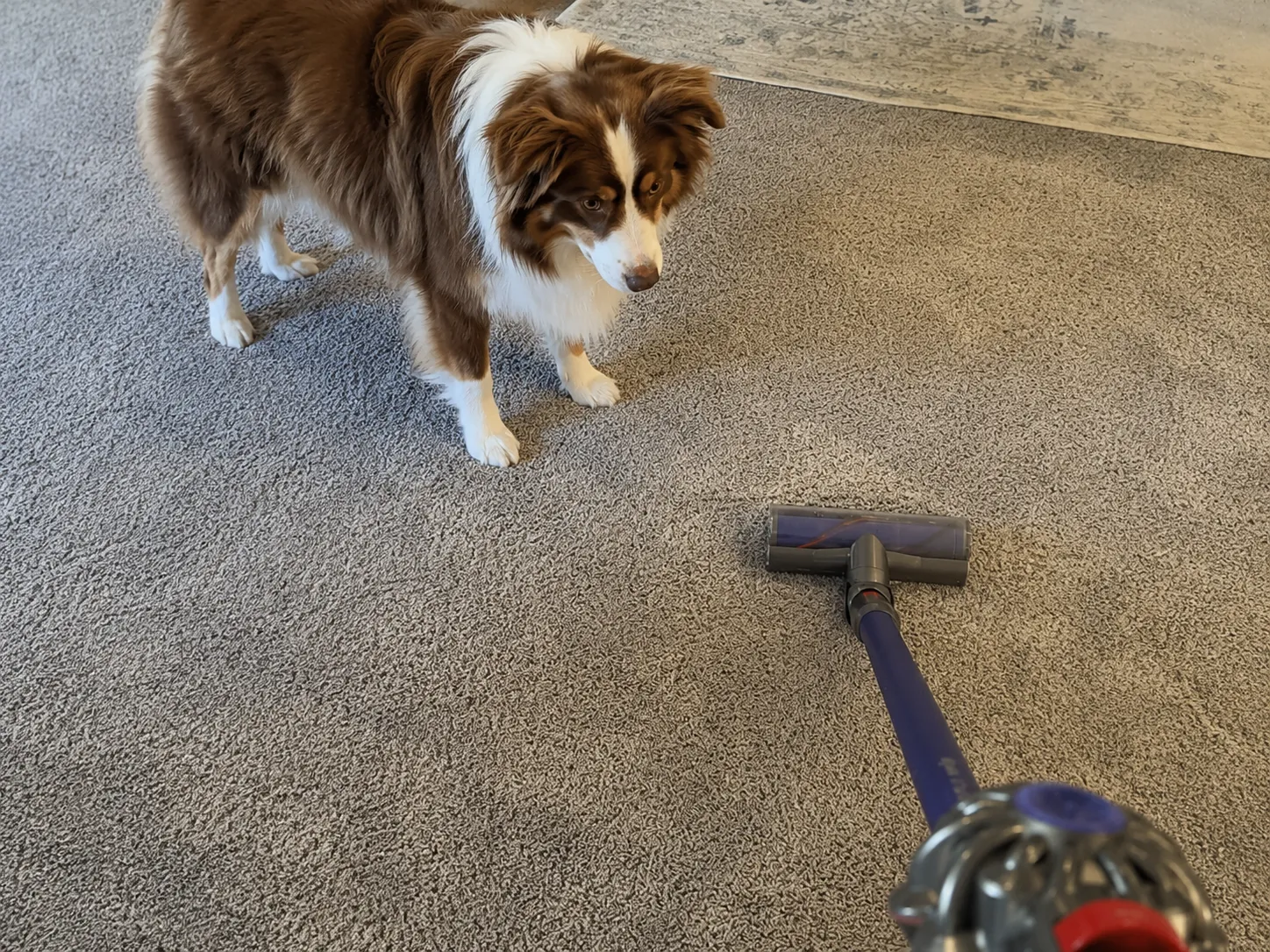
If your dog barks, chases, lunges at, or grabs the vacuum, do not assume there is one simple reason. A vacuum combines sound, vibration, movement, and an object traveling through the dog’s space. Fear, overstimulation, or chasing-related responses may contribute in different dogs.[1]
Do not begin by repeatedly vacuuming around your dog and hoping they get used to it. Prevent the full chase, start with an easier version of the vacuum, and gradually introduce sound and movement. If your dog’s reaction becomes stronger, reduce the difficulty.[2]
What should I do if I need to vacuum right now?
- Move your dog to a comfortable separate area if they normally chase or grab the vacuum.
- Use a closed door or secure barrier if your dog may rush back toward the machine.
- Do the cleaning now and training later. You do not need to turn every vacuum session into training.
- In a small apartment, vacuum one area at a time while your dog stays safely elsewhere.
Environmental management can be used to prevent unwanted behavior while safer alternatives are being trained.[4]
Safety: If your dog redirects biting toward a person, panics, repeatedly grabs the moving vacuum, or cannot be safely separated, stop direct practice. Keep other household members out of the immediate dog-vacuum area and contact your veterinarian or an appropriately qualified behavior professional.[4][5]
Why does my dog bark and attack the vacuum?
The vacuum may be triggering fear, overstimulation, chasing behavior, or more than one response at once. Barking alone cannot identify the cause.
PetMD describes vacuum noise, vibration, appearance, and movement as possible reasons for strong reactions in dogs.[1]
Watch which part changes your dog’s behavior:
- seeing the vacuum while it is off
- hearing the motor start
- watching the vacuum begin to move
- seeing it move toward the dog
- watching the hose or vacuum head move
How can I tell whether my dog is scared or trying to chase the vacuum?
Look at the whole behavior pattern rather than one bark or lunge. The signs below are clues for choosing a safer next step, not a diagnosis.
| What you notice | What it may suggest | Useful first step |
|---|---|---|
| Dog moves away, hides, freezes, trembles, or tries to leave | Fear or discomfort may be contributing | Increase distance and reduce the intensity of the exposure.[2] |
| Dog barks and rushes toward the moving vacuum | Fear, overstimulation, or chasing may be involved | Prevent the full chase and work on easier sound or movement separately.[1][2] |
| Dog is calm while the vacuum is off but reacts when the motor starts | Sound may be an important trigger in this setup | Increase distance before introducing the motor sound.[2] |
| Dog tolerates the sound but reacts when the vacuum head moves | Movement may be the more difficult component | Practice smaller, slower movements before normal cleaning.[2] |
| Dog becomes much more reactive when held close to the vacuum | The current setup may be too difficult; this behavior alone does not establish why | Increase distance rather than holding the dog close to the trigger.[2] |
These are clues, not diagnoses. The same dog may react differently to the vacuum’s sound, movement, and proximity.
How do I train my dog to stop chasing the vacuum?
Start below the level that triggers the full chase, then add difficulty gradually.
In plain English: Desensitization means starting with an easier version of the trigger. Counterconditioning means pairing that manageable exposure with something your dog values. The goal is not to push your dog to the point of panic and then offer food.[2]
Start with the vacuum off and still.
Place it far enough away that your dog can notice it without immediately barking, chasing, or trying to escape.
Pair the easy exposure with a reward.
Use food, play, or another reward your dog normally values while the vacuum remains manageable.[2]
Add a small amount of movement.
Move the vacuum head a short distance, stop, and make the next repetition harder only if your dog remains comfortable.
Add the motor sound separately if needed.
Start farther away if sound causes the stronger reaction.[2][3]
Combine sound and movement gradually.
Only combine the harder pieces once the easier versions are manageable.
How do I know whether to continue or stop the training session?
Use your dog’s response to decide whether to continue, make the exercise easier, or stop.
Green — Continue
- takes food normally
- can look away
- responds to familiar cues
- remains relatively relaxed
Yellow — Make It Easier
- fixates for longer
- barking starts increasing
- body becomes tense
- takes food less readily
Red — Stop
- panic or escape attempts
- repeated lunging
- grabbing the vacuum
- redirected biting
- cannot disengage
VCA advises lowering the intensity when signs of fear or arousal appear and notes that suddenly refusing normally accepted treats can indicate that a session is progressing too quickly.[2]
What if my dog won’t take treats around the vacuum?
Make the exercise easier before simply switching to a “better” treat.
Try one change at a time:
- move the vacuum farther away
- turn it off
- stop moving it
- move to another room
- end the session and try again later
Food refusal does not diagnose fear or anxiety. It is one piece of information that can suggest the current exposure is too difficult when a dog normally takes that food readily.[2]
Should I punish my dog for barking or attacking the vacuum?
AVSAB recommends reward-based training and environmental management rather than aversive training methods.[4]
5 things not to do
When is vacuum chasing serious enough to get professional help?
Get help when the behavior becomes unsafe, suddenly worsens, or cannot be managed with controlled practice.
Stop direct practice if your dog redirects biting toward people, repeatedly grabs the moving vacuum, panics, cannot be safely separated, or becomes more reactive after training attempts.
Start with your veterinarian if the behavior appears suddenly or raises safety concerns. The American College of Veterinary Behaviorists explains that board-certified veterinary behaviorists are veterinarians with additional behavior training and can evaluate possible medical as well as behavioral contributors.[5]
How do I choose behavior help in the US?
Ask what tools and training methods will be used and what happens if your dog becomes more distressed.
AVSAB recommends considering methods, education, credentials, and how clearly the professional explains the training approach.[4]
Start with your veterinarian. More complex cases may warrant a board-certified veterinary behaviorist.[5]
IAABC maintains a searchable directory of credentialed consultants and trainers.[6]
How long will it take my dog to stop chasing the vacuum?
There is no reliable timeline that applies to every dog.
VCA notes that desensitization and counterconditioning can take very different amounts of time depending on the individual case.[2]
Judge progress by whether your dog can:
- see the vacuum without immediately reacting
- look away and disengage
- handle small movements without chasing
- continue taking normal rewards
- recover more easily after noticing the vacuum
Frequently Asked Questions
Why does my dog attack the vacuum even when it is turned off?
The stationary vacuum may predict the noise and movement that normally follow. Start with the vacuum off and at a distance your dog can handle before adding another part of the trigger.[2]
Can I use a recording of vacuum noise for training?
A recording can help you work on sound separately, but it does not reproduce every part of a real vacuum, such as movement and vibration. Start quietly and increase volume gradually only while your dog remains comfortable. This applies VCA’s general sound-desensitization principles.[2]
Is it okay to put my dog in another room while I vacuum?
Yes, if your dog is comfortable there. Separating cleaning from training can prevent repeated chasing. If your dog becomes highly distressed when confined, use a different management setup.
Why does my dog only chase the vacuum head or hose?
If your dog stays relatively calm around the motor but reacts when the vacuum head or hose moves, movement may be the harder part of the trigger for that dog. Practice smaller, slower movement at a greater distance.[2]
Would a quieter or robot vacuum solve the problem?
It might help some dogs, but sound may not be the only trigger. Movement and proximity can also matter. Judge your dog’s response to the specific machine rather than assuming a quieter model will automatically solve the behavior.[1]
Why did my dog suddenly start attacking the vacuum?
A sudden major behavior change is worth discussing with your veterinarian rather than assuming it is only a training issue. Veterinary behavior specialists can evaluate possible medical and behavioral contributors.[5]
+ Sources used for this guide
Citation numbers open this section and jump to the relevant source.
-
PetMD — Why Are Dogs Scared of Vacuums?
Vacuum-specific discussion of noise, vibration, movement, fear, overstimulation, chasing responses, and robot vacuums.
https://www.petmd.com/dog/training/why-are-dogs-scared-of-vacuums -
VCA Animal Hospitals — Reducing Fear and Stress With Desensitization and Counterconditioning
Used for gradual exposure, vacuum sound and movement, distance, trigger intensity, counterconditioning, and distress guidance.
https://vcahospitals.com/warm-springs/know-your-pet/overcoming-fears-with-desensitization-and-counterconditioning -
American Kennel Club — How to Get Your Dog Used to the Vacuum Cleaner
Supporting vacuum-specific guidance for gradual exposure to vacuum sound and movement.
How to Get Your Dog Used to the Vacuum Cleaner
-
American Veterinary Society of Animal Behavior — Position Statements
Used for reward-based training, environmental management, and trainer-selection guidance.
Position Statements and Handouts (for the public)
-
American College of Veterinary Behaviorists — Information for Animal Owners
Used for veterinary behavior expertise, possible medical contributors, and higher-risk behavior guidance.
https://www.dacvb.org/page/AnimalOwners -
International Association of Animal Behavior Consultants — Consultant Locator
Used only as one option for locating credentialed behavior consultants and trainers.
https://iaabc.org/en/accessible/certs/members?size=large
 ✓
✓