

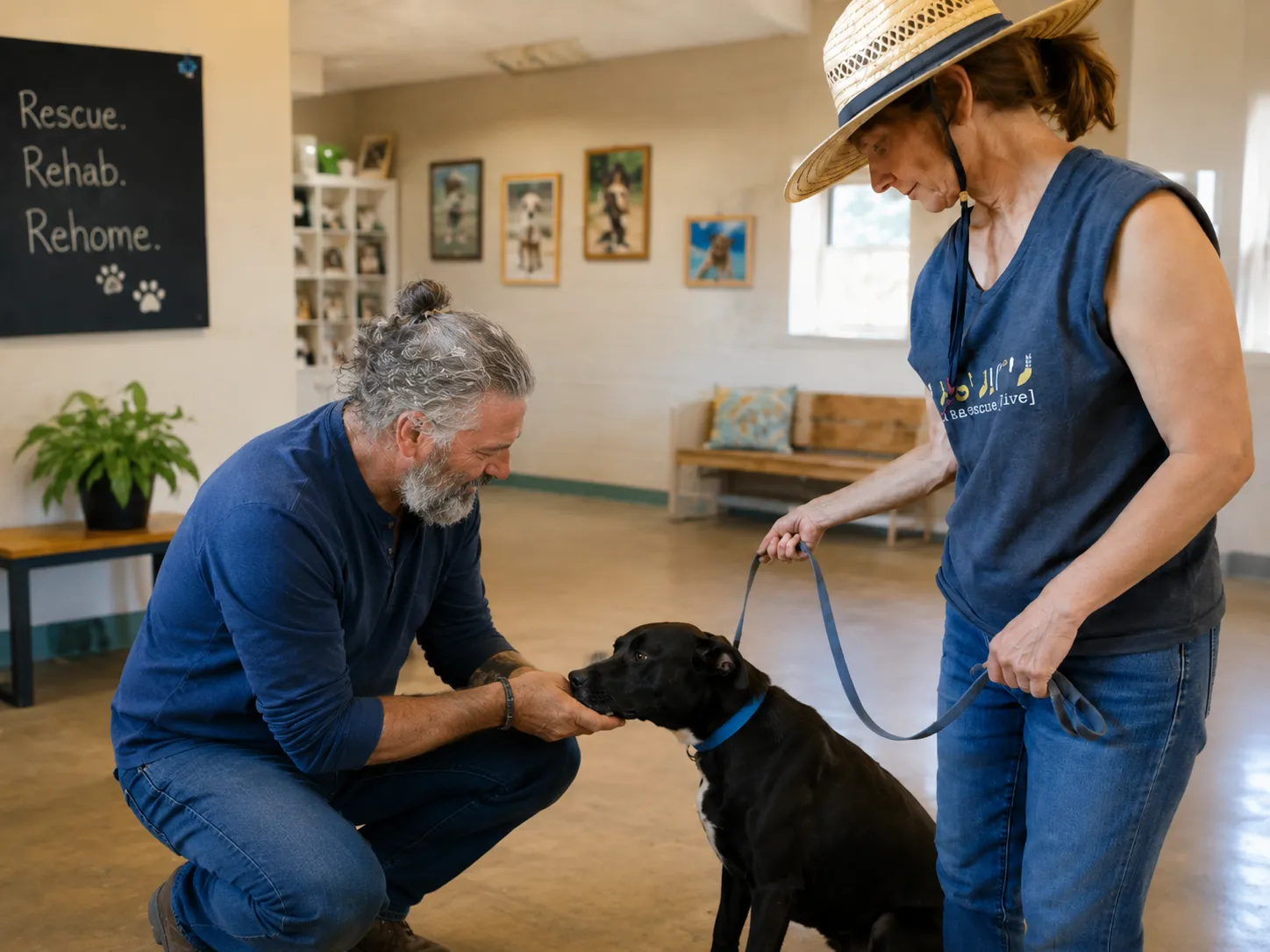
Should you be worried? Not necessarily. If your rescue dog barks at men while backing away, hiding, or trying to leave, fear is more likely.
But if the barking comes with a stiff body, hard staring, lunging, snapping, or biting attempts, take it seriously. Those are signs that your dog is very uncomfortable and the situation may become unsafe.[1][2]
And no barking at men does not automatically mean your rescue dog was abused. Limited early socialization, unfamiliar movement, voice, size, or a previous bad experience can also cause fear.[1]
Is It Fear or a Real Warning Sign?
Watch the body, not just the bark.
Fear is more likely if your dog:
- barks while backing away
- hides or tries to escape
- tucks his tail
- crouches or trembles
- refuses treats
Take it more seriously if your dog:
- freezes or becomes stiff
- hard-stares at the person
- repeatedly lunges
- snaps or tries to bite
Fearful dogs may bark to create distance. If they feel trapped or the pressure keeps increasing, fear can escalate into growling, lunging, snapping, or biting.[1][2]
Does This Mean My Rescue Dog Was Abused by a Man?
No. You usually cannot know that from barking alone.
A bad experience can cause fear, but so can limited positive exposure to different people during early development.[1]
Instead of guessing what happened before adoption, ask:
“What exactly makes my dog uncomfortable now?”
Why Does He Bark at Some Men but Ignore Others?
The trigger may be more specific than “men.”
Watch whether your dog reacts more to:
- tall or large men
- deep voices
- beards
- hats or uniforms
- fast movement
- direct eye contact
- someone bending over him
- someone reaching toward his head
- men entering the house
- men standing up or walking past
VCA recommends looking at the person’s appearance, distance, movement, and attempts to interact when identifying what triggers fear.[1]
What Should I Do When He Starts Barking?
Create more distance first.
- Move farther away before the barking gets stronger.
- Ask the person to stop approaching.
- Let your dog walk away.
- Reward calm looking before barking starts.
- Keep the exposure short.
Desensitization starts with the trigger at a level the dog can handle, then difficulty is increased slowly. Counterconditioning pairs that safe exposure with something positive, such as food.[3]
Not: Dog is scared → man keeps moving closer until he “gets used to it.”
What Should My Husband or Boyfriend Do?
Be calm, predictable, and low-pressure.
For now, ask him not to:
- stare at the dog
- follow him
- reach over his head
- force petting
- corner him
- keep calling him closer
Let the dog choose whether to approach. Fearful dogs should be allowed to avoid interaction when they are uncomfortable.[1]
Should He Give the Dog Treats?
Yes but do not use food to lure a scared dog closer.
The better setup is: your husband appears at a safe distance and good food follows. That helps the dog build a better association without forcing contact.[3]
What If My Dog Will Not Take Treats?
Make the situation easier.
Add distance, reduce movement, have the person sit down, or end the session. Refusing food can be a sign that the dog is too stressed for useful training.[1]
Why Does He Bark When My Husband Stands Up?
Movement itself may be the trigger.
Your dog may be fine while your husband sits still, then react when he:
- stands up
- walks across the room
- comes downstairs
- enters a doorway
- walks toward you
This tells you the dog may not be afraid of your husband all the time he may be reacting to specific movement or approach patterns.
Should I Correct Him for Barking?
Do not punish fear-driven barking.
AVSAB recommends reward-based behavior modification and advises against aversive tools such as shock collars, prong collars, physical punishment, and intimidation.[4]
ASPCA also warns that punishment can worsen fear- or anxiety-related barking.[5]
The goal is not just a quiet dog. The goal is a dog who feels safer.
When Should I Get Professional Help?
You do not need to wait for a bite.
Get help if your dog:
- has already bitten
- snaps at men
- repeatedly lunges
- cannot calm down even with distance
- becomes more fearful over time
- makes daily life with a male family member unsafe
Stiffening, staring, growling, lunging, snapping, and biting are all signs that should be taken seriously. Veterinary assessment can also help rule out pain or medical factors if behavior suddenly changes.[2]
How Do I Know He Is Getting Better?
Do not measure progress only by “he didn’t bark.”
Real progress can look like:
- staying in the room instead of hiding
- accepting food around a man
- looking at the man and relaxing again
- needing less distance
- recovering faster after a trigger
Your rescue dog does not need to love every man. The goal is helping him feel safe enough that he no longer needs barking, hiding, growling, or lunging to create distance.
Sources
-
VCA Animal Hospitals Fears and Phobias in Dogs: Animals and People
Fear signs, socialization, triggers, distance, and interaction guidance.
View source -
VCA Animal Hospitals Fear vs. Aggression
Stiffening, staring, growling, lunging, snapping, biting, and safety concerns.
View source -
VCA Animal Hospitals — Desensitization and Counterconditioning
Gradual exposure, safe distance, trigger intensity, and positive associations.
View source -
American Veterinary Society of Animal Behavior Humane Dog Training
Reward-based training and guidance against aversive methods.
View source -
ASPCA Barking
Fear-related barking and risks of punishment.
View source
 ✓
✓