

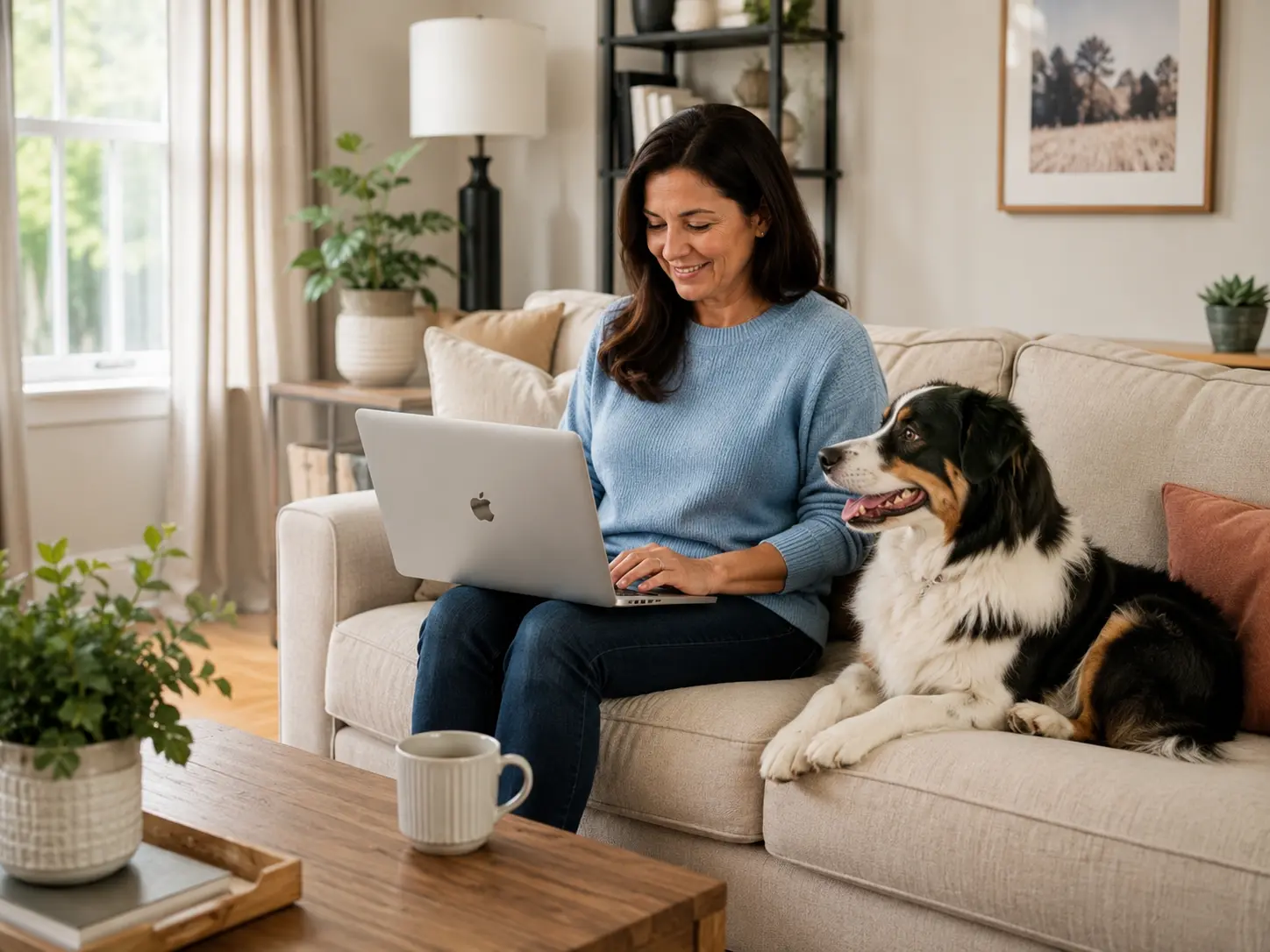
Quick Answer: Why Your Dog Barks When You Sit Down
This can happen when your dog barks after you:
- sit at your desk
- open your laptop
- join a video call
- put on headphones
- start talking to the screen
- sit on the sofa
- look at your phone
- try to relax after work
The goal is not only to stop the barking. The goal is to teach your dog what to do when you are busy.
Why Your Dog Barks When You Sit Down

One minute your dog may seem calm. The next minute, they may bark, stare, paw at you, bring a toy, jump up, or stand in front of your chair.
That sudden change often happens because your dog has noticed the first sign of a familiar pattern: you are about to be still, focused, or unavailable.
Sitting Down May Have Become a Cue
Your dog does not know that a laptop means work, a headset means a meeting, or a sofa means you need rest.
They may only understand that these actions usually lead to less interaction.
To your dog, your routine may mean:
- “My owner is about to stop paying attention.”
- “The laptop means I should ask now.”
- “When I bark, my owner reacts.”
- “If I bring a toy and bark, play might start.”
This is why barking may start before your call begins. Your dog is reacting to the routine, not only the call itself.
Barking May Have Worked Before

Barking does not need to get a huge reward to become a habit. Small reactions can be enough.
Your dog may bark and get:
- eye contact
- talking
- scolding
- touch
- a toy
- a treat
- a door opened
- you standing up
- you ending a task
A simple pattern can form:
This does not mean your dog is bad. It means the behavior may have been rewarded by accident.
Work Calls Can Make Barking Worse
Work calls create pressure because you need quiet quickly.
If your dog barks during a Zoom, Teams, or phone call, you may give a chew, toss a treat, open the door, or talk to your dog just to get through the meeting.
That may solve the moment, but it can teach your dog:
This is why barking during calls can grow even when you are trying your best. If the barking is specifically tied to Zoom, Teams, phone calls, your meeting voice, headphones, or the office door, use the more focused dog barking during work calls guide. If barking affects your wider workday, including focus blocks, notifications, hallway sounds, and daily routines, see dog barking during work from home.
Your Dog May Need More Before Quiet Time
Some dogs bark because they are not ready to settle.
This is more likely when:
- the morning walk was skipped
- the walk was too short
- your dog had little sniffing time
- your dog has not chewed, played, or trained yet
- your dog expects play at that time
- your dog has extra energy when you need quiet
A short sniff walk, simple training session, or food puzzle before work can make quiet time easier.
Real-World Scenarios

Scenario 1: Dog Barks When the Laptop Opens
You open your laptop and your dog starts barking, pawing, or bringing toys.
This often points to a learned routine. Your dog may have learned that laptop time means less attention, so they bark early to start interaction.
Scenario 2: Dog Barks During Work Calls
You join a video call and your dog starts barking as soon as you speak.
Your voice may be the trigger. Your dog hears you talking but does not understand why the attention is not directed at them.
Scenario 3: Dog Barks When You Sit on the Sofa
You sit down after work and your dog stands in front of you barking.
This may be linked with play, food, evening routine, boredom, or a learned request for attention.
Scenario 4: Dog Barks After Finishing a Chew
You give a chew before a meeting. Your dog is quiet for a few minutes, finishes it, then starts barking again.
The chew helped for a short time, but your dog may still need a longer calm routine or a clear settle behavior.
Step-by-Step Solutions
1. Find the First Trigger
For three days, write down what happens right before the barking starts.
- Did barking start when you sat down?
- Did it start when the laptop opened?
- Did it start when you began talking?
- Did your dog bring a toy first?
- Did your dog stare, paw, whine, or pace first?
- What did you do after the barking?
You are looking for the first signal, not only the barking itself.
2. Meet Basic Needs Before You Sit Down
Before work, calls, or sofa time, check the simple things first.
- toilet break
- fresh water
- meal timing
- short sniff walk
- simple play
- five minutes of training
- safe chew or food puzzle
- comfortable resting spot
This does not mean your dog needs to be exhausted. It means you remove obvious reasons for barking before asking for quiet.
3. Teach a Settle Spot
Choose one calm place near your desk or sofa.
This can be a dog bed, mat, blanket, crate, or safe resting area.
Start when you are not on a real call:
- Place the mat near your desk or sofa.
- Toss a treat onto the mat.
- Calmly praise when your dog steps on it.
- Feed a few small treats while your dog stays there.
- Release them after a few seconds.
- Repeat in short sessions.
Then slowly add real cues such as sitting down, opening the laptop, typing, putting on headphones, and talking softly.
4. Reward Quiet Before Barking Starts
The first few seconds matter.
When you sit down and your dog is quiet, reward calm behavior before barking begins.
You can use:
- a small treat
- calm praise
- a chew
- a food puzzle
- a scatter of kibble
- a stuffed toy
- a lick mat
Keep your voice low. The reward should support calm behavior, not excitement.
5. Stop Rewarding the Barking Pattern
After basic needs are met and your dog knows a replacement behavior, avoid giving the main reward during active barking.
For example:
- If barking gets a toy, do not throw the toy during barking.
- If barking gets food, do not give food while barking is happening.
- If barking gets eye contact, look away briefly.
- If barking makes you stand up, wait for a short pause before moving.
Then reward a calmer behavior, such as going to the mat, sitting, looking away, sniffing for scattered food, or a short pause in barking.
Work Call Routine
For work calls, use a plan before the call starts. Do not rely on panic treats after barking begins.
10–20 Minutes Before the Call
- take your dog for a toilet break
- offer a short sniff walk or simple training
- prepare the settle spot
- prepare a chew, lick mat, or puzzle
- close the door if needed
- use white noise if hallway sounds trigger barking
At the Start of the Call
- send your dog to the mat
- give the planned chew or food puzzle
- reward quiet early
- keep your own voice calm
After the Call
- give your dog a short break
- offer calm attention
- reset before the next work block
Troubleshooting Table
Simple 5-Day Work-From-Home Barking Plan
Day 1: Track the Pattern
Write down exactly when barking starts. Look for triggers like sitting down, opening the laptop, putting on headphones, starting a call, or sitting on the sofa.
Day 2: Meet Needs Before Work Time
Before your main work block, give your dog a toilet break, fresh water, a short sniff walk, simple play, or five minutes of training.
Day 3: Introduce a Settle Spot
Place a mat, bed, crate, or blanket near your desk or sofa. Reward your dog for stepping onto it and staying there briefly.
Day 4: Practice Fake Calls
Open your laptop, put on headphones, say a few words, and reward your dog for staying calm. Start with 30–60 seconds.
Day 5: Use the Routine During Real Work
Before your dog barks, reward quiet behavior. Use a chew, puzzle, lick mat, scatter feeding, or calm praise. If barking starts, wait for a small pause or calmer behavior before giving attention.
What Not to Do
Do Not Yell During Work Calls
Yelling may still count as attention and can raise the energy in the room.
Do Not Make Treats Appear Only After Barking Starts
If treats only appear after barking, your dog may learn to bark first. Reward quiet before the barking begins.
Do Not Assume Your Dog Is Being Spiteful
Your dog is not trying to ruin your work. Barking is usually communication, habit, frustration, or a learned pattern.
Do Not Wait Until an Important Meeting to Train
Practice the routine during easy moments first. Real calls are harder because you are under pressure.
Do Not Ignore Sudden Behavior Changes
If barking starts suddenly, gets worse quickly, or appears with other changes, treat it as information and check for health, fear, pain, or stress.
When to Contact a Vet or Trainer
A good plan should explain what to do before, during, and after the barking. It should not only tell you to ignore, punish, or correct the dog without understanding the cause.
Quick Summary
If your dog barks when you sit down, open your laptop, join a work call, or relax on the sofa, your routine may have become a trigger.
Your dog may have learned that barking gets attention, movement, food, play, outside access, or a quick reaction.
The better plan is to find the first trigger, meet basic needs before work time, teach a settle spot, reward quiet early, stop rewarding barking directly, and practice fake work sessions before real calls.
Your dog needs a clear job when you are busy: when you sit down, they settle.
FAQs
Why does my dog bark when I sit on the sofa?
Your dog may have learned that sofa time leads to attention, play, food, petting, or a walk. If barking has worked before, they may repeat it.
Why does my dog bark during work calls?
Your dog may react to your voice, laptop, headphones, or lack of attention. Calls can also make owners respond quickly, which may accidentally reward barking.
Is demand barking the same as separation anxiety?
No. Demand barking often happens when you are present but focused elsewhere. Separation-related barking usually happens when the dog is alone or separated from their owner.
Should I ignore my dog when they bark for attention?
Ignoring alone is usually not enough. First check basic needs, then teach a settle behavior and reward quiet before barking starts.
How do I stop my dog barking when I work from home?
Use a routine before work starts: toilet break, short activity, settle mat, long-lasting enrichment, and calm rewards before barking begins.
What should I do if my dog suddenly starts barking more?
Check for health changes, pain, fear, new sounds, routine changes, or stress. If the barking is sudden, intense, or unusual, contact a veterinarian.
 ✓
✓