

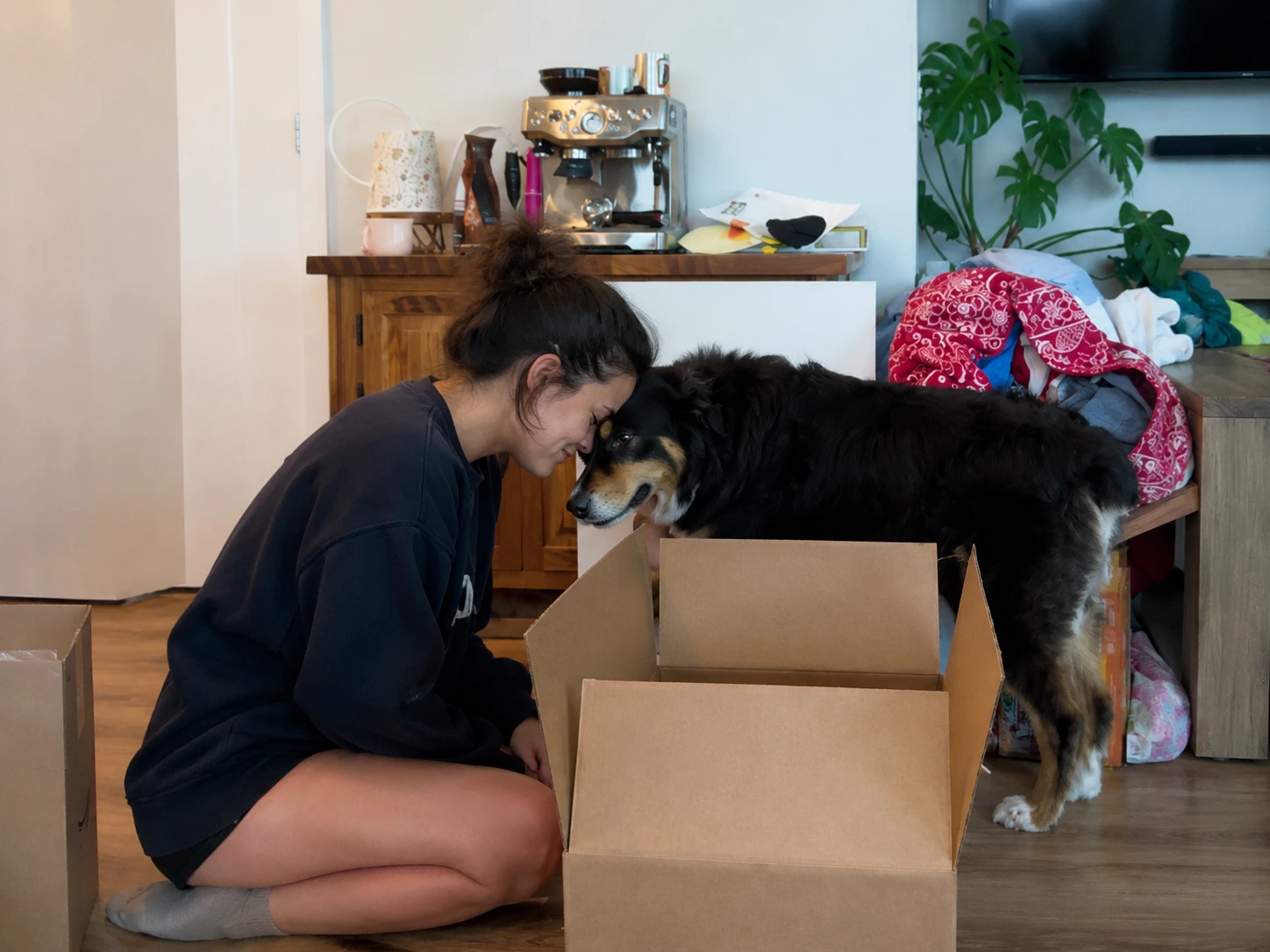
A dog that previously stayed alone comfortably may become distressed after moving because the home, routine and surrounding sounds have changed. Start by preventing a long panic episode, checking what triggers the behavior and rebuilding alone time from a duration your dog can currently handle.
This does not mean you caused the problem, and your dog is not behaving this way on purpose.
What Should You Do First?
Dog separation anxiety after moving should be handled by avoiding long panic-level absences, identifying the first stress sign, and restarting alone-time practice at an easier duration.
- Avoid a long test absence. Do not leave your dog for a full workday just to see whether they eventually settle.
- Make one short camera recording. Record only long enough to identify the first trigger and early stress signs.
- Compare possible causes. Check whether distress begins when you leave, after a new sound or only when your dog is confined. If another trusted person staying home changes the response, compare separation anxiety vs isolation distress.
- Practice below the first stress sign. If pacing begins after 30 seconds, the next practice should be shorter than 30 seconds.
- Contact a veterinarian for severe or sudden behavior. Injuries, collapse, breathing difficulty, new confusion or abrupt house-soiling should not be treated as a simple training issue.
Moving can be associated with separation anxiety, but barking, damage or indoor accidents alone do not confirm it. Noise, confinement, house-training problems and medical conditions can cause similar behavior. [1][2]
See the First 24-Hour PlanWhy Can Separation Anxiety Start After Moving?
A move can change your dog’s environment, routine and alone-time setup at the same time. Moving is a recognized possible trigger for separation anxiety, although another behavioral or medical problem may also be involved. [1][6]
The home is unfamiliar
The floor plan, entrance, sleeping area, window view and household sounds may all be different.
Your schedule may have shifted
Work hours, meals, walks, sleep and the amount of time you spend at home often change during a move.
The barking may have another trigger
Elevators, hallway footsteps, deliveries, traffic or neighboring dogs may trigger barking after you leave.
The move may not be the only cause
A new crate setup, pain, urinary problems, sensory changes or cognitive decline may also affect behavior.
What Signs Should You Watch For?
Look for several signs that repeatedly begin when you prepare to leave or shortly after you walk out the door. The dog separation-anxiety symptoms guide explains how those signs fit together. [2][5]
- Persistent barking, howling or whining
- Repeated pacing along the same route
- Waiting beside or staring at the main exit
- Scratching or chewing around doors and windows
- Heavy panting, trembling or drooling
- Refusing food your dog normally enjoys
- Peeing or pooping indoors despite established house training
- Frantic attempts to escape a crate, room or gated area
- Being unable to lie down and remain relaxed
If your dog remains distressed while you are home, reacts only after a specific sound or panics only when confined, separation anxiety may not be the only explanation.
What Should You Look for During a Short Camera Check?
Record only as long as needed to identify the first trigger and early stress signs. Stop the check if your dog is rapidly escalating or risks getting hurt. The first 15–30 minutes can be informative, but you do not need to continue when distress begins sooner. [2][6]
- When the first change from relaxed behavior appears
- What happens immediately before barking or pacing starts
- Whether your dog can lie down and relax
- Whether your dog remains focused on the exit
- Whether food is eaten or ignored
- Whether hallway or outdoor sounds trigger the behavior
- Whether a crate, gate or closed door increases agitation
- Whether behavior settles, continues or becomes more intense
For a detailed setup, read Pet Camera for Dog Separation Anxiety.
Compare the New Behavior With the Previous Baseline
Compare what your dog handled before moving with what has changed now. You do not need access to the old home to make this comparison.
Before moving: How long did your dog usually rest alone?
Now: How soon does the first stress sign appear?
Before moving: Was your dog loose, gated or crated?
Now: Has the confinement setup changed?
Before moving: Was the previous home quieter?
Now: Are elevators, shared hallways or deliveries new?
Before moving: What were your work and walk times?
Now: Has the daily schedule changed?
What Should You Do During the First 24 Hours?
Focus on physical safety, one quiet home base, familiar routines and one brief monitored departure. Avoid making a full workday your dog’s first alone-time test. [4][6]
- Update your dog’s microchip information and ID tag.
- Secure doors, windows, gates and balcony access.
- Remove cords, glass, nails, packing materials and other hazards.
- Use a secure room while boxes are carried through open doors.
- Place familiar bedding, food and water in a quiet area.
- Keep meals, walks and potty breaks close to the previous schedule.
Cornell recommends updated identification, secure exits, pet-proofing and a quiet area with familiar belongings during a move. [6]
What If You Must Leave for Work Tomorrow?
Reduce the longest unavoidable absence rather than expecting your dog to manage a full day immediately. The guide on working full time with a dog who has separation anxiety covers practical sitter, daycare, walker and schedule options.
- Split the day with another household member.
- Ask a trusted relative, friend or neighbor to check in.
- Come home during lunch where practical.
- Request temporary remote work or adjusted hours.
- Use paid help only for the longest absence if full-day care is unaffordable.
- Use daycare only when your dog already handles that environment comfortably.
A fearful, reactive, elderly or easily overstimulated dog may be more comfortable with a quiet in-home caregiver. For longer travel, compare boarding vs an in-home sitter.
What If a Neighbor Reports Barking?
Ask when the barking occurred, compare the time with camera footage and test whether a quieter interior room reduces the trigger.
- Ask for the approximate start and end time.
- Check for hallway, elevator or delivery sounds.
- Try a room away from the shared hallway or main entrance.
- Cover windows when outside movement triggers barking.
- Use low-volume background sound only when noise is a confirmed trigger.
- Keep a record of camera checks, veterinary visits and training steps.
- Avoid promising a neighbor or landlord an immediate cure.
Rental and noise rules vary by location and lease. This section provides behavior guidance, not legal advice.
How Should You Restart Alone-Time Training?
Start below your dog’s earliest stress sign, use one or two easy repetitions and increase only after the current duration repeatedly looks comfortable. There is no universal daily schedule. [1][2]
It is the earliest moment your dog stops looking relaxed. It may involve staring at the door, pacing, panting, scanning, whining or refusing food—not only barking.
- Begin with one or two departures that are easier than the current limit.
- Wait until your dog is relaxed before another repetition.
- Keep the same duration until it looks easy several times.
- Make small increases rather than large jumps.
- Return to the previous easy duration when stress appears.
- Shorten the session on difficult days instead of forcing progress.
Your dog begins staring at the door after 20 seconds. Begin with a 5–10 second departure. When that remains easy several times, increase slightly. If pacing starts, return to the last comfortable duration.
What Does a Low-Key Return Mean?
It does not mean ignoring your dog. Enter calmly, avoid an intensely excited reunion and offer normal affection as your dog begins settling. The aim is to make departures and returns feel routine rather than dramatic. [1][7]
Contact a veterinarian or qualified reward-based separation-anxiety professional when distress starts within seconds, your dog cannot settle between repetitions or physical safety cannot be maintained.
Should You Use a Crate, Safe Room or Free Roam?
Use the setup in which your dog is physically safe and visibly calmer. A crate is not automatically the safest choice for separation-related distress. [1][5]
Use only when your dog already relaxes inside
Stop using the crate for absences if you see bar biting, frantic scratching, heavy drooling or escape attempts.
Use when your dog needs more space
Choose a dog-proofed interior room. Watch for gate climbing or intense barrier-focused behavior.
Use when confinement increases distress
Limit access to a safely dog-proofed area and remove cords, trash and unsafe objects.
Nighttime comfort does not prove daytime comfort
Sleeping in a crate while you are nearby does not guarantee that your dog will remain calm there when left alone.
Compare the options in Crate Training vs. Free Roam and Crate Alternatives for Dog Separation Anxiety.
Which Products or Professional Support May Help?
Products may help you observe behavior or reduce a confirmed environmental trigger. They should not be presented as guaranteed treatments.
Use it to identify timing and triggers
- Look for clear video and reliable recording.
- Check subscription requirements.
- Use secure account settings.
Test it while you are home first
- Choose the correct size.
- Check for damaged pieces.
- Do not expect food to override severe distress.
Use it only for a confirmed sound trigger
- Keep the volume low.
- Place it between your dog and the hallway.
- Do not use it instead of training.
Discuss them with your veterinarian
- Review ingredients and doses.
- Check possible medication interactions.
- Avoid guaranteed-result claims.
Can Prescription Medication Help?
A veterinarian may consider medication when anxiety is severe, injury is possible, necessary absences cannot be managed or your dog cannot remain calm enough for behavior work to progress. Medication is normally part of a broader plan rather than a stand-alone solution. [5][6]
Do not give your dog human medication or another animal’s prescription. Ask your veterinarian how a prescribed medication should be tested and which side effects require a call.
What Mistakes Should You Avoid?
- Punishing barking, damage or accidents: punishment may add fear without teaching your dog to settle.
- Allowing prolonged panic: sustained howling, pacing or escape attempts mean the absence is too difficult.
- Using a stronger crate without checking distress: your dog may still injure paws, nails or teeth.
- Using exercise as the complete solution: activity supports welfare but does not replace gradual alone-time work.
- Getting another pet as treatment: another animal is not a guaranteed solution and may add management demands.
Punishment and unsuitable confinement may worsen distress, while another pet is not considered a reliable automatic fix. [1][7]
Who Should You Contact?
- Difficulty breathing
- Collapse or loss of consciousness
- Severe uncontrolled bleeding
- Major trauma during an escape attempt
Breathing difficulty, collapse and serious bleeding are veterinary emergencies. [8]
- A broken tooth
- Bleeding or damaged paws
- Repeated escape attempts
- Sudden behavior changes
- New confusion or indoor accidents
- Refusing food or water
Frequently Asked Questions
Can moving cause separation anxiety in a dog?
Moving is a recognized possible trigger because your dog’s surroundings and routine may change together. Noise, confinement and medical issues can cause similar signs, so one symptom alone is not enough to confirm separation anxiety. [1]
What should I do if I have to work tomorrow?
Reduce the longest absence where possible. Split schedules, arrange a trusted check-in, return during lunch, request temporary adjusted hours or use a suitable sitter. Avoid making the full workday your dog’s first test.
Will my dog adjust on their own after moving?
Mild uncertainty may improve as the home becomes familiar. Persistent howling, pacing, escape attempts or an inability to settle should not be left indefinitely without assessment and a practical plan.
What should I do if a neighbor complains about barking?
Ask for the approximate time, compare it with camera footage and check for hallway, elevator or delivery triggers. Test a quieter room and keep a record of the steps you are taking.
Should I crate my dog after moving?
Use a crate only when your dog enters willingly and remains calm. Bar biting, frantic scratching, heavy drooling or escape attempts suggest that another safe setup should be considered. [1]
How do I know whether the situation is an emergency?
Difficulty breathing, collapse, major trauma or uncontrolled bleeding require emergency veterinary care. Damaged paws, a broken tooth, repeated escape attempts or sudden confusion require a prompt call to a veterinarian. [8]
What Should You Do Today?
- Make one brief camera recording.
- Write down the time of the first stress sign.
- Make the next practice shorter than that time.
- Stop testing and contact a veterinarian if your dog risks injury.
Use the Crate vs. Free-Roam Guide to choose a safer setup for the next monitored departure.
Sources
- ASPCA — Separation Anxiety.
Used for possible triggers, symptoms, alternative causes, gradual departures, punishment and crate cautions.
View the ASPCA guide - Merck Veterinary Manual — Behavior Problems of Dogs.
Used for symptom timing, video observation, environmental triggers and differential diagnosis.
View the Merck Veterinary Manual guide - VCA Animal Hospitals — Separation Anxiety in Dogs.
Used for gradual departures, management and behavior-modification principles.
View the VCA separation-anxiety guide - VCA Animal Hospitals — Moving With Your Dog.
Used for adjustment to a new home, familiar sleeping areas and gradual introduction to absences.
View the VCA moving guide - American Animal Hospital Association — Separation Anxiety in Pets.
Used for symptoms, safe spaces, environmental support, medication and professional-help guidance.
View the AAHA guide - Cornell University College of Veterinary Medicine — Moving to a New Home With Your Dog.
Used for safety checks, identification updates, camera monitoring, familiar belongings, noise concerns and gradual departures.
View the Cornell moving guide - Humane World for Animals — Calm a Dog With Separation Anxiety.
Used for calm departures and returns, punishment, another-pet limitations and realistic treatment expectations.
View the Humane World guide - VCA Animal Hospitals — Common Emergencies in Dogs.
Used for emergency signs including breathing difficulty, collapse, major bleeding and serious trauma.
View the VCA emergency guide
Editorial note: Veterinary and behavior-related statements were based on the sources listed above. This version is not presented as medically reviewed by a named veterinarian.
Medical disclaimer: This article provides general educational information and does not diagnose or treat an individual dog. Sudden, severe or injury-producing behavior should be discussed with a veterinarian.
 ✓
✓