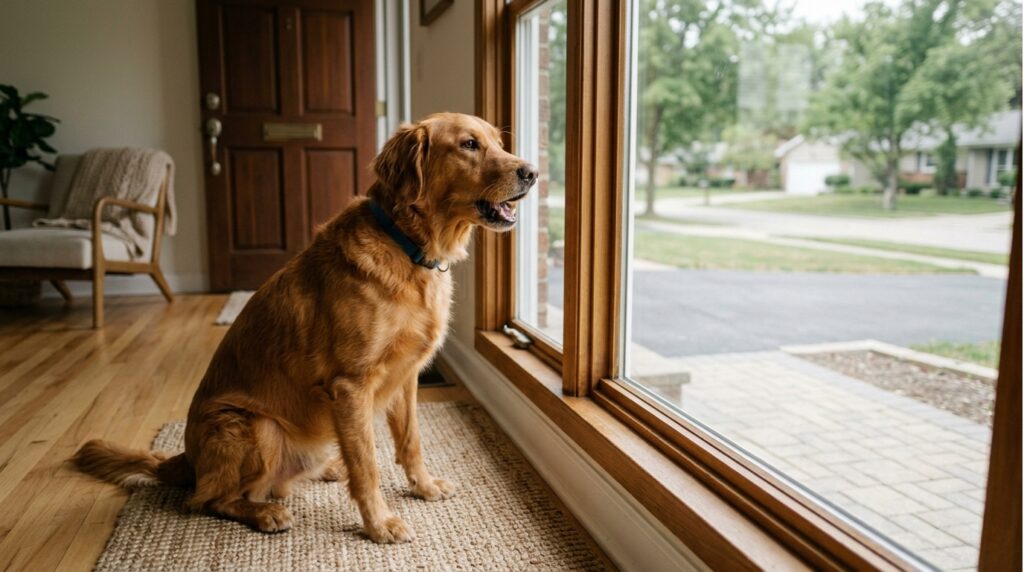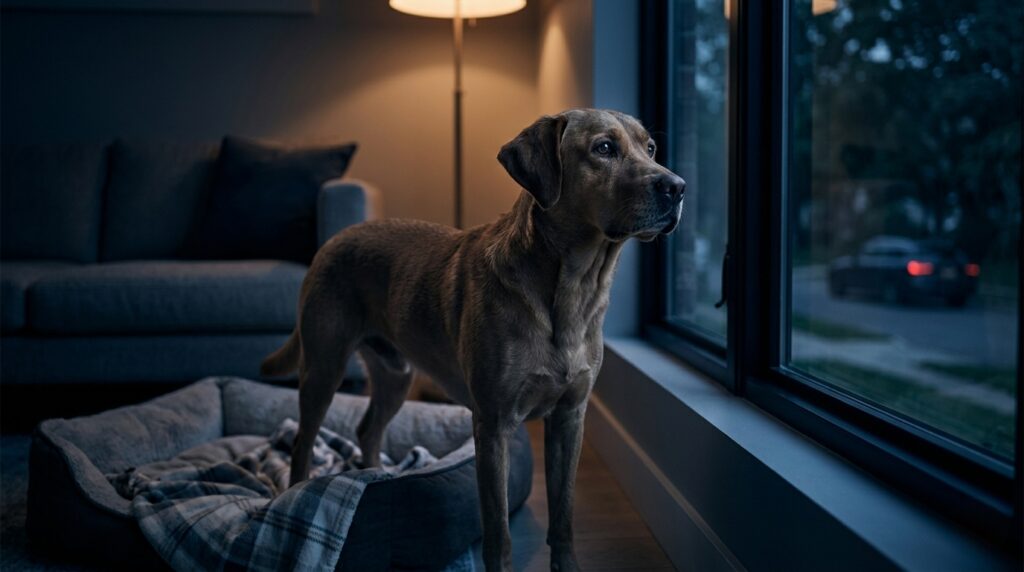

Dog barking at the door can become stressful fast. Your dog may bark when the doorbell rings, someone knocks, the mail arrives, a delivery driver walks up, or a neighbor moves in the hallway.
Many owners shout “Quiet!” because they feel embarrassed, rushed, or worried about complaints. But shouting often adds more noise, attention, and tension. For some dogs, it can make barking harder to interrupt.
The better goal is not just silence. The goal is to teach your dog what to do when something happens at the door.
Immediate Answer
To reduce dog barking at the door, avoid shouting “Quiet” during the barking. Instead, reduce your dog’s access to the trigger, teach a calm routine away from the door, reward quiet moments early, and practice with easy door sounds before real visitors arrive.
Door barking is often linked with alert barking, alarm barking, or territorial barking. Dogs may bark when they see or hear people approaching the home, including visitors, mail carriers, delivery drivers, neighbors, or people passing by.
In This Article
Why Dogs Bark at the Door
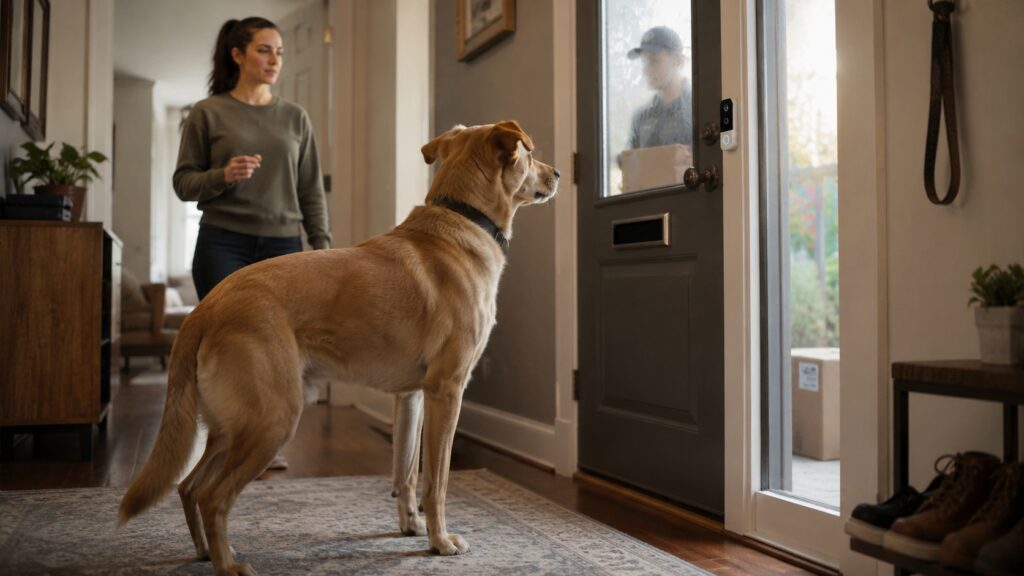
Door barking usually happens because your dog notices a change near the home. That change may feel exciting, worrying, important, or threatening to your dog.
This does not mean your dog is stubborn or “bad.” In many cases, your dog is reacting to something they hear, see, or expect.
1. Your Dog Is Alerting You
Your dog may bark because they heard or saw something near the home.
Common door barking triggers include:
- Doorbell
- Knock
- Footsteps
- Car door
- Mail slot
- Neighbor’s gate
- Apartment hallway noise
- Delivery driver outside
- Visitors approaching the front door
- Other dogs barking nearby
Your dog may react before you notice anything. For example, they may hear footsteps, a gate click, elevator noise, or a hallway door before someone knocks.
2. The Barking Pattern May Become Rewarding
Door barking can become a learned routine.
For example:
- The mail carrier arrives.
- Your dog barks.
- The mail carrier leaves.
- Your dog settles.
From your dog’s point of view, it may look like barking made the person go away.
This is why barking at the mail carrier, delivery driver, or people passing the home can become stronger over time. The person leaves anyway, and your dog may accidentally learn that barking “worked.”
3. Shouting “Quiet” Can Add More Energy
When you shout “Quiet!” or “Stop!” during barking, your dog may not understand it as a trained cue.
Your loud voice can add:
- More attention
- More excitement
- More tension
- More movement toward the door
If your dog is already highly aroused, shouting may sound like you are joining the alert instead of calmly guiding them.
4. Your Dog Practices the Same Routine Too Often
Mail, deliveries, guests, neighbors, and hallway sounds can repeat the same barking pattern many times.
The more often your dog rehearses barking at the door, the harder it can be to change the habit. This is why management matters.
If your dog keeps practicing the old behavior all day, training becomes much harder.
5. Some Homes Make Door Barking Easier to Trigger
Door barking may be more noticeable in:
- Apartments
- Flats
- Terraced houses
- Shared-wall homes
- Busy neighborhoods
- Homes with front-facing windows
- Homes where the dog can see the street or hallway
This does not automatically mean your dog has anxiety. It simply means your dog may need a calmer setup and a clearer routine.
Which Door Barking Plan Fits Your Dog?
Use this table to choose the best first step for your situation.
| Door Barking Situation | Best First Step |
|---|---|
| Dog barks at the doorbell | Practice low-volume doorbell sounds and send your dog to a mat |
| Dog barks when someone knocks | Start with soft practice knocks away from the real door |
| Dog barks at the mail carrier | Block door or window access before mail delivery time |
| Dog barks at delivery drivers | Use a gate or calmer room during expected delivery windows |
| Dog barks at apartment hallway sounds | Reduce hallway access and use soft background noise |
| Dog rushes guests at the door | Build a visitor routine with a gate, mat, or leash |
| One dog barks and another joins | Train each dog separately before practicing together |
| Dog growls, lunges, snaps, or bites | Contact a qualified reward-based trainer or behavior professional |
| Dog suddenly starts barking more than usual | Contact a veterinarian first |
This matters because not all barking has the same cause. Alert barking, demand barking, fear-based barking, and separation-related barking may need different plans.
For related help, read:
Real-World Door Barking Scenarios
These are common owner situations, not medical or behavior diagnoses.
Real-World Scenario: The Mail Carrier Problem
An owner notices their dog barks every time the mail arrives. The dog barks, the mail carrier leaves, and the dog settles.
A better plan is to change the setup before the mail arrives. Move the dog away from the door, block the window view, and reward calm behavior before barking starts.
Real-World Scenario: Apartment Hallway Barking
A dog barks at hallway sounds. The owner may not always hear the trigger, but the dog reacts to footsteps, doors, voices, or elevator noise.
A safer first plan is to reduce hallway access, use soft background noise, and reward the dog for staying settled before barking builds.
Real-World Scenario: Guests Cause Chaos
An owner feels unable to invite people over because the dog rushes to the door and barks loudly.
This does not mean the dog is “bad.” It means the dog needs a repeatable visitor routine. A mat, bed, gated area, or leash setup can give the dog a clear job away from the door.
Real-World Scenario: One Dog Starts, Then Another Joins
In a multi-dog home, one dog hears the door and barks. The other dog joins in. Soon both dogs are barking.
In this situation, it often helps to train each dog separately first. Once each dog understands the calm routine, you can practice together later.
Step-by-Step Solutions to Stop Dog Barking at the Door
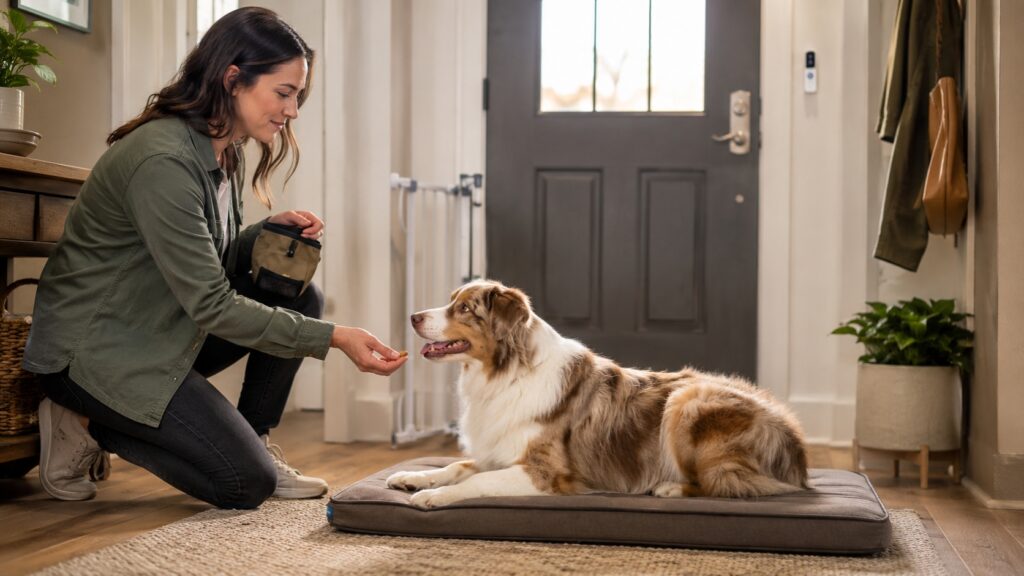
Step 1: Stop Shouting During the Bark
What to do
Use a calm voice and reduce fast movement.
How to do it
Instead of yelling “Quiet,” use one short cue in a normal voice, such as:
- “Thank you”
- “This way”
- “Mat”
- “Place”
- “Find it”
Then guide your dog away from the door with food, a toy, or a simple hand cue.
When to apply it
Use this as soon as your dog notices the trigger, before the barking becomes intense.
Why it helps
A calm response keeps the room from becoming more exciting. It also reduces the chance that your dog sees your shouting as part of the alert.
Step 2: Block the Daily Door Barking Rehearsal
What to do
Prevent your dog from practicing the same barking routine all day.
How to do it
Use simple management:
- Close curtains or blinds
- Use privacy window film
- Move furniture away from the window
- Use a baby gate to block the front door area
- Play soft background noise near hallway-facing rooms
- Keep your dog in a calmer room during known delivery times
When to apply it
Use this before known triggers, such as:
- Mail delivery
- School pickup time
- Evening hallway traffic
- Expected guests
- Regular package delivery windows
Why it helps
Your dog cannot keep improving at the old behavior if they are not rehearsing it all day.
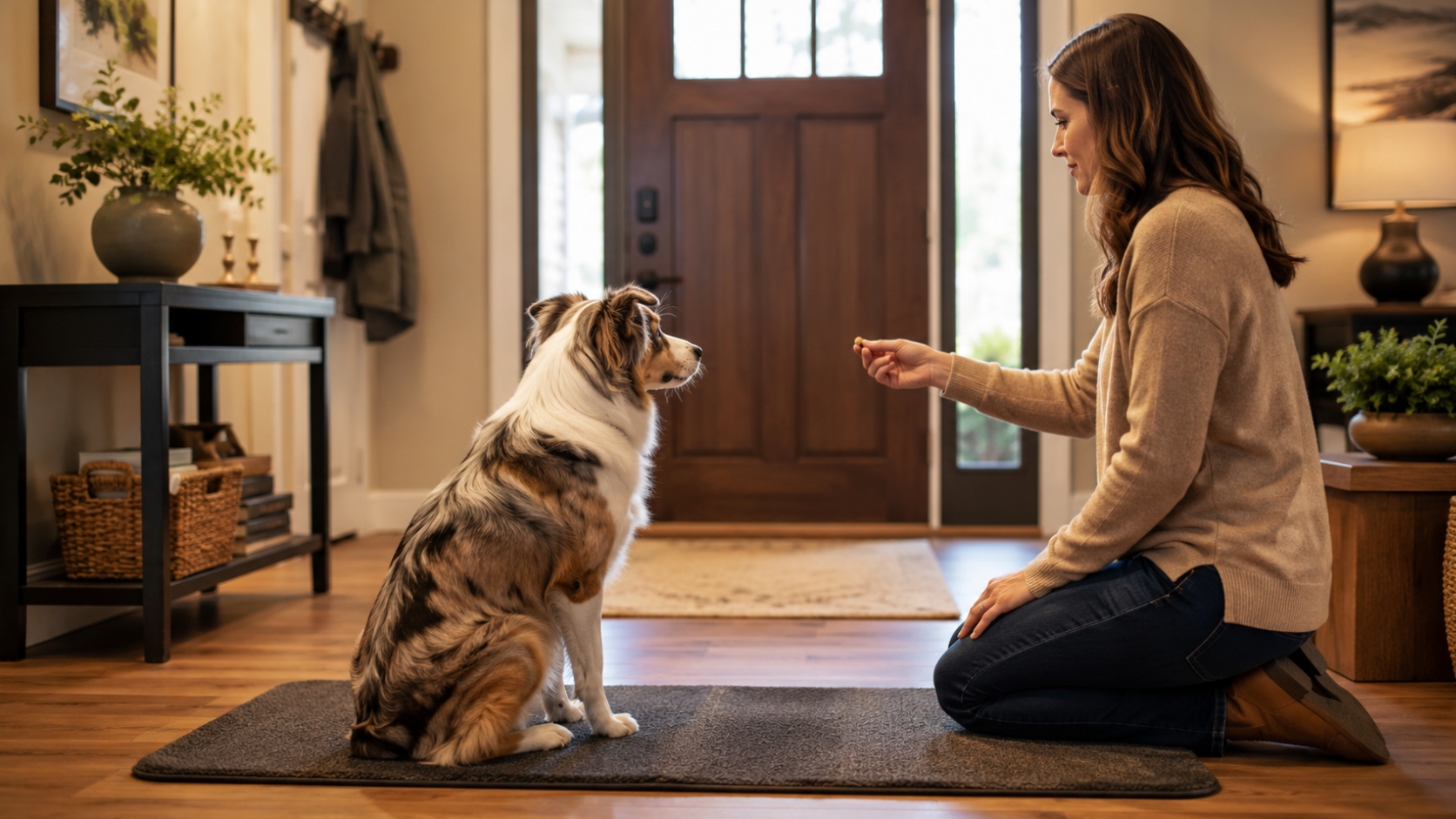
Step 3: Teach a “Go to Mat” or “Place” Routine
What to do
Teach your dog to move away from the door and settle on a mat, bed, or rug.
How to do it
- Place a mat several feet away from the door.
- Toss a treat on the mat.
- When your dog steps on it, calmly praise and give another treat.
- Repeat until your dog moves to the mat quickly.
- Add a cue like “Mat” or “Place.”
- Practice when the house is calm.
- Slowly add easy door sounds later.
When to apply it
Practice daily during calm moments first. Do not start teaching this when someone is already knocking.
Why it helps
“Stop barking” can be hard for many dogs. “Go to your mat” gives your dog a clear job.
Step 4: Practice Easy Door Sounds Before Real Visitors Arrive
What to do
Teach your dog that door sounds can predict calm rewards, not chaos.
How to do it
- Start with a very soft knock on a table or wall.
- Say your mat cue.
- Reward your dog for moving away from the door.
- Repeat with slightly louder sounds.
- Later, practice with a real door knock.
- Then practice with a recorded doorbell at low volume.
- Keep sessions short and easy.
When to apply it
Use this during planned training sessions, not during real deliveries or surprise visitors.
Why it helps
Many dogs only hear cues when they are already overexcited. Easy practice helps your dog learn before the real trigger happens.
Step 5: Reward the Moment Before Barking
What to do
Catch the early warning signs before the full barking starts.
What to look for
Your dog may show early signs such as:
- Ears forward
- Staring at the door
- Body freezing
- Moving toward the window
- Low growl
- First small “woof”
- Sudden alert posture
How to do it
Before the full barking starts, call your dog away and reward them for turning back to you or moving to the mat.
When to apply it
Use this when your dog has noticed something but has not reached full barking yet.
Why it helps
It is easier to guide a dog at a low arousal level than when barking is already intense.
Step 6: Build a Calm Visitor Routine
What to do
Make guest arrival predictable.
How to do it
- Put your dog behind a gate, on a mat, or on leash before opening the door.
- Keep treats ready near the entrance.
- Ask guests to ignore your dog at first.
- Reward your dog for looking at the guest, then turning back to you.
- Allow greeting only if your dog is calm enough and it is safe.
When to apply it
Use this before guests enter, not after your dog is already rushing the door.
Why it helps
Many dogs bark more when visitors talk, stare, reach, bend over them, or move toward them too quickly.
A clear visitor routine helps your dog predict what happens next.
Step 7: Use Different Plans for Alert Barking and Demand Barking
What to do
Look at what starts the barking and what your dog gets from it.
Alert barking usually happens when:
- Your dog hears something outside
- Your dog sees someone approaching
- Someone knocks
- The doorbell rings
- A person passes the home
- A delivery driver arrives
For alert barking, reduce the trigger and teach a calm door routine.
Demand barking usually happens when your dog wants:
- Attention
- Food
- Play
- Access to a room
- Access to a toy
- You to open a door
For demand barking, avoid giving the wanted thing during the bark. Reward calm behavior instead.
Why it helps
Ignoring is not always useful for door barking because the trigger is outside your control. The person outside may still leave, even if you ignore your dog.
That can accidentally teach your dog that barking worked.
Helpful Tools That May Support Door Barking Training
These tools do not train your dog by themselves, but they can make the training plan easier.
1. Baby Gate
A baby gate can stop your dog from rushing the front door. It also creates a safer distance between your dog and visitors.
Best for:
- Guest arrival
- Delivery drivers
- Dogs who rush the door
- Multi-dog homes
2. Training Mat or Dog Bed
A mat gives your dog a clear place to go when the doorbell rings or someone knocks.
Best for:
- “Go to mat” training
- Visitor routines
- Calm settling practice
3. Treat Pouch
A treat pouch helps you reward quickly before barking becomes intense.
Best for:
- Early interruption
- Door sound practice
- Visitor training
4. Privacy Window Film
Privacy film can reduce visual triggers without making the room dark.
Best for:
- Dogs barking at people outside
- Street-facing windows
- Apartment hallway views
- Mail carrier barking
5. Soft Background Noise
A fan, white-noise machine, or calm background audio may reduce hallway and outside sounds.
Best for:
- Apartment barking
- Shared-wall homes
- Hallway footsteps
- Elevator noise
6. Doorbell Recording
A recorded doorbell sound lets you practice at low volume before using the real doorbell.
Best for:
- Doorbell barking
- Controlled training sessions
- Dogs who get overexcited by real visitors
Important Note About Anti-Bark Devices
Avoid relying on anti-bark devices as the first solution. Bark collars, ultrasonic devices, citronella collars, and vibration collars may target the sound without solving the reason your dog is barking.
If you are considering a collar or ultrasonic tool, read our guide on why anti-bark devices may not solve dog barking problems before using one.
Best Setup by Situation
Because this is a practical door-barking problem, the best setup depends on your home and trigger.
| Situation | Best Setup |
|---|---|
| Apartment hallway barking | Baby gate, soft background noise, treats near hallway-facing room |
| Mail carrier barking | Privacy film, closed curtains, dog moved away before delivery time |
| Doorbell barking | Training mat, low-volume doorbell recording, treat pouch |
| Guest arrival chaos | Baby gate, leash or mat, guest ignores dog at first |
| Delivery driver barking | Dog in calmer room before delivery, background noise, mat practice |
| Multi-dog barking | Separate training sessions, then controlled practice together |
| Dog rushes the door | Gate or leash setup before opening the door |
| Fearful or unsafe barking | Professional help before visitor practice |
This section is especially useful if you live in an apartment, flat, terraced house, or shared-wall home where barking complaints can become urgent.
What Not to Do
Avoid Repeating “Quiet” Loudly
If your dog does not know the cue, repeating it during barking may only add more noise, attention, and tension.
Avoid Waiting for the Dog to Grow Out of It
Door barking can become a stronger habit if the same routine happens every day.
Avoid Training Only During Real Chaos
Practice when the house is calm. If your dog only hears the cue during high arousal, the cue may not mean much.
Avoid Punishment if Fear May Be Involved
If your dog may be barking because they feel worried, punishment can increase stress and make the door area feel more negative.
Avoid Letting Dogs Trigger Each Other All Day
In multi-dog homes, train separately at first. Once each dog understands the routine, practice together.
When This Plan May Not Be Enough
A basic door barking plan may not be enough if your dog:
- Cannot calm down after the trigger leaves
- Barks for several minutes after every sound
- Lunges at visitors
- Growls, snaps, or bites near the door
- Seems fearful of guests
- Panics when left alone
- Barks at night and seems confused
- Suddenly starts barking more than usual
- Shows pain signs or behavior changes
In these cases, do not treat the barking as a simple obedience issue. Your dog may need veterinary care, a qualified reward-based trainer, or a certified behavior professional.
When to Contact a Vet or Qualified Trainer
Contact a veterinarian if the barking:
- Starts suddenly
- Gets worse quickly
- Happens with confusion
- Happens with pain signs
- Comes with appetite changes
- Comes with disorientation
- Appears with sudden fear or behavior change
- Happens alongside sleep-wake changes, especially in senior dogs
Consider help from a qualified reward-based trainer or behavior professional if:
- Your dog lunges, snaps, or bites near the door
- You cannot safely open the door
- Your dog is highly fearful of visitors
- The barking is causing housing, landlord, building, or neighbor complaints
- You live in an apartment, flat, terraced house, or shared-wall home and need a faster management plan
For senior dogs, also read: Sudden Excessive Barking in Older Dogs: Behavior Change or Medical Concern?
Quick Summary
Dog barking at the door is usually not fixed by shouting “Quiet.” Shouting can add energy, attention, or tension, which may make barking harder to interrupt.
A better plan is to:
- Reduce access to triggers
- Stop daily barking rehearsal
- Teach a mat routine
- Practice easy door sounds
- Reward early calm behavior
- Use a clear visitor routine
- Choose different plans for alert barking and demand barking
- Get help if barking is sudden, extreme, fearful, or unsafe
The goal is not just silence. The goal is a dog who knows what to do when someone is at the door.
Start with one simple step today: block your dog’s access to the door or window during the busiest trigger time, then begin practicing a calm mat routine when the house is quiet.
FAQs
Why does my dog bark before someone knocks?
Your dog may notice early clues, such as a car door, footsteps, a gate click, a mail slot, elevator noise, or hallway movement. Dogs often hear these sounds before owners notice them.
Should I ignore my dog barking at the door?
Usually, ignoring is not the best first plan for door barking. The trigger is outside your control, and the person outside may still leave. That can accidentally reward the barking.
It is usually better to redirect your dog early and teach a calm routine away from the door.
How do I stop my dog barking at the mail carrier?
Start before mail delivery. Block window or door access, move your dog to a calmer area, use a mat cue, and reward calm behavior before barking starts.
Practice with easy door sounds when the mail carrier is not there.
How do I stop my dog barking at the doorbell?
Practice with a low-volume doorbell recording first. Say your mat cue, reward your dog for moving away from the door, and keep sessions short.
Do not start with the real doorbell at full intensity if your dog already reacts strongly.
Why does shouting “Quiet” make barking worse?
Your dog may not understand “Quiet” as a trained cue. A loud voice can add attention, excitement, or tension. Some dogs may think you are joining the alert.
Is my dog protecting me or being reactive?
It can be hard to tell without seeing the full pattern. Alert barking means your dog noticed something. But barking with lunging, growling, snapping, biting, fear, or trouble calming down may need professional support.
Focus on safety, distance, and a repeatable routine.
What is the best command for dog barking at the door?
A clear action cue is usually better than only saying “Quiet.” Useful cues include:
- “Mat”
- “Place”
- “This way”
- “Find it”
These tell your dog what to do instead of only telling them what to stop.
Can a baby gate help with door barking?
Yes, a baby gate can help by stopping your dog from rushing the door. It also gives you more control during visitor arrivals and delivery situations.
A gate works best when paired with rewards, calm practice, and a clear mat routine.
Should I use a bark collar for door barking?
A bark collar should not be the first solution. Door barking is often caused by alert behavior, fear, excitement, or learned patterns. A device may suppress the sound without addressing the trigger.
A safer first step is management, reward-based training, and professional help if the barking is intense or unsafe.