
You leave the house, close the door, and within seconds, your dog starts barking or howling.
Maybe a neighbor told you. Maybe you recorded it yourself. Either way, it feels stressful, confusing, and sometimes embarrassing.
If your dog barks when you leave, the behavior usually falls into one of two main categories:
- Separation anxiety your dog is experiencing emotional distress.
- Habit or protest barking your dog is reacting temporarily to your departure.
This distinction matters because each problem needs a different solution.
Quick answer: If your dog stops barking within 10–15 minutes, it may be habit or protest barking. If the barking continues, escalates, or comes with panic behaviors like pacing, scratching, whining, or destruction, separation anxiety is more likely.
Table of Contents
- Why Dogs Bark When Left Alone
- 1. Separation Anxiety: Panic Response
- 2. Habit or Protest Barking
- 3. Boredom or Under-Stimulation
- 4. Trigger-Based Barking While Alone
- 5. Crate vs Alone Confusion
- Quick Self-Test: Which One Is It?
- Severity Matters: Most Blogs Skip This
- Real-Life Situations You Might Recognize
- How to Stop Dog Barking When Left Alone
- Step 1: Identify the Cause
- Step 2: Break Departure Triggers
- Step 3: Train Short Absences
- Step 4: Keep Departures Low-Key
- Step 5: Give a Safe Activity
- Step 6: Fix Exercise Timing
- Step 7: Adjust the Environment
- Step 8: Rethink Crate Use
- How Long Does It Take to Fix?
- One Insight Most Blogs Miss
- What NOT to Do
- Final Thoughts
- FAQs
- What to Do Next
Why Dogs Bark When Left Alone
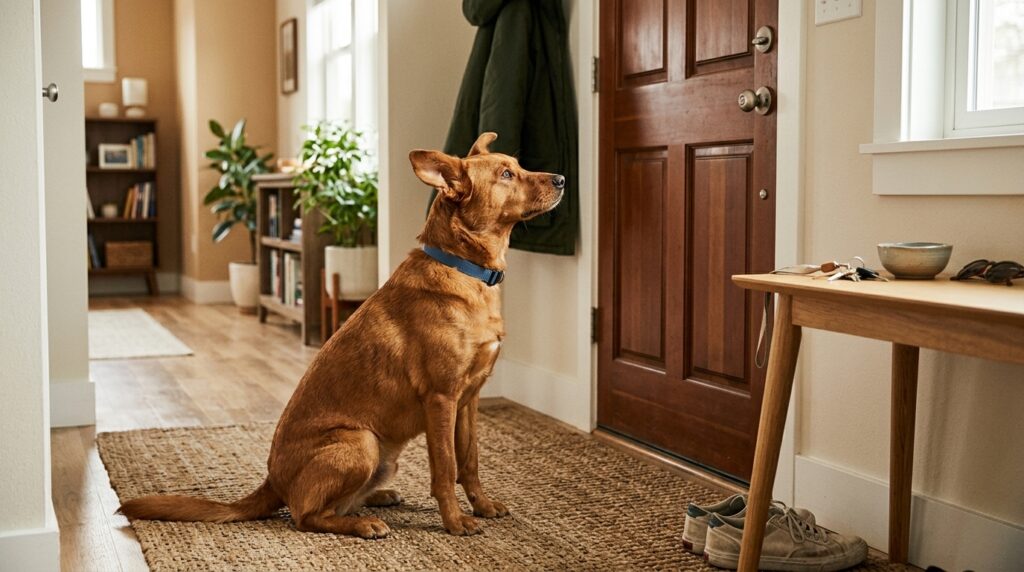
Dogs bark when left alone for different reasons. Some are distressed. Some are frustrated. Some are bored. Others are reacting to sounds or movement outside the home.
The key is not just asking, “How do I stop the barking?” The better question is:
Why is my dog barking when I leave?
Once you understand the cause, the solution becomes much clearer.
1. Separation Anxiety: Panic Response
Separation anxiety is not stubbornness, bad behavior, or your dog trying to annoy you. It is an emotional panic response that happens when your dog feels unable to cope with being alone.
What separation anxiety often looks like:
- Barking starts within seconds of you leaving.
- The barking continues for a long time.
- Your dog may pace, whine, howl, or scratch at doors.
- The behavior gets worse over time instead of improving.
- Your dog may seem panicked, not just noisy.
Important: Separation anxiety is not mainly a noise problem. It is an emotional distress problem. That means punishment, yelling, or “letting them bark it out” can make things worse.
2. Habit or Protest Barking
Habit or protest barking is more common than many dog owners realize. In this case, your dog is not necessarily panicking. They may simply be reacting to the moment you leave.
What habit barking often looks like:
- Barking lasts around 5–15 minutes.
- The barking stops on its own.
- It happens mainly right after you leave.
- Your dog eventually settles, sleeps, or plays.
- There are no major panic signs.
This type of barking is usually a temporary protest or learned routine. Your dog may be saying, “Wait, don’t leave,” but they are still able to calm down after a short time.
3. Boredom or Under-Stimulation
Some dogs bark because they have excess physical or mental energy. This is especially common in young dogs, working breeds, high-energy dogs, or dogs that spend long periods alone.
Boredom barking is more likely if:
- Your dog did not get enough exercise before you left.
- Your dog has no safe activity while alone.
- Your dog is young or naturally energetic.
- Your dog spends many hours alone with nothing to do.
- The barking happens after a period of restlessness.
In these cases, barking may be your dog’s way of releasing built-up energy.
4. Trigger-Based Barking While Alone
Sometimes the barking is not actually about you leaving. Your dog may be reacting to things happening around the home.
Common triggers include:
- People walking past windows.
- Delivery drivers or mail carriers.
- Other dogs barking nearby.
- Cars, footsteps, or hallway noise.
- Birds, cats, or other animals outside.
If your dog barks randomly throughout the day while alone, environmental triggers may be part of the problem.
5. Crate vs Alone Confusion
Some dogs are calm when left loose in a safe area but bark intensely when placed in a crate.
If your dog is calm when free but barks in the crate, the issue may not be separation anxiety. It may be confinement stress.
Signs of crate-related stress include:
- Barking only happens inside the crate.
- Your dog scratches, bites, or paws at the crate.
- Your dog settles better in a gated room or safe space.
- The crate causes stress even when you are nearby.
Crates can help some dogs, but they are not a universal solution. For some dogs, a safe room or playpen may work better.
Quick Self-Test: Which One Is It?
The easiest way to understand your dog’s barking is to record them when you leave.
Use your phone, a pet camera, or a home camera and watch what happens after you walk out.
- Stops within 10–15 minutes: likely habit or protest barking.
- Continues or escalates: separation anxiety is more likely.
- Starts later in the day: boredom or environmental triggers may be involved.
- Only happens in the crate: confinement stress may be the issue.
Simple rule: Timing tells you a lot. Short barking that settles is different from barking that continues, escalates, or comes with panic signs.
Severity Matters: Most Blogs Skip This
Not all alone-time barking problems are equal. A dog that barks for three minutes and then sleeps does not need the same plan as a dog that panics for two hours.
Mild Barking
Mild barking usually means your dog barks briefly and settles quickly.
This may include:
- Short barking after you leave.
- No destructive behavior.
- No intense panic signs.
- Your dog eventually rests or plays.
Moderate Barking
Moderate barking lasts longer and may include some stress signs.
This may include:
- Barking for longer than 15 minutes.
- Whining, pacing, or restlessness.
- Difficulty settling.
- Stress around departure cues like keys or shoes.
Severe Barking
Severe barking often points to deeper separation-related distress.
This may include:
- Continuous barking or howling.
- Panic behaviors.
- Scratching doors or windows.
- Destructive behavior.
- Drooling, trembling, or attempts to escape.
The more severe the problem is, the slower you need to go with training.
Real-Life Situations You Might Recognize
Many owners describe the same situations when dealing with barking during alone time.
- Your dog is calm until you pick up your keys.
- Barking starts the moment the door closes.
- The behavior suddenly got worse.
- Your dog only barks when left in the crate.
- Neighbors are starting to complain.
- Your dog barks more after a schedule change.
- Your dog settles some days but panics on others.
These are not all the same problem. That is why identifying the cause matters before choosing a solution.
How to Stop Dog Barking When Left Alone
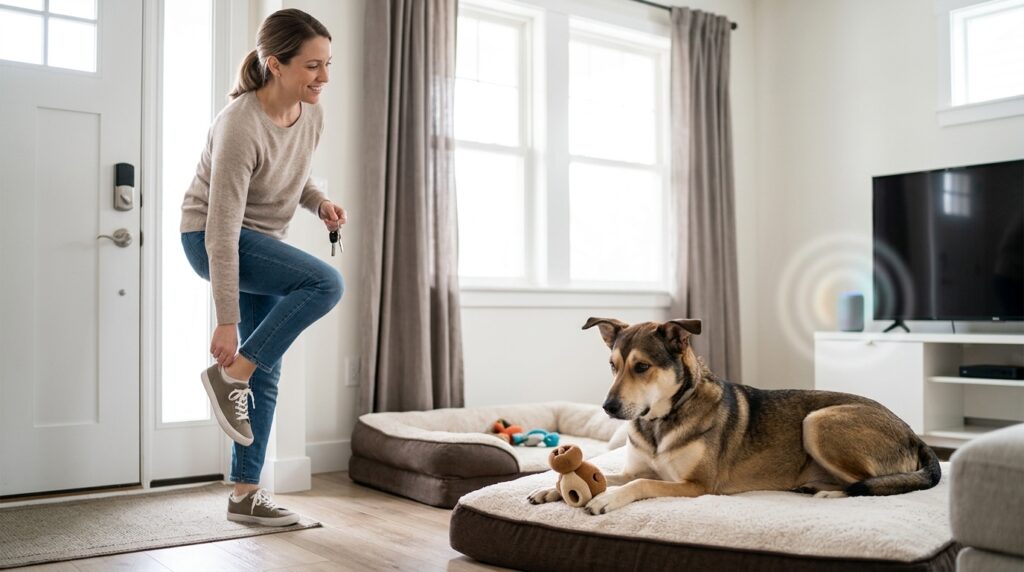
The right solution depends on the reason behind the barking. The goal is not just to stop the noise. The goal is to help your dog feel calm, safe, and settled when alone.
Step 1: Identify the Cause
Do not skip this step.
Fixing the wrong problem leads to slow progress or no progress at all. A dog with anxiety needs a different plan from a dog who is simply bored or protesting.
Start by asking:
- How quickly does the barking start?
- How long does it last?
- Does it stop on its own?
- Are there panic signs?
- Does it happen only in the crate?
- Are outside sounds or window triggers involved?
Step 2: Break Departure Triggers
Dogs often react before you actually leave. Keys, shoes, bags, jackets, and doors can all become warning signs.
To reduce this pattern, practice departure cues without leaving.
- Pick up your keys randomly and sit back down.
- Put on your shoes without leaving.
- Open and close the door without exiting.
- Grab your bag, then continue normal activities.
This teaches your dog that these cues do not always mean they are about to be left alone.
Step 3: Train Short Absences
Start smaller than you think you need to.
For many dogs, the first goal is not 30 minutes alone. It may be only 30 seconds.
Example progression:
- Leave for 30 seconds.
- Return calmly.
- Repeat until your dog stays relaxed.
- Increase to 1 minute.
- Then try 3 minutes.
- Then 5 minutes.
- Then 10 minutes.
Only increase the time when your dog stays calm at the current level.
Even calm dogs may bark at outside noises, people passing by, or other animals. If your dog also does this while you’re home especially at night then it may not be a separation issue at all. In that case, understanding why dogs bark at night and what triggers it will help you fix the real cause.
Key rule: Progress should be based on your dog’s calm behavior, not on your schedule.
Step 4: Keep Departures Low-Key
Emotional goodbyes can make alone-time feel like a big event.
Instead, keep leaving and returning calm.
- Avoid dramatic goodbyes.
- Ignore your dog for 5–10 minutes before leaving.
- Leave calmly.
- Return calmly.
- Wait for calm behavior before giving attention.
Big emotions can create bigger reactions. Calm routines help your dog settle faster.
Step 5: Give a Safe Activity
Safe activities work especially well for habit barkers or bored dogs.
Useful options include:
- Stuffed food toys.
- Frozen treats.
- Long-lasting chews.
- Puzzle feeders.
- Snuffle mats before you leave.
The goal is to shift your dog’s focus from your exit to something calm and rewarding.
Always choose safe items based on your dog’s chewing style and supervise new chews before leaving them alone with one.
Step 6: Fix Exercise Timing
A tired dog usually settles faster than a dog full of unused energy.
Exercise before leaving can help, but timing matters more than total duration.
Try:
- A walk before leaving.
- A short training session.
- A sniffing activity.
- Calm play followed by a short rest period.
Avoid making your dog overly excited right before you leave. The best routine is usually exercise, calm-down time, then departure.
Step 7: Adjust the Environment
Many barking problems are made worse by the environment.
Try these changes:
- Close curtains to block visual triggers.
- Use white noise or soft background sound.
- Move your dog away from busy windows.
- Create a quiet resting area.
- Limit access to areas where barking starts.
This is especially helpful for dogs that bark at people, cars, animals, or sounds while alone.
Step 8: Rethink Crate Use
If barking mainly happens in the crate, the crate itself may be part of the problem.
In that case, try:
- Using a safe room instead.
- Trying a playpen or gated area.
- Reintroducing the crate slowly.
- Feeding meals in the crate without closing the door.
- Practicing short calm crate sessions while you are home.
A crate should feel safe, not like a trap. If your dog is more relaxed outside the crate, a different setup may be better.
How Long Does It Take to Fix?
The timeline depends on the cause and severity of the barking.
- Habit barking: a few days to a few weeks.
- Mild anxiety: several weeks.
- Severe anxiety: several months and sometimes professional help.
Progress depends more on consistency than speed. Going too fast often causes setbacks.
One Insight Most Blogs Miss
If your dog suddenly started barking when alone, look for recent changes.
Common triggers include:
- A new work schedule.
- Moving house.
- Less daily exercise.
- A new pet or family member.
- New outdoor sounds.
- Construction nearby.
- A change in your dog’s routine.
Behavior changes usually follow environment changes. Your dog may not be “acting out.” They may be reacting to something different in their world.
What NOT to Do
Avoid methods that suppress the barking without addressing the cause. They can make anxiety, fear, or frustration worse.
Avoid these common mistakes:
- Letting your dog “bark it out” if they are anxious.
- Using shock collars or harsh anti-bark devices.
- Making long emotional goodbyes.
- Increasing alone time too quickly.
- Guessing the cause instead of observing the behavior.
- Punishing barking after you return home.
Punishment may stop noise temporarily, but it does not teach your dog how to feel safe when alone.
Final Thoughts
Barking when left alone usually comes down to anxiety, habit, boredom, triggers, or confinement stress.
The timing of the barking tells you a lot. A dog that barks briefly and settles is very different from a dog that continues barking, escalates, or shows panic behaviors.
The best approach is simple:
- Record your dog when you leave.
- Identify the cause.
- Start with short, calm absences.
- Build slowly.
- Use safe activities and a better environment.
- Avoid punishment.
Fix the cause, not just the noise.
FAQs
How long is normal barking after I leave?
Barking for a few minutes after you leave can be normal protest barking. If your dog stops within 10–15 minutes and settles, it may not be separation anxiety.
Should I ignore barking when I leave?
Ignoring may be okay if the barking stops quickly. But if barking continues, escalates, or includes panic signs, ignoring it can make anxiety worse.
Why did my dog suddenly start barking when alone?
Sudden barking is often linked to changes in routine, environment, exercise, household activity, or outside triggers.
Does crate training stop barking?
Not always. If your dog only barks in the crate, the issue may be confinement stress rather than separation anxiety.
Can separation anxiety be fixed?
Yes, many dogs improve with gradual desensitization, calm routines, and structured alone-time training. Severe cases may need help from a qualified trainer, behavior consultant, or veterinarian.
Are anti-bark collars a good solution?
Anti-bark collars may suppress noise, but they do not address the emotional cause of barking. For anxious dogs, they can increase fear and stress.
What to Do Next
The next time you leave, record your dog.
Within one day, you will usually know whether the barking is:
- Short-term habit barking.
- Separation-related anxiety.
- Boredom or under-stimulation.
- Environmental trigger barking.
- Crate or confinement stress.
Once you know the cause, you can apply the right solution instead of guessing.