
If your dog barks when you sit down, open a laptop, join a work call, or try to relax on the sofa, it can feel personal.
One minute your dog seems calm. The next minute, they are barking, staring, bringing toys, pawing, or trying to get your full attention.
This is common for people who work from home, live in an apartment or flat, or need quiet during calls.
But your dog is probably not being spiteful.
The barking may have become a learned pattern: “When my owner sits down, barking changes what happens.”
Dog barking can be communication, attention-seeking, boredom, frustration, alerting, fear, or another need. The AKC explains that barking is one way dogs communicate, and the MSD/Merck Veterinary Manual explains that attention-seeking behavior can be reinforced when owners respond to it.
Table of Contents
- Immediate Answer
- Why Your Dog Barks When You Sit Down
- Real-World Scenarios
- Step-by-Step Solutions
- Simple 5-Day Work-From-Home Barking Plan
- What Not to Do
- When to Contact a Vet or Qualified Trainer
- Quick Summary
- FAQs
Immediate Answer
Your dog may bark when you sit down or start working because sitting, opening a laptop, joining a call, or looking at a screen has become a cue.
Your dog may have learned that barking during these moments gets a result, such as:
- You look at them
- You talk to them
- You give a treat
- You throw a toy
- You let them outside
- You move from your desk
- You stop focusing on the laptop
This can be linked with demand barking dog behavior, boredom, lack of routine, frustration, or accidental reinforcement.
If your dog barking during work calls is getting worse, the goal is not only to “ignore it.”
A safer goal is to teach your dog what to do instead before the barking starts.
Why Your Dog Barks When You Sit Down
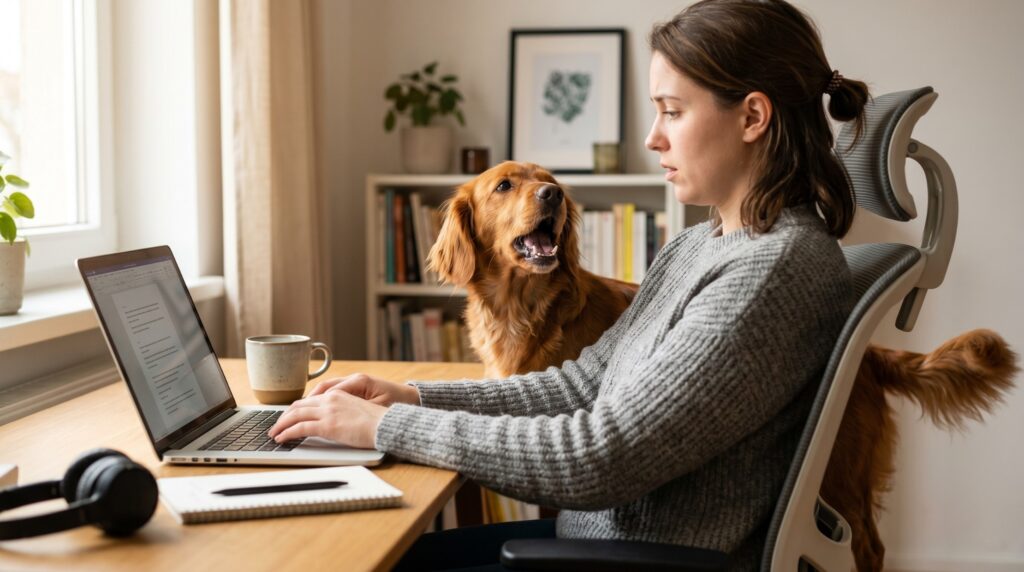
1. Sitting Down May Have Become a Cue
Dogs can learn repeated household patterns.
Your dog may notice actions that mean you are about to be still or busy:
- Sitting at a desk
- Opening a laptop
- Picking up your phone
- Joining a video call
- Sitting on the sofa
- Turning on the TV
- Reading a book
- Putting on headphones
To your dog, these actions may not mean “my owner is working.”
They may mean, “attention is about to be harder to get.”
That is why a dog may seem calm, then suddenly bark when the laptop opens.
The laptop may have become part of the routine that predicts less attention.
2. Barking May Have Worked Before
Demand barking can grow when it gets results.
Even if you feel annoyed, your dog may still get something from barking:
- Eye contact
- Talking
- Scolding
- Touch
- Food
- A toy
- Being let outside
- You standing up
- You ending the call early
The MSD/Merck Veterinary Manual explains that attention-seeking behavior can happen when a dog acts in a way that gets attention from people.
It also notes that attention from the owner can reinforce the behavior.
A simple pattern can form:
Dog barks → owner reacts → dog learns barking works → dog barks sooner next time.
This does not mean your dog is bad.
It means the behavior may have been rewarded by accident.
3. Work Calls Make Calm Training Harder
Many owners try to ignore barking.
But work calls make this difficult.
If you are on Zoom, Teams, or a phone call, you may need quiet fast.
So you might give a chew, toss a treat, open the door, or speak to your dog.
From your dog’s point of view, this may confirm the pattern:
“When the human talks to the screen, barking gets me something.”
This does not mean you failed.
It means the work-from-home setup makes barking easy to reward by accident.
4. Your Dog May Need More Activity Before Work Time
A dog who has had little movement, sniffing, chewing, or mental activity may struggle when you sit down for a long work block.
This can happen when:
- The morning walk was skipped or too short
- The dog slept while you were busy
- There was little sniffing or enrichment
- The dog expects play at that time
- The dog has extra energy when you need quiet
The barking may be a way to ask for something to do.
The PDSA explains that walks give dogs exercise, mental stimulation, and a chance to sniff. VCA Hospitals also describes sniffing walks as a useful form of mental stimulation for dogs.
This is one possible cause, not the only one.
5. Your Dog May Be Seeking Interaction, Not Acting Out of Spite
Some owners think their dog is guarding the laptop, jealous of work, or trying to be difficult.
In many cases, the dog may simply be seeking interaction, routine, movement, or attention.
This is different from separation-related barking.
The ASPCA explains that separation-related barking or howling usually happens when a dog is left alone or separated from their guardian.
If barking happens mainly when you are present but focused elsewhere, attention-seeking barking or frustration may be more likely.
That is not a diagnosis.
It is a pattern to watch.
Real-World Scenarios
Dog Barks When the Laptop Opens
An owner opens a laptop, and the dog starts barking, bringing toys, or pawing at the chair.
This could point to a learned pattern.
The dog may have learned that laptop time means less attention, so they bark early to start interaction.
Dog Barks During Work Calls
An owner joins a video call.
The dog starts barking as soon as the owner begins speaking.
This could happen because the dog hears the owner talking but does not understand why the attention is not directed at them.
If barking has led to treats, talking, or being let out before, the pattern can grow.
Dog Barks When the Owner Sits on the Sofa
An owner sits down to watch TV after work.
The dog stands in front of them and barks.
This may be linked with routine, boredom, frustration, or a learned request for play.
Dog Barks After Finishing a Chew
An owner gives a chew before a meeting.
The dog is quiet for five minutes, finishes it, then starts barking again.
This may mean the chew helped for a short time but did not teach a longer calm routine.
The dog still needs a plan for what to do after the chew is gone.
Step-by-Step Solutions
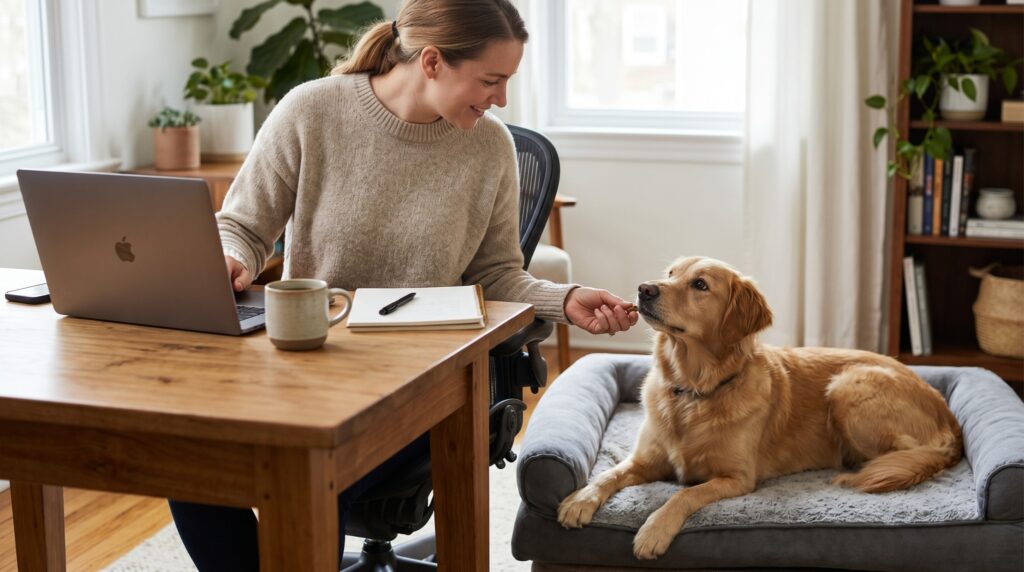
Step 1: Find the Exact Trigger
What to do: Track what starts the barking.
How to do it: For 3 days, write down:
- Did barking start when you sat down?
- Did it start when the laptop opened?
- Did it start when you began talking?
- Did it happen during calls only?
- Did it happen on the sofa too?
- Did your dog bring a toy?
- Did your dog need the toilet, food, water, or exercise?
- What did you do after the barking?
Look for the first signal, not just the barking.
When to apply it: Use this when the barking feels random.
It often follows a pattern.
Step 2: Meet Basic Needs Before You Sit Down
What to do: Give your dog a fair chance to settle before work or quiet time.
How to do it: Before a call, desk session, or sofa time, check:
- Toilet break
- Water
- Meal timing
- Short sniff walk
- Simple play
- 5 minutes of training
- Chew or food puzzle
- Comfortable resting spot
A slow sniffing walk can add mental activity, not just physical exercise.
The AKC’s guide to excessive barking discusses boredom and attention-seeking barking as common barking patterns.
When to apply it: Use this before predictable barking times, such as morning meetings, afternoon calls, evening TV, or desk work.
Step 3: Teach a Settle Spot
What to do: Teach your dog to go to a bed, mat, crate, or safe resting area when you sit down.
How to do it:
- Start when you are not on a real call.
- Place a mat near your desk or sofa.
- Toss a treat onto the mat.
- When your dog steps on it, calmly praise.
- Feed a few small treats while your dog stays there.
- Release them after a few seconds.
- Repeat in short sessions.
- Slowly add your real cues: sit down, open laptop, put on headphones.
The goal is for your dog to learn:
“When my owner sits down, I go to my spot.”
The MSD/Merck Veterinary Manual explains that behavior modification can involve teaching alternative behaviors and changing the situations that trigger problem behavior.
When to apply it: Practice before the problem moment.
Do not start training during an important call when your dog is already barking.
Step 4: Reward Quiet Before Barking Starts
What to do: Catch calm behavior early.
How to do it: When you sit down and your dog is quiet, calmly reward before barking begins.
You can reward with:
- A small treat
- A chew
- Calm praise
- A food puzzle
- A scatter of kibble
- A stuffed toy
- Access to their mat
Keep your voice low.
The goal is calm, not excitement.
When to apply it: Use this during the first 5–30 seconds after you sit down, open your laptop, or start a call.
That early window matters because it rewards the behavior you want before barking starts.
Step 5: Stop Rewarding the Barking Pattern
What to do: Avoid giving the main reward after barking starts.
How to do it: First, check safety, toilet needs, water, food, and health concerns.
Then ask:
What is this barking doing for my dog?
- If barking usually gets a toy, avoid throwing the toy during barking.
- If barking usually gets a treat, avoid giving the treat while barking is happening.
- If barking usually gets eye contact, look away briefly.
- If barking usually makes you stand up, wait for a short pause before moving.
Then reward a calmer behavior, such as:
- Four paws on the floor
- Looking away
- Going to the mat
- Sitting
- Sniffing for tossed kibble
- A short pause in barking
When to apply it: Use this after you have already taught a replacement behavior.
Ignoring alone can fail if your dog does not know what to do instead.
Step 6: Use a Meeting Plan, Not Panic Treats
What to do: Prepare your dog before calls instead of reacting during calls.
How to do it: Create a work-call routine.
10–20 minutes before the call:
- Toilet break
- Short sniff walk or simple training
- Settle spot ready
- Chew or puzzle ready
- Door closed if needed
- White noise on if hallway sounds trigger barking
At the start of the call:
- Send your dog to the mat
- Give the planned chew or puzzle
- Reward quiet before barking starts
After the call:
- Take a short break with your dog if possible
- Offer calm attention before the next work block
When to apply it: Use this for Zoom, Teams, phone calls, client meetings, or any call where barking creates stress.
If you are tempted to yell, use a bark collar, or rely on quick punishment because you need quiet during work, read why bark collars and yelling can backfire with dog barking.
Step 7: Make the Reward Last Longer
What to do: Use enrichment that lasts longer than a quick biscuit.
How to do it: Try:
- Stuffed food toy
- Frozen lick mat
- Safe chew
- Scatter feeding
- Snuffle mat
- Puzzle feeder
- Rolled towel with kibble hidden inside
Start with easy versions.
If it is too hard, your dog may give up and bark.
The ASPCA explains that food puzzles can provide mental stimulation and make mealtime more interactive. VCA Hospitals also explains that enrichment and foraging toys can help dogs use natural food-seeking behavior.
When to apply it: Use this when your dog is quiet but likely to get bored during desk work or TV time.
Step 8: Practice Fake Work Calls
What to do: Train the work-call routine when there is no pressure.
How to do it: Pretend to take a call:
- Sit at your desk.
- Open the laptop.
- Say a few words.
- Reward your dog for staying calm.
- End after 30–60 seconds.
- Repeat later.
Slowly make it more realistic by adding headphones, typing, a camera, or longer talking.
When to apply it: Use this daily in short sessions before expecting your dog to handle a real meeting.
Simple 5-Day Work-From-Home Barking Plan
Day 1: Find the Trigger
Write down exactly when barking starts.
Does it happen when you sit down, open the laptop, put on headphones, start talking, or sit on the sofa?
Also write down what you do after the barking.
Day 2: Meet Needs Before Work Time
Before your main work block, give your dog:
- A toilet break
- Fresh water
- A short sniff walk
- Simple play
- 5 minutes of training
The goal is to make settling easier before you sit down.
Day 3: Introduce a Settle Spot
Place a mat or bed near your desk or sofa.
Reward your dog for stepping on it, staying there briefly, and relaxing while you sit nearby.
Keep sessions short and easy.
Day 4: Practice Fake Calls
Open your laptop, put on headphones, say a few words, and reward your dog for staying calm.
Start with 30–60 seconds.
Repeat a few times before using the routine during a real call.
Day 5: Reward Quiet Before Barking Starts
Before your dog barks, reward calm behavior on the mat.
Use a chew, food puzzle, scatter feeding, or calm praise.
If barking starts, wait for a small pause or calmer behavior before giving attention.
What Not to Do
Avoid these common mistakes:
- Avoid yelling during work calls. It may still count as attention and can raise the energy in the room.
- Avoid making treats appear only after barking starts.
- Avoid assuming your dog is being spiteful.
- Avoid waiting until a major meeting to work on the problem.
- Avoid relying only on chews if your dog finishes them quickly.
- Avoid ignoring barking if your dog may need the toilet, water, food, or help.
- Avoid treating sudden behavior changes as “just demand barking.”
VCA Hospitals notes that punishment can increase anxiety and may aggravate many barking problems.
If barking already feels emotionally exhausting or hard to live with, read why dog barking feels overwhelming for a calmer starting point.
If you are thinking about an anti-bark gadget for work-from-home barking, read our guide on why anti-bark devices stop working for some dogs once it is published.
When to Contact a Vet or Qualified Trainer
Contact a veterinarian if your dog’s barking starts suddenly, gets worse, or appears with:
- Pain
- Confusion
- Appetite changes
- Disorientation
- Restlessness
- Sudden fear
- Sleep changes
- New sound sensitivity
The ASPCA advises ruling out medical causes before treating barking as a behavior issue. The ASPCA also explains that older dogs may show behavior changes linked with confusion, sleep-wake changes, anxiety, or medical issues.
A qualified force-free trainer or behavior professional may help if:
- Your dog barks through work calls daily
- You live in an apartment or flat with noise complaints
- Barking causes stress at work
- Your dog cannot settle after activity and enrichment
- Your dog becomes frantic when ignored
- You are unsure if it is demand barking or separation-related distress
- You feel stuck in a reward-barking cycle
A safer behavior-education approach is to identify the pattern first, then teach a calm replacement behavior.
Quick Summary
If your dog barks when you sit down or start working, they may have learned that sitting, laptop time, phone calls, or sofa time are chances to get attention.
The fix is not just ignoring the barking.
A better plan is:
- Find the trigger
- Meet basic needs first
- Teach a settle spot
- Reward quiet early
- Stop rewarding barking
- Prepare before calls
- Practice fake work sessions
Your dog needs to learn what to do when you are busy.
FAQs
Why does my dog bark when I sit on the sofa?
Your dog may see sofa time as a chance to ask for attention, play, food, or movement.
If barking worked before, they may repeat it.
Why does my dog bark during work calls?
Your dog may react to your voice, laptop, headphones, or lack of attention.
They may have learned that barking during calls gets a fast response.
Is demand barking the same as separation anxiety?
No.
Demand barking often happens when you are present but focused elsewhere.
Separation-related barking may happen when the dog is alone or separated from you.
Should I ignore my dog when they bark for attention?
Ignoring alone can backfire if your dog has no replacement behavior.
First check basic needs, then teach a settle spot and reward quiet before barking starts.
How do I stop my dog barking when I work from home?
Build a routine:
- Toilet break
- Short activity
- Settle mat
- Long-lasting enrichment
- Calm rewards before barking begins