
You are not wrong for feeling tired. If your dog barks at the window, during work calls, at night, in an apartment, or when another dog starts barking, it can feel exhausting.
So, why do dogs bark so much?
Most barking is communication. Your dog may be reacting to something, asking for something, feeling stressed, feeling bored, or repeating a habit that has worked before.
Dogs bark naturally, but frequent or sudden barking can also point to a problem that needs attention. VCA explains that dogs may bark around sounds, sights, odors, separation, anxiety, frustration, and sometimes medical issues.
Disclaimer: This article is for dog behavior education only. It is not veterinary advice, medical advice, or a diagnosis. If your dog’s barking starts suddenly, gets worse, or appears with pain, confusion, appetite changes, sleep changes, or disorientation, contact a veterinarian.
Note: This article is written by a non-veterinary pet content publisher. It is based on reward-based training principles and reputable pet behavior sources.
Table of Contents
- Immediate Answer: Why Do Dogs Bark?
- Common Reasons Dogs Bark So Much
- Real-World Scenarios
- How to Reduce Constant Dog Barking
- What Not to Do
- When to Contact a Vet or Qualified Trainer
- Quick Summary
- FAQs
Immediate Answer: Why Do Dogs Bark?
Dogs bark because barking may communicate something, respond to a trigger, or get a result.
Your dog may bark to:
- Alert you to sounds, people, animals, or movement
- Ask for something like food, play, a toilet break, or attention
- React to stress, fear, or frustration
- Respond to another dog barking
- Release boredom or extra energy
- Repeat a learned habit
Constant dog barking does not usually mean your dog is bad, dominant, or trying to annoy you.
A better first question is:
“What is this barking doing for my dog?“
Common Reasons Dogs Bark So Much
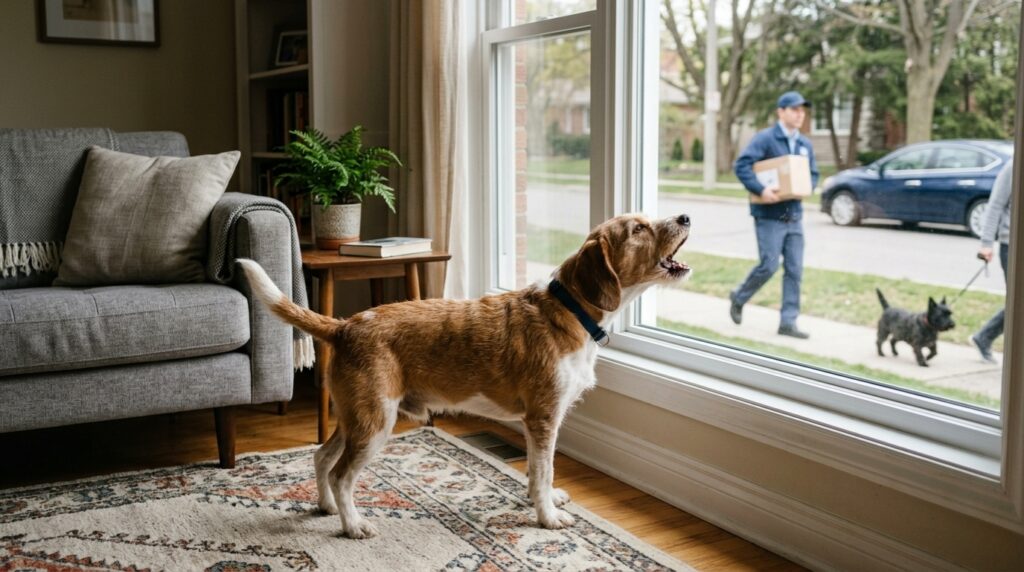
1. Alert Barking: “Something Is There”
Alert barking happens when your dog notices something and reacts.
Your dog may bark at:
- People passing the window
- Delivery workers
- Footsteps outside
- Dogs barking nearby
- Cars, bikes, leaves, wind, or distant sounds
- The TV or doorbell
To you, it may look like your dog is barking at nothing. But your dog may hear, see, or smell something you do not notice.
This can also become a habit. Your dog barks at a passerby. The person walks away. Over time, your dog may learn that barking happens before the trigger disappears.
That pattern can make window barking harder to change.
2. Demand Barking: “I Want Something”
Demand barking can happen when barking often gets a response.
Your dog may bark because they want:
- Food
- A toy
- Play
- A walk
- The door opened
- Attention
- You to stop working
This is why some dogs bark during Zoom calls or work-from-home hours. They may learn that barking makes you look, speak, move, or react.
ASPCA lists attention-seeking barking as barking used to gain attention or rewards such as food, toys, or play.
Before ignoring demand barking, check basic needs first: toilet, water, food timing, safety, and health.
3. Stress, Fear, or Frustration Barking
Some dog barking may be linked with stress, fear, anxiety, or frustration.
This may happen when your dog:
- Cannot reach another dog
- Sees people outside but cannot investigate
- Is left alone
- Hears sudden noises
- Feels trapped
- Gets overexcited
- Is confined and wants out
This does not mean every barking dog has anxiety.
But if barking is intense or comes with pacing, whining, shaking, scratching, hiding, destruction, or panic-like behavior, do not treat it as a simple obedience issue.
ASPCA notes that barking may be linked with illness, injury, separation anxiety, frustration, and socially facilitated barking. It also advises ruling out medical causes when barking may be linked with pain.
4. Boredom or Under-Stimulation Barking
Some dogs bark because they do not have enough to do.
This can happen when dogs have:
- Too little sniffing time
- Too little mental work
- Long indoor days
- Limited outdoor time
- No calm routine before busy work hours
In apartments, flats, smaller homes, or bad weather, barking triggers can feel worse because the dog spends more time indoors.
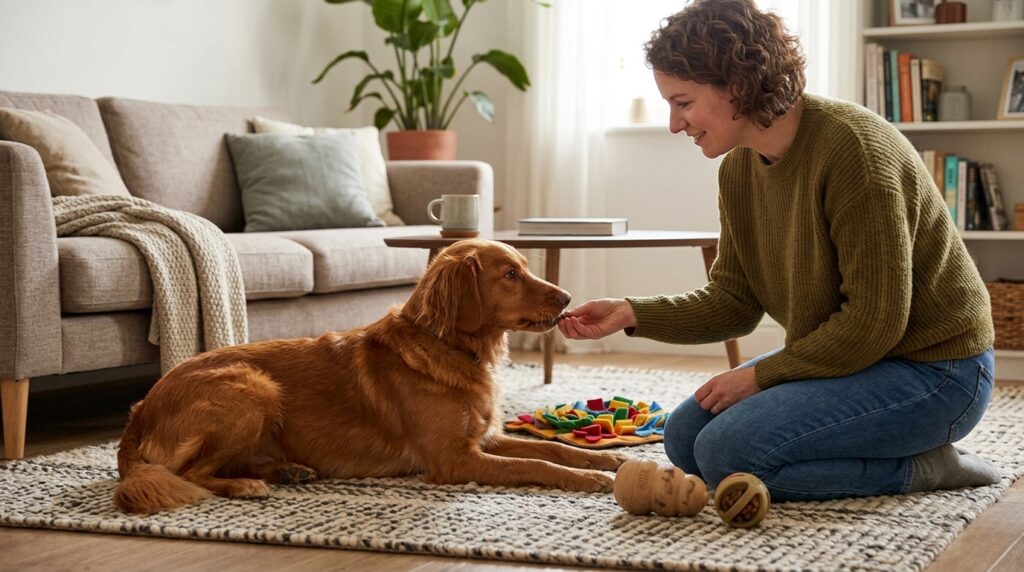
Food puzzles, snuffle mats, scent games, and short training games can help give the dog a better outlet. PDSA lists treat toys, snuffle mats, hide-and-seek, and slow feeders as ways to keep dogs occupied.
5. Group Barking in Multi-Dog Homes
In homes with more than one dog, one dog may start barking and the others may join.
The first dog may notice the trigger. The others may react to the excitement.
This is not just “bad behavior.” It is a chain reaction.
Watch which dog reacts first. Then manage that dog’s trigger before the barking spreads.
Real-World Scenarios
These are general owner-observed patterns. They are not diagnoses.
Real-World Scenario: Dog Barking at Nothing
Your dog barks at the same wall, window, or corner every night.
This could be linked to a repeated sound, smell, outside movement, routine, or learned habit.
What to check:
- Does it happen at the same time?
- Is there outside movement?
- Could there be pipes, neighbors, wildlife, or wind?
- Does your dog calm down when moved away from that spot?
Real-World Scenario: Dog Barking During Zoom Calls
Your work call starts. Your dog starts barking.
This may be attention-seeking, boredom, frustration, or routine confusion.
What to check:
- Does barking start when you talk?
- Does it stop when you give attention?
- Did your dog get a toilet break before the call?
- Did your dog get exercise or enrichment first?
- Does it happen only during work hours?
Real-World Scenario: Window Barking at Every Passerby
Your dog barks at every person, dog, bike, or delivery worker outside.
This may be alert barking. The habit can get stronger if your dog keeps practicing it every day.
What to check:
- Does barking happen mainly near windows?
- Does your dog rush to the same viewing spot?
- Does barking reduce when the view is blocked?
- Does barking happen more during busy street times?
Real-World Scenario: “I Need to Pee” vs. “I Want Attention”
Your dog barks near the door, but you are not sure what they want.
What to check:
- Has your dog recently been outside?
- Is your dog standing by the door?
- Is your dog pacing or sniffing?
- Does your dog ask again after a short toilet break?
- Does barking stop only when you give attention?
How to Reduce Constant Dog Barking
Step 1: Track the Barking Pattern
Do this before trying to fix everything.
For 3–5 days, write down:
- Time of day
- Location
- Possible trigger
- Your response
- How long the barking lasted
- What helped it stop
This helps you see whether the barking is linked to attention, windows, visitors, boredom, outdoor sounds, or being left alone.
Step 2: Manage the Trigger First
Training is harder if your dog keeps practicing the barking loop.
For window barking:
- Close blinds
- Use privacy film
- Move furniture away from the window
- Play soft background noise
- Create a calm resting spot away from the street view
For yard, garden, or balcony barking:
- Supervise outdoor time
- Bring your dog in before barking builds
- Use a leash if needed
- Avoid leaving your dog outside to bark for long periods
ASPCA recommends blocking a dog’s view of people and animals when territorial barking is triggered by what the dog sees outside.
Step 3: Teach a Replacement Behavior
Do not only tell your dog what to stop doing. Teach what to do instead.
Pick one simple behavior:
- Go to mat
- Sit
- Look at me
- Come away
- Find it
Practice when your dog is calm first.
Example:
- Say “find it.”
- Toss a few treats on the floor.
- Let your dog sniff and search.
- Repeat before barking becomes intense.
AKC explains that scent games can help dogs use their noses and stay mentally stimulated, even indoors.
Step 4: Avoid Rewarding Demand Barking by Accident
After checking safety, toilet needs, food, water, and health concerns, do not give the wanted reward while your dog is barking for attention.
Reward calm behavior instead.
If your dog barks for attention:
- Stay calm
- Avoid yelling
- Wait for a short quiet pause
- Reward the pause
- Teach a better request, like sitting or bringing a toy
If your dog barks during calls:
- Give a toilet break before the call
- Offer a safe chew or food puzzle
- Set up a calm spot nearby
- Reward quiet before barking starts
AKC also recommends waiting until the dog is quiet before giving what they want, then reinforcing the quiet behavior.
Step 5: Add Daily Mental Work
Mental work does not need to be complicated.
Try:
- Sniff walks
- Food puzzles
- Scatter feeding
- Short training games
- “Find it” games
- Calm chew time
- 3–5 minutes of basic cue practice
Use this when barking happens during quiet indoor time, work hours, bad weather, or long periods with little activity.
Step 6: Handle Multi-Dog Barking as a Group Pattern
If one dog starts and the others join, work with the first dog first.
Try this:
- Watch which dog reacts first
- Move that dog away from the trigger earlier
- Reward the calmer dog for staying quiet
- Train dogs separately before expecting group calm
- Use gates or separate resting areas if needed
Step 7: Use Calm Interruption, Not Punishment
Use a simple cue such as:
- “This way”
- “Come”
- “Find it”
- “Let’s go”
Then guide your dog away from the trigger and reward calm behavior.
Do not repeat the cue again and again. Say it once, help your dog move, then reward.
IAABC states that positive reinforcement should be the primary training strategy and says it carries the lowest risk of negative side effects such as fear or aggression. IAABC also opposes aversive methods involving pain, fear, or intimidation.
What Not to Do
Do Not Shout Over the Barking
Shouting can add excitement or stress. For some dogs, it may also count as attention.
VCA warns that yelling or punishing a dog barking from anxiety or territorial response may increase barking and anxiety.
Do Not Assume Your Dog Is Being Dominant
Barking is usually better understood through triggers, emotions, communication, or learned results.
Do Not Start With Harsh Corrections
Punishment may stop noise for a short time, but it does not teach your dog what to do instead.
It may also increase fear or stress in some dogs.
Do Not Let the Same Barking Loop Happen Every Day
If your dog barks out the window for long periods, the habit may get stronger.
Block the view, change the setup, and teach a replacement behavior.
Do Not Ignore Sudden Changes
If your dog suddenly barks more than usual, do not treat it as only a training issue.
RSPCA says that if barking increases or becomes excessive, it can be a sign that something is not right, and owners should check for health issues.
When to Contact a Vet or Qualified Trainer
Contact a veterinarian if barking:
- Starts suddenly
- Gets worse quickly
- Happens with signs of pain
- Happens with confusion or disorientation
- Comes with appetite changes
- Comes with sleep changes
- Appears as a new behavior in a senior dog
Merck Veterinary Manual lists disorientation, loss of housetraining, and changes in sleep patterns among signs linked with cognitive dysfunction in older dogs. This article cannot diagnose that. A vet check is the safer step if these signs appear.
Contact a qualified reward-based trainer or behavior professional if barking:
- Causes neighbor, landlord, council, or apartment complaints
- Happens around strangers, dogs, or visitors
- Is intense and hard to interrupt
- Happens when your dog is left alone
- Comes with lunging, snapping, or panic-like behavior
- Spreads through a multi-dog household
Quick Summary
Dogs bark because barking may communicate something, respond to a trigger, or get a result.
Common reasons include:
- Alert barking
- Demand barking
- Stress or frustration
- Boredom
- Group barking
- Learned habits
The best first step is to track the pattern. Then reduce the trigger, teach a replacement behavior, and reward calm choices before barking gets out of control.Back to Table of Contents
FAQs
Why do dogs bark so much?
Dogs may bark because they are alerting, asking for something, reacting to stress, feeling bored, responding to another dog, or repeating a learned habit.
Why does my dog bark at nothing?
Your dog may notice sounds, sights, smells, or movement that are not obvious to you. It may also be a learned habit linked to one place, time, or routine.
Is it okay to let a dog bark for a long time?
Letting a dog bark for long periods is usually not helpful. It may disturb neighbors and make the barking pattern harder to change. It is better to find the cause and guide your dog toward a calmer behavior.
Why does my dog bark during Zoom calls?
Your dog may want attention, feel bored, or feel frustrated because you are home but not available. Try a toilet break, a short activity, and a calm chew or food puzzle before the call starts.
Can some dogs bark more than others?
Yes. Some individual dogs and some breed types may be more vocal than others. But breed does not mean barking is impossible to improve. Setup, routine, training, and enrichment still matter.
How do I know if barking means my dog needs to pee?
Look at the full pattern. Door standing, pacing, sniffing, or barking after a long gap since the last toilet break may point to a toilet need. If your dog just went out and still barks at you, it may be attention, boredom, or another request.
How do I stop constant dog barking?
Start by tracking when and where it happens. Then reduce the trigger, teach a calm replacement behavior, and reward quiet before your dog gets too worked up. If the barking is sudden, intense, or linked with distress signs, speak with a vet or qualified reward-based professional.