
If your dog starts barking during work calls, while you eat, when you close the bathroom door, or when you sit down with your laptop, it can be hard to know what is really happening.
Are they asking for attention? Are they bored? Are they frustrated? Or are they struggling when you leave or close a door?
If you are trying to tell whether your dog is barking for attention or anxiety, the trigger before the bark matters more than the bark itself.
The difference matters. A demand barking dog may need clearer routines and calm-behavior training. A dog whose barking appears linked with fear, distress, or separation may need a slower plan and support from a veterinarian or qualified behavior professional.
Table of Contents
- Immediate Answer
- Why Dogs Bark
- 1. Your Dog Has Learned That Barking Works
- 2. Your Dog Struggles When You Are Present but Unavailable
- 3. Your Dog May Be Reacting to Leaving Cues
- 4. Your Dog May Be Bored or Under-Stimulated
- 5. Your Dog May Be Over-Aroused
- Attention Barking vs Anxiety-Related Barking
- What Owners Often Misunderstand
- Look at What Happens Before the Bark
- Common Owner Situations
- Step-by-Step Solutions
- Simple 5-Day Barking Pattern Plan
- What Not to Do
- When to Contact a Vet or Qualified Trainer
- Quick Summary
- FAQs
Immediate Answer
Your dog may be barking for attention if the barking usually happens when you are present but not paying attention.
This often happens during:
- Work calls
- Meals
- Sofa time
- Laptop time
- Conversations
- Times when you stop interacting with your dog
Your dog’s barking may be linked with separation-related distress if it happens when you leave, close a door, pick up keys, put on shoes, or move toward an exit.
The simple difference is this:
- Attention barking often asks: “Can I get something from you?”
- Distress-related barking may suggest: “I am struggling to cope with this situation.”
Why Dogs Bark
Barking is one way dogs communicate.
The AKC explains that barking can happen for many reasons, including alerting, excitement, boredom, frustration, fear, loneliness, and attention-seeking.
The hard part is not hearing the bark. The hard part is working out what the bark is doing for your dog.
Some dogs bark because they want:
- Attention
- Food
- Play
- Access to a room
- Movement from the owner
Other dogs bark because they may be:
- Worried
- Frustrated
- Startled
- Over-aroused
- Distressed when separated
1. Your Dog Has Learned That Barking Works
If your dog barks and you look at them, talk to them, toss food, open a door, or stop your call, barking may become a learned pattern.
This can happen by accident.
For example, your dog barks during a video call. You panic and give a treat so they stop. The barking stops for a moment, but next call, it happens again.
That does not mean your dog is “bad.” It means barking may have worked.
The Merck Veterinary Manual explains that behavior problems can involve previous learning, fear, anxiety, uncertainty, and environmental factors.
In simple terms, if barking repeatedly changes what the owner does, the dog may learn that barking is useful.
2. Your Dog Struggles When You Are Present but Unavailable
Some dogs cope well when the owner is moving around. But when the owner sits at a desk, joins a call, eats dinner, or looks at a screen, the dog may get frustrated.
Think of it as an invisible barrier.
You are home, but not available. To your dog, this can be confusing. They can see you and hear you, but they cannot get the usual response.
This pattern often appears as:
- Dog barking during work calls
- Barking when you open a laptop
- Barking when you sit on the sofa
- Barking while you eat
- Barking when you talk on the phone
If this sounds like your dog’s main pattern, you may also find this guide helpful: why your dog barks when you sit down or start working. It explains why laptop time, sofa time, and work calls can become barking triggers.
3. Your Dog May Be Reacting to Leaving Cues
Some barking starts before the owner leaves.
Common triggers include:
- Picking up keys
- Putting on shoes
- Grabbing a bag
- Closing a door
- Going into the bathroom or office
- Walking toward the front door
This barking may be linked with worry, barrier frustration, or a learned routine. It may also be excitement.
But if your dog becomes frantic, cannot settle, refuses food when alone, scratches doors, or damages exits, distress may be possible.
The AKC’s guidance on separation anxiety in dogs explains that separation-related problems can involve distress when a dog is left alone or separated from their person.
The Merck Veterinary Manual also notes that behavior problems may be connected with fear, anxiety, arousal, medical issues, or environmental events.
That is why sudden or intense barking should not automatically be treated as “bad behavior.”
4. Your Dog May Be Bored or Under-Stimulated
Boredom barking can look like attention barking.
A dog with too little sniffing, chewing, training, play, or rest may bark because they have energy and no better outlet.
The ASPCA recommends enrichment activities that let dogs use natural behaviors such as smelling, chewing, searching, and problem-solving.
Dogs Trust also explains that enrichment can help prevent boredom and give dogs appropriate ways to sniff, chew, search, and use energy.
This may be more noticeable in:
- Small homes
- Busy work-from-home routines
- Apartment living
- Rainy days
- Days when walks, play, or rest are disrupted
If your dog has had no real outlet all morning, barking during your work call may not be “random.” It may be the moment their unused energy finally comes out.
5. Your Dog May Be Over-Aroused
Some dogs bark during transitions.
For example:
- Before walks
- Before meals
- When guests arrive
- When the owner stands up
- When the laptop closes
- When the workday ends
This can look like happy barking. But excitement can still become a problem if the dog cannot settle again.
Look at the whole body, not one signal.
A dog who is loose, able to disengage, and easy to redirect is different from a dog who is stiff, frantic, pacing, or unable to calm down.
Attention Barking vs Anxiety-Related Barking
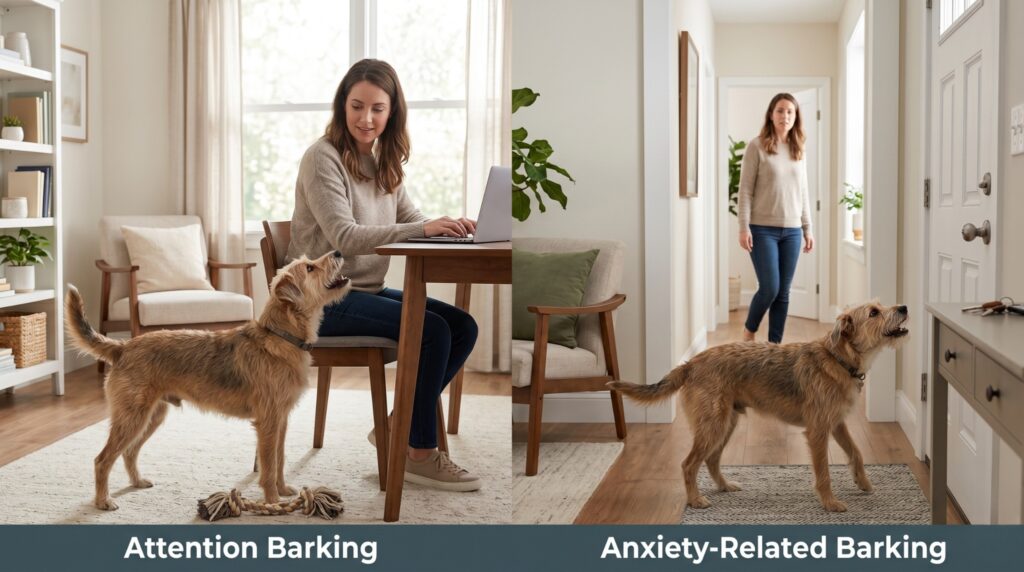
Attention Barking Often Looks Like This
Your dog may:
- Bark while looking at you
- Bring toys, paw, jump, or nudge
- Stop when you respond
- Bark when you eat, work, talk, or sit down
- Seem calm once they get what they want
- Repeat the barking because it has worked before
This is often what owners mean by a demand barking dog. The dog is usually trying to make something happen. They may want food, play, movement, access, or interaction.
Barking That May Be Linked With Anxiety or Distress
Your dog may:
- Bark when you leave or close a door
- Pace, pant, whine, or tremble
- Scratch doors or chew exits
- Refuse food when alone
- Bark before you leave, not just after
- React strongly to keys, shoes, coats, or bags
- Take a long time to calm down
This does not prove anxiety. It may suggest distress, fear, frustration, separation-related difficulty, or another issue that needs a slower plan.
This is why “just ignore it” is not always safe advice.
What Owners Often Misunderstand
Many owners think the choice is simple: ignore the barking or reward quiet.
But the right response depends on the cause.
Ignoring may help some attention barking, but it is not a safe universal plan. If the dog is panicking, frightened, in pain, confused, or unable to cope, ignoring may make the situation worse.
On the other hand, giving treats, food, or attention every time the dog barks for attention can teach the dog to bark more.
The goal is not to punish the bark. The goal is to understand the pattern before choosing the plan.
Look at What Happens Before the Bark
Do not focus only on the barking. Look at the 30 seconds before it starts.
Ask:
- Did I sit down?
- Did I open my laptop?
- Did I start speaking on a call?
- Did I pick up keys?
- Did I close a door?
- Did I stop interacting with my dog?
- Did a sound happen outside?
- Did my dog miss a walk, meal, nap, or toilet break?
The trigger often tells you more than the bark.
Common Owner Situations
Dog Barks During Work Calls
An owner notices their dog is quiet most of the morning, but starts barking when the owner joins video calls.
This may point to attention barking, frustration, or a learned routine. The dog may have learned that barking during calls gets a fast response because the owner feels pressure to stop the noise.
In this case, the solution is not to wait until the dog is already barking. The better plan is to prepare before the call starts.
Dog Barks When the Bathroom Door Closes
An owner notices their dog follows them around the home and barks when a door separates them.
This could point to barrier frustration, attention-seeking, or separation-related distress.
The wider pattern matters. If the dog also panics when left alone, refuses food, damages doors, or cannot settle, a slower plan may be needed.
Dog Barks When the Owner Picks Up Keys
An owner notices their dog starts barking before the owner leaves.
This may be linked with leaving cues. The barking is not always simple excitement. It may also be linked with worry, routine prediction, or stress around separation.
If your dog becomes tense as soon as you touch keys, shoes, or a bag, the cue itself may have become stressful.
Dog Barks While the Owner Eats
An owner notices their dog barks at the table and stops when given food.
This is more likely to be attention or demand barking, especially if barking near meals has worked before.
In this case, feeding from the table after barking may accidentally teach: “When I bark, food appears.”
A better plan is to reward calm behavior before the meal starts.
Step-by-Step Solutions
Step 1: Track the Barking Pattern
What to do: Write down when the barking happens.
How to do it: For 3–5 days, note:
- Time of day
- What happened right before barking
- Where you were
- Where your dog was
- What stopped the barking
- Whether your dog seemed calm or distressed
When to apply it: Use this before choosing a plan. It helps you avoid treating distress like demand barking, or demand barking like distress.
Step 2: Stop Rewarding Attention Barking by Accident
What to do: After checking safety, toilet needs, hunger, and health concerns, avoid giving attention, food, play, or movement after attention-based barking.
How to do it: If your dog barks at you for attention and seems otherwise calm, pause.
Avoid:
- Talking
- Staring
- Touching
- Tossing food
- Opening the door immediately
- Starting play during the bark
Wait for a short quiet moment. Then reward the quiet behavior with calm attention, a treat, or a cue such as “go to mat.”
The AKC’s barking guidance also emphasizes rewarding quiet behavior instead of reacting only to the bark.
When to apply it: Use this when barking happens while you are present and your dog seems to be trying to get a response from you.
Do not use this as the only plan if your dog seems panicked, destructive, confused, in pain, or unable to settle.
Step 3: Teach a Work Call Routine
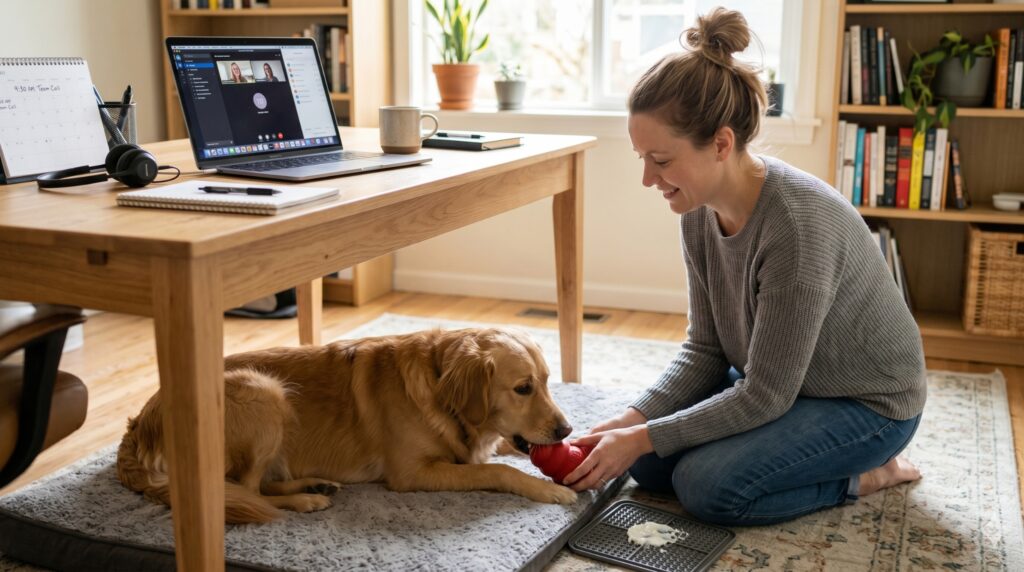
What to do: Give your dog a predictable job during work calls.
How to do it: Before the call starts:
- Offer a toilet break if needed
- Use a short sniff walk if appropriate
- Set up a mat, bed, chew, lick mat, or food puzzle
- Cue your dog to go to the mat
- Reward calm behavior before barking starts
- Keep your voice and body calm
The ASPCA’s canine enrichment ideas and Dogs Trust enrichment activities both support using safe enrichment to give dogs appropriate mental outlets.
When to apply it: Use this before meetings, laptop time, focused work, or any regular barking trigger.
The key is timing. Reward calm behavior before the barking begins, not after barking forces your attention.
Step 4: Build Door and Separation Tolerance Slowly
What to do: Practice short, calm separations before your dog reaches panic level.
How to do it: Start with tiny steps:
- Touch the door handle, then return
- Open and close the door without leaving
- Step behind the door for one second
- Return calmly
- Increase only if your dog stays relaxed
Do not jump from “one second behind the door” to “leaving for 30 minutes.” That is too big for many dogs.
When to apply it: Use this if barking happens when doors close, when you leave the room, or when your dog sees leaving cues.
If barking is intense, or your dog harms themselves or damages doors, speak with a veterinarian or qualified behavior professional.
Step 5: Give Better Outlets Before Problem Times
What to do: Meet your dog’s basic needs before high-risk barking moments.
How to do it: Use simple outlets:
- Sniff walk
- Safe chew
- Food puzzle
- Short training game
- Calm play
- Rest break in a quiet space
The ASPCA enrichment guide includes food puzzles and scent-based activities, while Dogs Trust explains that enrichment lets dogs use natural instincts such as sniffing and chewing.
When to apply it: Use this before:
- Work calls
- Meal times
- Crate time
- Night settling
- Leaving the house
- Long laptop sessions
This works best as prevention. It is less useful once your dog is already barking hard.
Step 6: Reward Calm Behavior You Want Repeated
What to do: Notice and reward quiet moments.
How to do it: When your dog lies down, watches calmly, chooses their bed, or stays quiet during a trigger, reward softly.
You can use:
- A small treat
- Calm praise
- Gentle attention
- A chew or puzzle
- Release to play after calm behavior
The Merck Veterinary Manual’s behavior modification overview discusses behavior-change methods such as reinforcement, shaping, desensitization, and counterconditioning.
When to apply it: Use this throughout the day, especially during times your dog usually barks.
Dogs repeat behavior that works. Make calm behavior work too.
Simple 5-Day Barking Pattern Plan
Day 1: Track the Barking
Write down every barking episode. Focus on what happened 30 seconds before the barking started.
Do not try to solve everything on the first day. Just collect the pattern.
Day 2: Separate the Barking Into Two Groups
Put each episode into one of these groups:
- Group 1: Barking when you are present but unavailable. Examples: laptop time, work calls, meals, sofa time.
- Group 2: Barking around doors, exits, or leaving cues. Examples: keys, shoes, bags, bathroom door, office door, front door.
This helps you see whether the barking looks more like attention, frustration, separation-related distress, or a mix.
Day 3: Stop Accidentally Rewarding Attention Barking
For barking that looks attention-based, stop giving the reward during the bark.
Do not talk, stare, toss food, or start play while the barking is happening.
Wait for a small quiet moment. Then reward calm behavior. Keep it calm and boring.
Day 4: Set Up a Routine Before the Trigger
Choose one common trigger.
For example:
- Work call
- Dinner time
- Laptop time
- Bathroom door closing
Before the trigger starts, give your dog a clear routine. Use a mat, chew, food puzzle, lick mat, or calm settle cue.
Reward before barking begins.
Day 5: Practice Tiny Door or Leaving-Cue Steps
If your dog barks around doors or leaving cues, practice very small steps.
For example:
- Touch keys, then put them down
- Touch the door handle, then return
- Open the door, close it, and stay inside
- Step behind the door for one second
Only increase if your dog stays relaxed.
If your dog panics, damages doors, refuses food when alone, or cannot settle, contact a veterinarian or qualified behavior professional.
What Not to Do
Do Not Assume All Barking Is Manipulation
A dog barking from distress is not trying to annoy you. They may be struggling with the situation.
Calling it “manipulation” can make owners choose the wrong plan.
Do Not Use “Bark It Out” for Every Barking Problem
Ignoring can help some attention barking. But it is not a universal solution.
If the dog is distressed, ignoring may increase panic or frustration.
Do Not Yell Over the Barking
Yelling adds more noise. Some dogs may see it as attention. Others may become more stressed.
If barking already comes from fear, frustration, or over-arousal, yelling can make the emotional state worse.
Do Not Punish Fear-Based Barking
Punishment may stop the sound in the moment, but it does not teach the dog what to do instead.
The Merck Veterinary Manual’s behavior modification guidance explains that behavior change often involves approaches such as reinforcement, desensitization, and counterconditioning rather than confrontation.
Punishment-based methods can also be risky when barking is linked with fear, anxiety, or distress.
Do Not Rely Only on Quick Fixes
Anti-bark gadgets, corrections, or distractions may interrupt barking. But they may not address the trigger behind it.
Focus on the pattern:
- What happens before the bark
- What your dog does during it
- What happens after
- What your dog learns from the result
When to Contact a Vet or Qualified Trainer
Speak with a veterinarian if your dog’s barking starts suddenly, gets worse, or appears with:
- Pain signs
- Confusion
- Appetite changes
- Disorientation
- Restlessness at night
- Sudden fearfulness
- New sensitivity to sound or touch
The Merck Veterinary Manual explains that behavior problems can be influenced by medical issues, fear, anxiety, arousal, learning, and environmental events.
That is why sudden behavior changes should be checked carefully.
Consider a qualified trainer or behavior professional if your dog:
- Barks when left alone
- Damages doors, crates, or windows
- Cannot settle after you leave
- Barks during every work call
- Causes neighbor complaints
- Seems panicked behind closed doors
- Has a history of severe fear
Look for a professional who uses reward-based methods and looks at triggers, timing, body language, and what happens after the bark.
Quick Summary
- Your dog may be barking for attention if they bark when you are present but unavailable, such as during laptop time, meals, or calls.
- Your dog’s barking may be linked with distress if it happens around leaving, closed doors, pacing, panic, or an inability to settle.
- To stop dog barking for attention, avoid rewarding barking by accident, teach a calm routine, and reward quiet behavior before barking starts.
- If the barking is sudden, intense, or linked with distress, speak with a veterinarian or qualified behavior professional.
FAQs
Why does my dog bark during work calls?
Your dog may have learned that barking during calls gets a fast response. It may also happen because you are home but unavailable.
Set up a call routine before the meeting starts. Use a toilet break, mat, chew, food puzzle, or calm settle cue before your dog starts barking.
Is demand barking the same as anxiety barking?
No. Demand barking usually asks for attention, food, play, or access. Anxiety-related barking may be linked with fear, separation, or distress.
The trigger before the bark usually gives the clearest clue.
Should I ignore my dog when they bark for attention?
Sometimes, but only if the dog is not distressed and their needs have been checked.
Wait for a quiet moment, then reward calm behavior. Do not ignore barking that looks like panic, pain, confusion, or fear.
Does a wagging tail mean my dog is happy?
Not always. Look at the whole body, not just the tail.
Loose, relaxed movement is different from stiff, frantic, tense, or unable-to-settle behavior.
How do I stop my dog barking when I leave the room?
Start with very short door practice. Touch the door, open it, close it, step away for one second, and return calmly.
Build slowly. Get help if your dog panics, damages things, refuses food when alone, or cannot settle.