
Your dog barks, and you are left guessing.
Are they scared? Bored? Asking for attention? Warning you about a sound? Or reacting to something you cannot see?
The fastest way to understand barking is not to judge the sound alone. Look at the full pattern: what triggered the bark, what your dog’s body looked like, when it happened, and what happened right after.
Barking is a normal way dogs communicate. PDSA explains that barking is a normal behavior for many dogs and is often used to communicate. RSPCA also notes that dogs may bark because they want food, play, attention, or support from their owner.
Different types of dog barking need different responses. Alarm barking, demand barking, boredom barking, fear barking, and play barking can look similar at first, but the reason behind them can be very different.
Table of Contents
- Immediate Answer
- Why Dogs Bark
- Owner-Reported Barking Patterns We See Often
- Main Types of Dog Barking
- How to Tell Similar Barks Apart
- Real-World Barking Scenarios
- 7-Day Barking Decoder Plan
- Step-by-Step Solutions
- Practical Barking Response Table
- What Not to Do
- When to Contact a Vet or Qualified Trainer
- Quick Summary
- FAQs
Immediate Answer
The main types of dog barking include:
| Type of Barking | Common Trigger | What It May Look Like | Best First Response |
|---|---|---|---|
| Alarm barking | Strangers, cars, hallway sounds, delivery drivers, outside movement | Fast, sharp, intense barking; dog rushes to window, door, or fence | Reduce the trigger and guide your dog away calmly |
| Alert barking | A small change in the environment | One or two short barks | Acknowledge calmly and reward settling |
| Demand barking | Food, play, attention, access, or interaction | Dog barks at you directly, stares, paws, jumps, or repeats barking | Check needs first, then reward quiet behavior |
| Boredom barking | Lack of activity, mental work, or interaction | Repetitive barking, often during low-stimulation times | Add sniffing, chewing, training, food toys, or play |
| Fear or stress barking | People, dogs, noises, objects, or situations that feel scary | Stiff body, backing away, hiding, lip licking, pacing, tense tail | Increase distance and lower pressure |
| Play barking | Excitement during play | Loose body, bouncy movement, play bows, short bursts of noise | Allow play if both dogs look relaxed and willing |
The sound matters, but the full picture matters more.
Ask:
- What happened right before the barking?
- What did my dog’s body look like?
- Did the barking make something happen?
- Is this sudden, repeated, or getting worse?
Why Dogs Bark
Dogs bark for many reasons.
A bark may mean:
- “I noticed something.”
- “I want something.”
- “I am worried.”
- “I need space.”
- “I am bored.”
- “Something changed.”
- “Pay attention to me.”
- “I do not feel safe.”
A common mistake is treating all barking as disobedience. Barking is easier to understand when you ask:
What is this barking doing for my dog right now?
Does barking get attention? Does it make a stranger move away? Does it bring food, play, or access? Does it happen when your dog has too little to do?
That answer helps you choose the right response.
Owner-Reported Barking Patterns We See Often
Many barking problems do not fit neatly into one category. Owners often describe mixed patterns, such as:
- A dog barking at the same wall, ceiling, or corner every night.
- A dog barking when the owner finally sits down after work.
- A dog barking during work-from-home calls.
- A dog barking at apartment hallway footsteps, elevator dings, or door slams.
- A dog barking at delivery drivers, mail carriers, or people passing the window.
- A dog barking more in the early evening after a low-activity day.
- A senior dog suddenly barking at night or seeming confused.
These patterns matter because they give clues.
A dog barking at your face while you eat may be demand barking. A dog barking at the door after waking from a nap may need the toilet. A dog barking at a hallway sound with a stiff body may be alarm or fear-related barking.
The goal is not just to stop the noise. The goal is to understand the pattern behind it.
Main Types of Dog Barking
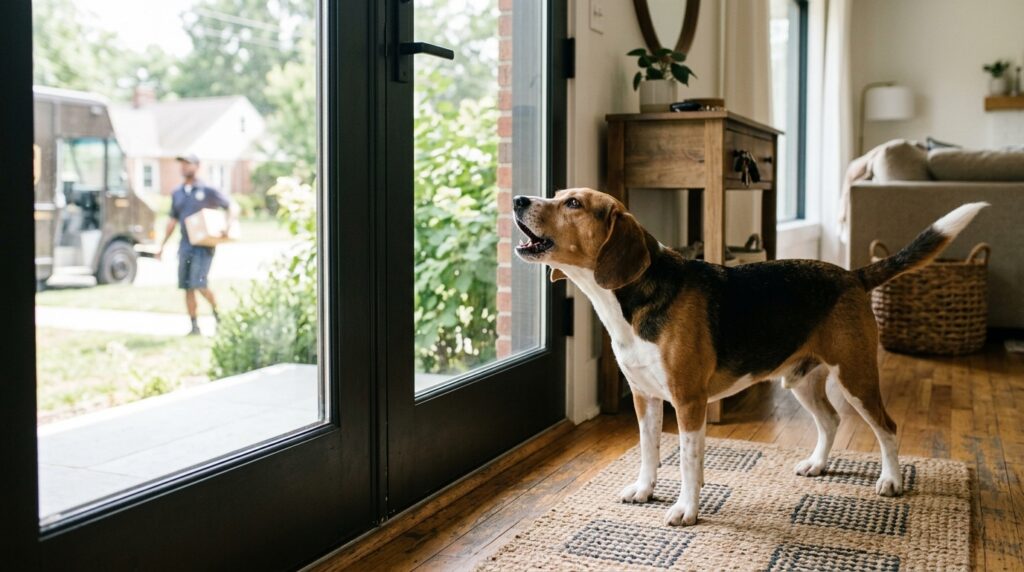
1. Alarm Barking
Alarm barking often happens when your dog notices a possible threat, sudden sound, or change in the environment.
Common triggers include:
- Someone walking past the window
- A delivery driver
- Apartment or flat hallway sounds
- Passing cars
- Yard or garden movement
- Another dog barking
- Night sounds outside
- Doorbells, knocking, or gates
- Neighbors moving upstairs or outside
Alarm barking is often fast, sharp, and intense. Your dog may rush toward the door, window, fence, balcony, or sound source.
This type of barking can feel urgent because it may affect sleep, neighbors, apartment living, or shared-wall homes.
The ASPCA barking guide explains that if dogs are allowed to repeatedly practice excessive alarm barking, the behavior can become stronger and harder to reduce.
What to do first
Do not start by yelling. First, reduce the trigger.
Try:
- Close curtains or blinds.
- Use privacy film on windows.
- Move your dog’s bed away from the door or window.
- Use background sound for hallway noise.
- Calmly guide your dog away from the trigger.
- Reward your dog when they notice a sound but stay calm.
The goal is to stop your dog from rehearsing the same barking pattern again and again.
2. Alert Barking
Alert barking is usually shorter than alarm barking.
It may sound like:
- One sharp bark
- Two quick barks
- A short “woof”
- A brief bark when something changes
Your dog may simply be saying, “I noticed something.”
A few alert barks can be normal. The issue starts when your dog cannot settle after noticing something.
Example
Your dog gives two barks when someone walks past the house. That may be alert barking.
Your dog barks at the window for several minutes and cannot settle. That is closer to alarm barking.
What to do first
Stay calm. Acknowledge the sound briefly, then redirect your dog.
For example:
“Thanks, come away.”
Then reward them for moving away, settling, or looking back at you.
3. Demand Barking
Demand barking is usually directed at you.
Your dog may bark when you:
- Sit down
- Open the fridge
- Work at your desk
- Watch TV
- Stop playing
- Hold food
- Hold a toy
- Talk on the phone
- Ignore them
- Prepare their leash
- Eat your own meal
This is where many owners struggle.
The question is often:
Is this attention-seeking, or does my dog really need something?
Before calling it demand barking, check basic needs.
Ask:
- Do they need the toilet?
- Do they have water?
- Have they eaten on schedule?
- Are they physically comfortable?
- Are they tired or overstimulated?
- Is there a real trigger nearby?
- Has their routine changed?
If those needs are met and barking keeps getting results, it can become a learned pattern.
VCA Hospitals notes that some owners accidentally encourage barking by responding with attention, play, food, or affection.
What to do first
Do not reward active demand barking with the exact thing your dog is demanding.
Instead:
- Check basic needs.
- Wait for even one second of quiet.
- Reward the quiet moment.
- Ask for an easy behavior, such as “sit” or “go to mat.”
- Give attention before barking starts next time.
Do not wait until your dog is frantic. Reward calm behavior early.
4. Boredom Barking
Boredom barking often sounds repetitive. It may happen when your dog has energy but no clear outlet.
Common times include:
- While the owner works from home
- During video calls
- In the early evening
- After a low-activity day
- When the dog has been indoors too long
- When the dog is alone in a room
- When the dog is left in a yard or garden
- When the dog has had exercise but no mental stimulation
Boredom barking is better treated as a routine and enrichment problem, not a character problem.
A dog may have had a walk but still need mental work. Many dogs also need sniffing, chewing, problem-solving, and calm activities to settle well.
PDSA explains that dogs may bark to communicate, greet, play, warn, or respond to something they are experiencing.
Helpful outlets
Try:
- Sniff-focused walks
- Food puzzles
- Safe chews
- Scatter feeding
- “Find it” games
- Short training sessions
- Scent games
- Calm mat training
- Lick mats
- Planned play before work or TV time
What to do first
Add one structured outlet before the barking usually starts.
For example, if your dog barks every evening at 7 PM, give them a sniff walk, food toy, chew, or short training session at 6:30 PM.
Preventing boredom barking is usually easier than interrupting it once it starts.
5. Fear or Stress Barking
Fear or stress barking can look loud and intense from the outside. But the dog may not be trying to be “bad.” They may be trying to create distance from something scary.
Possible signs of fear or stress barking include:
- Stiff body
- Tail tucked
- Tail very high and tense
- Ears pinned back
- Backing away
- Hiding
- Pacing
- Lip licking
- Yawning when not tired
- Panting when not hot
- Whale eye
- Barking that gets worse as the trigger gets closer
- Refusing food near the trigger
- Trying to escape
MSD Veterinary Manual lists vocalization, low body posture, yawning, and lip licking among behavioral signs that may appear with fear and anxiety in dogs.
If barking comes with fear signs, your dog may need distance before they can learn a calmer response.
What to do first
Do not force your dog closer to the trigger.
Instead:
- Move away from the person, dog, sound, or object.
- Lower the pressure.
- Reward from a distance where your dog can still eat and respond.
- Calmly praise when they notice the trigger without barking.
- Leave the area if barking escalates.
If your dog looks scared, safety and distance come before training.
6. Play Barking
Some dogs bark during play. This may include excited yips, short bursts of barking, or growl-barks.
Play barking often comes with:
- Loose body
- Bouncy movement
- Play bows
- Wiggly body
- Taking turns
- Pauses
- Soft face
- Coming back for more play
A growl-bark during play is not automatically aggression. Body language matters.
When to pause play
Pause the play if one dog:
- Becomes stiff
- Keeps trying to leave
- Hides
- Tucks their tail
- Turns away repeatedly
- Cannot take breaks
- Pins, chases, or overwhelms the other dog
- Keeps barking while the other dog avoids them
Good play has pauses, consent, and loose movement.
How to Tell Similar Barks Apart
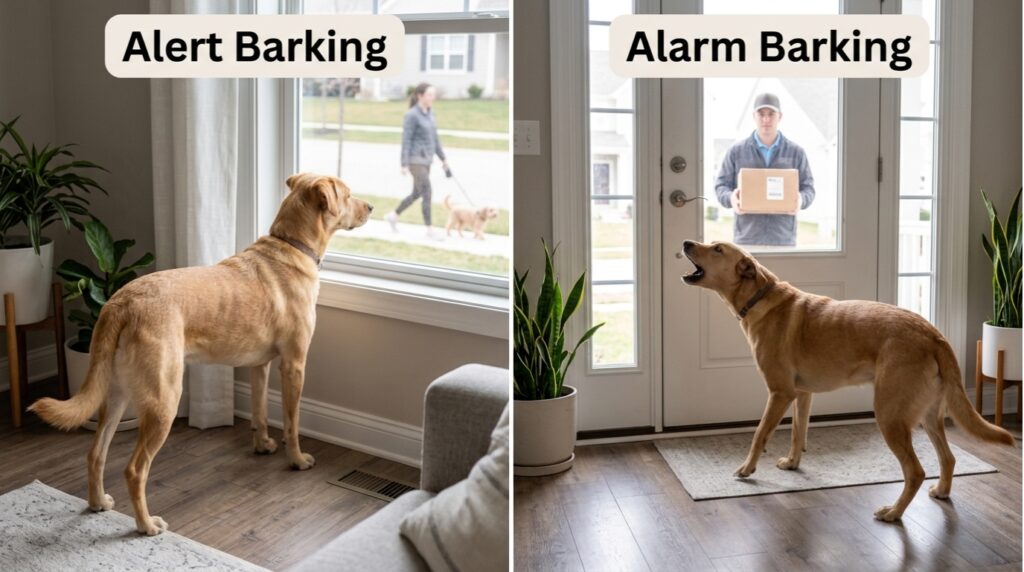
Alarm Barking vs. Alert Barking
Alert barking is usually brief. Alarm barking is more intense and harder to interrupt.
| Question | Alert Barking | Alarm Barking |
|---|---|---|
| How long does it last? | One or two barks | Several seconds or minutes |
| Can your dog settle? | Usually yes | Often difficult |
| Body language | Interested but not frantic | Tense, rushing, intense |
| Common trigger | Small change | Stranger, noise, movement, threat-like trigger |
| Best response | Acknowledge and redirect | Reduce trigger and guide away |
Example: Two barks when someone passes the house may be alert barking. Repeated barking at the window until the person disappears may be alarm barking.
Demand Barking vs. Genuine Need
A dog may bark because they want attention. They may also bark because they need the toilet, water, food, comfort, or help.
Check the basics first:
- Have they had a toilet break?
- Do they have water?
- Have they eaten on schedule?
- Are they physically comfortable?
- Is there a real trigger nearby?
- Has their routine changed?
- Are they showing pain, confusion, or distress?
The same bark can mean different things depending on timing.
A bark at the door after a nap may mean “I need the toilet.” A bark at your face while you eat may be demand barking.
Boredom Barking vs. Distress When Alone
Boredom barking may improve when your dog’s day includes suitable exercise, sniffing, chewing, training, and mental work.
Barking when alone may be more concerning if it appears with distress signs.
Possible distress signs include:
- Pacing
- Drooling
- Destruction near doors or windows
- Barking or howling only when left alone
- Trying to escape
- Trouble settling when separated from you
- Panic-like behavior
- Accidents when left alone
ASPCA explains that dogs with separation anxiety may bark or howl when left alone or separated from their guardian, and that this barking is persistent and not usually triggered by anything except being alone.
Do not diagnose separation anxiety from barking alone. But if barking is intense, sudden, or linked with distress, speak with a veterinarian or qualified behavior professional.
Real-World Barking Scenarios
Scenario 1: Dog Barking at “Nothing”
An owner notices their dog barking at the same wall every night.
It may look like the dog is barking at nothing, but there may be a hidden trigger.
Possible causes include:
- Pipes
- Vents
- Appliances
- Pests in walls
- Outdoor wildlife
- Reflections
- Neighbor noise
- A learned attention pattern
- A repeated nighttime routine
What to check:
- Is there a pipe, vent, or appliance nearby?
- Does it happen at the same time each night?
- Is there wildlife outside?
- Does your dog settle if moved away from the area?
- Does barking usually lead to attention?
- Is the barking sudden or unusual?
For a deeper breakdown, read our guide: Why Do Dogs Bark at Nothing? Hidden Triggers Owners Often Miss.
Scenario 2: Dog Barking When the Owner Sits Down
An owner sits on the sofa, and the dog starts barking directly at them.
This may be:
- Demand barking
- Boredom barking
- Evening restlessness
- An unmet need
- A learned routine
What to check:
- Did the dog get enough activity today?
- Do they need the toilet?
- Are they asking for food, play, or attention?
- Does barking usually make the owner respond?
- Does this happen at the same time every day?
Better response: Instead of reacting only after barking starts, give your dog a planned outlet before your usual sit-down time. Try a chew, food toy, short training game, or sniff walk before TV time.
Scenario 3: Dog Barking at Hallway Sounds
A dog barks every time someone walks past the apartment or flat door.
This may be alert barking, alarm barking, or fear-related barking.
Common triggers include:
- Footsteps
- Elevator sounds
- Door slams
- Neighbor voices
- Keys
- Deliveries
- Other dogs in the hallway
What to check:
- Can the dog hear footsteps clearly?
- Is the dog resting near the front door?
- Does barking happen more at night?
- Are stairs, lifts, or deliveries a trigger?
- Can your dog settle after one or two barks?
Better response: Move your dog’s resting area away from the front door. Use background sound if needed. Reward your dog for noticing sounds and staying calm.
If your dog seems to bark at empty hallways, walls, or sounds you cannot hear, read our guide on why dogs bark at nothing.
Scenario 4: Growl-Bark During Play
An owner hears a growl-bark during play and worries it is aggression.
It may be normal play noise if:
- The body is loose
- Movements are bouncy
- Both dogs keep choosing to play
- There are pauses
- Both dogs take turns
- Neither dog is trying hard to escape
Pause the play if one dog looks stiff, hides, tucks their tail, keeps turning away, or cannot take breaks.
Scenario 5: Sudden Barking at Night
A dog who usually sleeps quietly suddenly starts barking at night.
Possible causes include:
- Wildlife outside
- New sounds
- Pain or discomfort
- Needing the toilet
- Anxiety
- Routine change
- Senior dog confusion
- A learned barking pattern
Sudden night barking deserves extra caution, especially in senior dogs or dogs showing confusion, restlessness, appetite changes, sleep changes, or disorientation.
MSD Veterinary Manual’s medical causes table lists signs such as altered response to stimuli, confusion, disorientation, altered sleep cycles, irritability, vocalization, and house soiling as possible behavior-related warning signs.
For more help with this situation, read: Why Is My Dog Barking at Night All of a Sudden? Behavior vs Health Signals.
7-Day Barking Decoder Plan
Use this simple plan before deciding your dog is “just being difficult.”
Day 1: Track the Pattern
Write down:
- Time
- Location
- Trigger
- Barking style
- Body language
- What you did
- What happened next
Do not try to solve everything yet. Just observe.
Day 2: Watch Body Language
Note whether your dog looks loose, excited, stiff, scared, frustrated, tired, restless, or unable to settle.
Body language often tells you more than the sound of the bark.
Day 3: Check Basic Needs
Before assuming demand barking, check toilet needs, water, food schedule, pain or discomfort signs, rest, temperature, noise, and routine changes.
Some barking that looks attention-seeking may be linked with a real need.
Day 4: Reduce One Repeat Trigger
Choose one trigger to reduce.
Examples:
- Close curtains
- Add privacy film
- Move the bed away from the window
- Use background sound
- Block access to the front door
- Move your dog away from the fence line
Reducing rehearsal helps your dog learn a new pattern.
Day 5: Add One Better Outlet
Choose one daily enrichment activity.
Try a sniff walk, food puzzle, safe chew, scatter feeding, “find it” game, short training session, lick mat, or scent game.
Match the outlet to the need. A bored dog often needs mental work. A worried dog often needs distance and safety.
Day 6: Reward Quiet Before Barking Starts
Do not wait for barking to explode.
Reward calm moments early:
- Lying down quietly
- Looking at a sound without barking
- Coming away from the window
- Settling on a mat
- Choosing a chew
- Staying calm while you work
Quiet behavior needs reinforcement too.
Day 7: Review the Pattern
Look at your notes.
Ask:
- What type of barking is most common?
- What trigger appears again and again?
- What response made barking worse?
- What response helped?
- Is the barking sudden, intense, or linked with distress?
- Do I need help from a vet or qualified trainer?
If barking is sudden, fear-based, linked with being alone, or affecting safety, get professional support.
Step-by-Step Solutions
1. Identify the Barking Pattern
What to do: Track when, where, and why the barking happens.
How to do it: For 3–5 days, write down time of day, location, trigger, barking style, body language, what you did, and what happened next.
When to apply it: Use this when you cannot tell whether the barking is alarm, boredom, fear, stress, or demand barking.
Pattern tracking helps you stop guessing.
2. Check Needs Before Assuming “Bad Behavior”
What to do: Rule out simple needs first.
How to do it: Check toilet needs, water, meal timing, pain or discomfort signs, rest needs, heat or cold, noise, and sudden routine changes.
When to apply it: Use this when your dog barks at you, especially near doors, after waking, after meals, at night, or during routine changes.
3. Reduce Alarm Barking Triggers
What to do: Make it harder for your dog to rehearse barking at repeat triggers.
How to do it:
- Block window views with curtains, blinds, or privacy film.
- Move your dog’s bed away from the front door or window.
- Use background sound if hallway or street noise is a trigger.
- Reward your dog when they notice a sound and stay calm.
- Teach a simple cue like “settle,” then calmly guide them away.
When to apply it: Use this for barking at strangers, cars, neighbors, delivery drivers, apartment hallways, flats, yards, or gardens.
The goal is not to punish the bark. The goal is to reduce the trigger and teach a calmer pattern.
4. Handle Demand Barking Without Accidentally Rewarding It
What to do: After checking basic needs and safety, avoid giving the wanted item during active attention-based barking. Reward quiet behavior quickly.
How to do it:
- Check basic needs first.
- If needs are met, pause.
- Avoid feeding the barking with attention.
- Wait for a brief quiet moment.
- Reward the quiet moment.
- Ask for an easy behavior, such as “sit” or “go to mat.”
- Give attention before barking starts next time.
When to apply it: Use this when your dog barks at you for food, play, attention, or access.
Do not wait until the dog is frantic. Reward calm behavior early.
5. Give Boredom Barking a Better Outlet
What to do: Replace barking with an activity that meets the same need.
How to do it:
- A sniff-focused walk
- A food puzzle
- A safe chew
- A short training session
- Scatter feeding
- “Find it” games
- Calm mat training
- A planned play session before work or TV time
When to apply it: Use this during work calls, evening restlessness, indoor boredom, or repeated barking when no clear trigger is present.
Boredom barking often needs structure, not just “quiet.”
6. Give Fear Barking More Distance
What to do: Increase distance from the trigger and lower pressure.
How to do it:
- Move your dog away from the person, dog, sound, or object.
- Avoid forcing them closer.
- Reward from a distance where your dog can still eat and respond.
- Use calm praise when they look at the trigger without barking.
- Leave the area if barking escalates.
When to apply it: Use this when barking comes with stiff posture, backing away, hiding, pacing, or panic-like behavior.
If your dog looks scared, safety and distance come before training.
Practical Barking Response Table
| Situation | Likely Barking Type | What to Check | First Response |
|---|---|---|---|
| Dog barks at the window | Alarm barking | People, cars, animals, reflections | Block view and reward coming away |
| Dog barks at you while you eat | Demand barking | Food schedule, attention pattern | Check needs, then reward quiet |
| Dog barks during work calls | Boredom or demand barking | Activity level, learned attention pattern | Give outlet before calls |
| Dog barks at hallway footsteps | Alert or alarm barking | Door location, neighbor noise | Move resting area and use background sound |
| Dog barks at “nothing” at night | Hidden trigger or sudden change | Pipes, pests, wildlife, discomfort | Investigate pattern and check health signs |
| Dog barks while backing away | Fear or stress barking | Distance, trigger, body language | Increase distance immediately |
| Dog bark-growls during play | Play barking or conflict | Loose vs. stiff body | Pause if one dog looks uncomfortable |
What Not to Do
Avoid these common mistakes:
- Do not assume all barking means dominance or disobedience.
- Do not yell “quiet” again and again.
- Do not punish fear barking.
- Do not force a fearful dog toward the trigger.
- Do not ignore sudden behavior changes.
- Do not give food, toys, or attention while your dog is actively demand barking.
- Do not rely on bark collars, sprays, or harsh punishment, especially if fear, stress, or anxiety may be involved.
- Do not assume barking at “nothing” has no cause.
- Do not wait until the barking becomes extreme before rewarding calm behavior.
VCA Hospitals warns that yelling or punishing a dog who is barking because of anxiety or territorial response may increase both barking and anxiety. AVSAB recommends reward-based training methods for dog training and behavior problems.
A better goal is: Reduce the trigger, meet the need, and reward the behavior you want to see more often.
When to Contact a Vet or Qualified Trainer
A vet check is the safer first step when barking starts suddenly, gets worse quickly, or appears with other changes.
Contact a veterinarian if barking:
- Starts suddenly
- Gets worse quickly
- Happens with pain signs
- Happens with confusion
- Happens with appetite changes
- Happens with disorientation
- Happens with sleep changes
- Appears in a senior dog without a clear reason
- Happens with house soiling or unusual restlessness
- Appears with pacing, panting, or distress
Senior dogs need extra care. New barking in an older dog can sometimes be linked with discomfort, sensory changes, or cognitive changes.
Cornell Riney Canine Health Center describes cognitive dysfunction syndrome as a common age-related disease in dogs that affects the brain and may appear gradually in older dogs.
Contact a qualified trainer or behavior professional if barking:
- Causes neighbor complaints
- Is hard to interrupt
- Happens around strangers or other dogs
- Includes growling, lunging, or panic-like behavior
- Happens when the dog is left alone
- Makes daily life stressful for you or your dog
- Seems to be getting more intense over time
Look for reward-based, humane help. Be careful with anyone who promises instant fixes or relies mainly on fear, pain, or intimidation.
Quick Summary
Different types of dog barking need different responses.
Alarm barking often happens around sounds, movement, people, or animals. Alert barking is usually shorter and easier to interrupt. Demand barking is usually directed at you to get something. Boredom barking often appears when the dog lacks activity or mental work. Fear or stress barking may come with body signs that show the dog needs more distance.
Before trying to stop the barking, decode the pattern:
- What triggered the bark?
- What did your dog’s body look like?
- What happened right after?
- Did barking work for your dog?
- Is this sudden or getting worse?
Once you know the pattern, your response becomes clearer, safer, and fairer to your dog.
FAQs
What does a demand bark sound like?
A demand bark is often directed at you. Your dog may stare, bark repeatedly, paw, jump, or bark when you stop giving attention.
Check basic needs first. If your dog does not need the toilet, water, food, comfort, or help, reward quiet behavior instead of barking.
How do I know if my dog is barking out of fear?
Look for body signs.
Fear or stress barking may come with:
- Stiff body
- Tucked tail
- Pinned ears
- Backing away
- Hiding
- Pacing
- Lip licking
- Panting when not hot
- Barking that gets worse as the trigger comes closer
If your dog looks scared, create distance instead of forcing them closer.
Can dogs bark from boredom?
Yes. Dogs may bark when they lack activity, interaction, or mental work.
Boredom barking often happens during work time, TV time, early evening, or after a low-activity day.
Helpful outlets include sniff walks, food toys, safe chews, scent games, short training, and scatter feeding.
Is my dog barking at nothing?
Usually, dogs are not barking at truly nothing.
They may hear, smell, or notice something you cannot. Check for outdoor movement, pests, reflections, appliances, pipes, neighbor sounds, or repeated nighttime triggers.
If the barking is sudden, intense, or unusual, also check for discomfort or health-related changes.
Should I ignore barking?
It depends on the type of barking.
Ignoring may help with some demand barking after basic needs are met. But ignoring is not enough for fear barking, alarm barking, pain-related changes, or serious distress.
First identify the type of barking. Then choose the response.
Why does my dog bark when I sit down?
This may be demand barking, boredom barking, or a learned routine.
Many dogs learn that barking when the owner sits down leads to attention, play, food, or movement.
Give your dog a planned outlet before your usual sit-down time, such as a chew, food toy, sniff walk, or short training game.
Why does my dog bark at hallway sounds?
Hallway barking is often alert or alarm barking. Dogs may react to footsteps, door slams, elevator sounds, voices, keys, or deliveries.
Move your dog’s resting area away from the door, use background sound, and reward calm behavior when they notice sounds without barking.
Is play barking normal?
Yes, some dogs bark during play.
Play barking is usually less concerning when the dog’s body is loose, bouncy, and relaxed, and both dogs keep choosing to play.
Pause play if one dog becomes stiff, tries to leave, hides, or cannot take breaks.