
Table of Contents
- Immediate Answer: Why Do Dogs Bark at Nothing?
- Why Do Dogs Bark at Nothing?
- 1. Your Dog May Hear Something Hidden
- 2. Reflections and Shadows Can Trigger Barking
- 3. Smells Can Seem “Invisible” to You
- 4. Night Makes Small Triggers Easier to Notice
- 5. Sudden Barking Can Be Linked With a Change
- 6. Senior Dogs May Need Extra Care
- 7. Barking Can Become a Learned Pattern
- Real-World Scenarios
- Step-by-Step Solutions
- What Not to Do
- When to Contact a Vet or Qualified Trainer
- Quick Summary
- FAQs
Your dog may look like they are barking at empty air, but there is usually a reason. Why do dogs bark at nothing? Often, the trigger is hidden from you. Your dog may hear a sound, smell something, notice a reflection, react to outside movement, or repeat a barking habit that worked before.
This can feel creepy, annoying, and exhausting, especially at night. But your dog is not “crazy” or trying to ruin your sleep. Barking is one way dogs communicate, and the first step is to look for the trigger instead of guessing. PDSA explains that dogs may bark to communicate, alert, show fear, seek attention, or respond to something they notice in the environment.
Immediate Answer: Why Do Dogs Bark at Nothing?
Dogs often bark at “nothing” because the trigger is not obvious to humans.
Your dog may be reacting to:
- Sounds in walls, ceilings, pipes, vents, or hallways
- Wildlife or neighborhood animals outside
- Reflections in windows, glass doors, mirrors, or TV screens
- Smells near doors, walls, vents, or windows
- Night sounds that seem louder when the home is quiet
- Boredom, under-stimulation, or attention-seeking
- A learned barking pattern
- A sudden behavior change that needs a vet check
If dog barking at nothing all of a sudden starts without a clear reason, take it seriously. It does not mean your dog has a medical problem, but a sudden change is safer to discuss with a veterinarian, especially if it comes with pain signs, confusion, sleep changes, appetite changes, or disorientation. PDSA advises contacting a vet if barking starts out of the blue or gets worse over time, and MSD Veterinary Manual notes that medical causes should be ruled out when behavior problems appear.
Why Do Dogs Bark at Nothing?
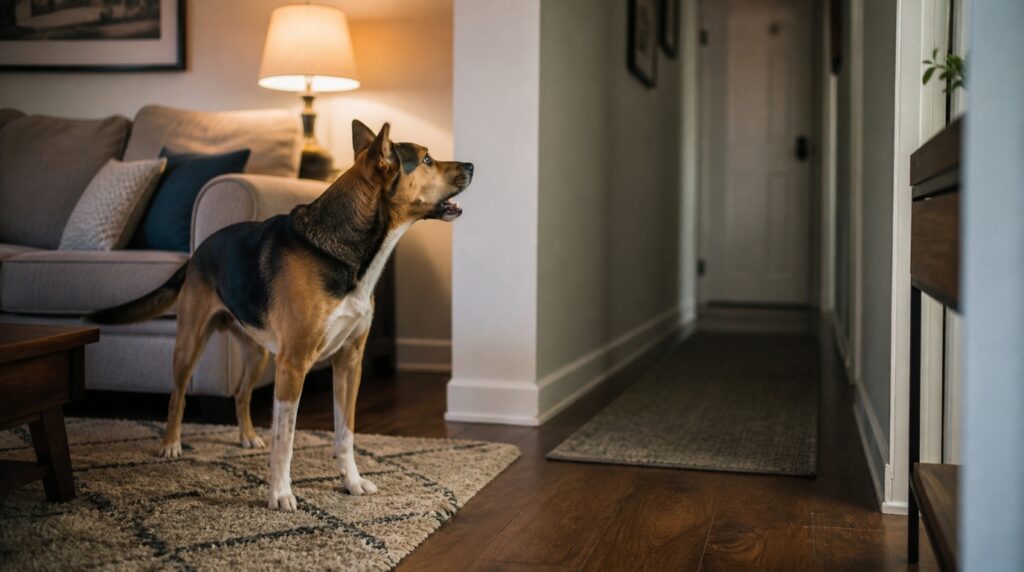
Dogs do not experience the home the same way people do. Dogs can hear some higher-pitched sounds better than humans, and they rely heavily on scent. That means your dog may notice sounds or smells you miss.
So when your dog barks at a wall, ceiling, window, hallway, or empty corner, ask:
What trigger can my dog notice that I cannot?
1. Your Dog May Hear Something Hidden
This is one of the most common reasons for dog barking at nothing.
Your dog may hear:
- Small animals or insects inside walls
- Pipes clicking
- Neighbors walking in a hallway
- A TV, washing machine, elevator, or appliance nearby
- Wind moving through vents
- Outdoor animals near the home
This can be more noticeable in apartments, flats, condos, terraced homes, or houses with shared walls.
Your dog may not be barking at the wall itself. They may be barking at sound behind the wall.
2. Reflections and Shadows Can Trigger Barking
At night, windows can act like mirrors. A dog may see movement, light, shadows, or their own reflection and react as if something is outside.
This can happen near:
- Glass doors
- Dark windows
- Patio doors
- Mirrors
- TV screens
- Shiny appliances
If your dog barks at windows or glass doors, blocking the view can help. ASPCA recommends limiting a dog’s ability to see people or animals outside when visual triggers cause barking.
3. Smells Can Seem “Invisible” to You
Dogs rely strongly on scent. A smell near a wall, door, vent, or window may be enough to get your dog’s attention.
Possible smell triggers include:
- Rodents or pests
- Outdoor animals
- Another dog nearby
- Food smells
- Trash bins
- Damp areas
- People or pets passing outside
This may explain why some dogs return to the same corner, baseboard, or doorway.
4. Night Makes Small Triggers Easier to Notice
At night, the home is quieter. Sounds that disappear into daytime noise can become easier for your dog to notice.
Your dog may bark at night because:
- Footsteps are clearer
- Outdoor animals are more active
- Heating, cooling, or plumbing systems make noise
- Reflections appear in windows
- Your dog has learned that barking wakes you up
If your dog often barks at 2 or 3 AM, look for a pattern before trying to correct the behavior.
5. Sudden Barking Can Be Linked With a Change
If dog barking at nothing starts all of a sudden, treat it as a change worth checking.
Possible causes include:
- A new sound in the home
- A pest issue
- A new neighbor or pet nearby
- A scary event
- A change in routine
- Pain, discomfort, or sensory change
This does not mean your dog is sick. But sudden changes deserve more care than a normal habit. A vet check is a safer first step if the barking is new, intense, or paired with other changes.
6. Senior Dogs May Need Extra Care
In some senior dogs, new barking, night waking, staring, or getting stuck can appear with age-related changes. Cornell University’s canine cognitive dysfunction resource lists signs such as disorientation, getting stuck in corners, staring into space, sleep pattern changes, and wandering at night.
What to look for:
- Barking in the middle of a room
- Staring at walls or corners
- Getting stuck behind furniture
- Restlessness at night
- More confusion than usual
- Changes in sleep, appetite, or house training
This is a situation where a veterinarian should be involved.
7. Barking Can Become a Learned Pattern
Sometimes barking starts because of a real trigger. Then it becomes a habit.
Example:
Your dog hears a hallway sound, barks, and you rush over. Over time, your dog may learn that barking brings attention.
This does not mean your dog is being bad. It means the barking worked.
VCA explains that giving attention or treats during barking can accidentally reward the behavior, while rewarding quiet and settled behavior is usually more helpful.
Non-obvious insight: The original trigger and the current reason may not be the same. At first, your dog may bark at a noise. Later, your dog may bark because barking brings attention.
Real-World Scenarios
Dog Barking at the Same Wall
An owner notices their dog barking at the same wall every evening. This could point to a repeated trigger, such as pests, pipes, neighbor noise, or another sound pattern behind the wall.
Dog Barking at Glass Doors at Night
An owner sees their dog staring through a dark glass door and barking. This could be linked with reflections, outside movement, shadows, or a learned night routine.
Senior Dog Barking in an Empty Room
An owner notices their older dog barking in a familiar room. This may be linked with age-related change, sensory change, discomfort, or confusion. A vet check is the safer next step.
Apartment Dog Barking at “Nothing”
An owner hears nothing, but the dog keeps barking near the front door. The dog may be hearing hallway footsteps, plumbing, elevator sounds, or people through shared walls.
Step-by-Step Solutions

1. Track the Pattern First
What to do: Write down when and where the barking happens.
How to do it: For 3–5 days, note:
- Time of day
- Location
- Where your dog looked
- What happened before the barking
- What stopped the barking
- Any sounds, lights, smells, or movement nearby
When to apply it: Use this when the barking seems random or happens in the same area often.
This helps you find patterns instead of guessing.
2. Check the Environment
What to do: Look for hidden triggers.
How to do it: Check:
- Walls and baseboards for pest signs
- Windows for reflections
- Vents for noise
- Doors for hallway sounds
- Outdoor areas for wildlife or neighborhood animals
- Appliances that make high-pitched sounds
- New devices like alarms, routers, pest repellers, or smart-home devices
When to apply it: Use this when your dog barks at walls, ceilings, corners, windows, or doors.
3. Block the Visual Trigger
What to do: Reduce what your dog can see.
How to do it:
- Close curtains at night
- Use privacy window film
- Move furniture away from windows
- Turn off lights that create reflections
- Block access to glass doors during common barking times
When to apply it: Use this when your dog barks at windows, glass doors, shadows, or outside movement.
4. Redirect Before the Barking Builds
What to do: Redirect your dog before they become locked onto the trigger.
How to do it:
- Use a simple cue like “this way”
- Move away from the trigger
- Reward your dog when they follow you
- Offer a calm activity, such as sniffing, chewing, or a food puzzle
- Keep your voice low and steady
When to apply it: Use this when your dog notices the trigger but has not reached full barking mode yet.
Early redirection usually works better than waiting until your dog is barking nonstop.
5. Teach a Quiet Reset Spot
What to do: Create a place where your dog can settle.
How to do it:
- Choose a bed, mat, crate, or quiet room
- Practice when your dog is already calm
- Reward your dog for going there
- Add a cue like “go settle”
- Use it before common barking times
When to apply it: Use this for dogs who bark at night, bark at windows, or get stuck in alert mode.
The goal is not to punish barking. The goal is to give your dog a calmer option.
6. Add Better Daily Enrichment
What to do: Give your dog healthy ways to use their body and brain.
How to do it:
- Add sniff walks
- Use puzzle feeders or foraging toys
- Practice short training games
- Rotate toys
- Offer safe chewing options
- Add calm play before problem times
VCA notes that foraging toys can provide mental and physical exercise and may reduce boredom, while PDSA says slow sniffing walks can support mental health.
When to apply it: Use this when barking may be linked with boredom, under-stimulation, or a lack of calm activity.
Some dogs need mental work, not just more running.
7. Change the Night Routine
What to do: Make night less exciting and less confusing.
How to do it:
- Close curtains before dark
- Use steady background noise
- Take your dog out before bed
- Avoid high-energy play right before sleep
- Keep the sleeping area calm
- Block access to barking zones
When to apply it: Use this when your dog mainly barks at night or wakes the household.
If your dog is older and night barking is new, contact a veterinarian.
What Not to Do
Do Not Shout “No” Over and Over
Shouting can make barking harder to manage. Your dog may become more stressed, or they may treat your attention as part of the barking cycle. VCA notes that yelling and punishment may aggravate barking problems and make some dogs more anxious.
Do Not Punish Fear-Based Barking
If your dog may be scared, harsh correction can increase stress. AVSAB’s humane dog training statement supports reward-based methods over aversive-based methods for welfare and long-term outcomes.
Do Not Assume It Is “Ghosts”
It may feel strange when your dog stares at an empty corner, but hidden sounds, smells, reflections, and learned patterns are more practical explanations.
Do Not Ignore Sudden Changes
Ignoring a new barking pattern can delay help if your dog is in pain, confused, or reacting to a real environmental change.
Do Not Rely Only on Treats After Barking Starts
Treats can help when used well. But if treats only appear after intense barking, your dog may learn that barking starts the reward cycle. Use rewards before the barking builds or after calm behavior.
When to Contact a Vet or Qualified Trainer
Contact a veterinarian if your dog’s barking:
- Starts suddenly
- Gets worse quickly
- Happens with confusion
- Happens with pain signs
- Comes with appetite changes
- Comes with sleep changes
- Happens in a senior dog
- Appears with disorientation
- Happens with vision or hearing changes
Contact a qualified reward-based trainer or behavior professional if:
- The barking is intense or frequent
- Your dog cannot settle
- You live in a shared-wall home
- Neighbors are complaining
- Your dog seems fearful or hard to redirect
- Your current approach is not helping
Start by tracking the pattern before trying to correct the barking. If the barking is sudden or linked with health changes, speak with a veterinarian first.
Quick Summary
Most barking has a trigger or context, even when it looks like your dog is barking at nothing.
Your dog may be reacting to sounds, smells, reflections, wildlife, neighbors, pests, boredom, fear, or a learned habit. Senior dogs and dogs with sudden behavior changes need extra care.
Start by tracking the pattern, checking the environment, blocking visual triggers, and redirecting early. If the barking is sudden, severe, or linked with confusion or health changes, contact a veterinarian.
FAQs
Why Does My Dog Bark at Nothing at Night?
Your dog may hear outdoor animals, pipes, neighbors, wind, or small house sounds. Night can make these sounds easier to notice because the home is quieter.
Why Is My Dog Barking at the Wall?
Your dog may hear or smell something near or behind the wall, such as pests, pipes, or neighbor noise. If it keeps happening in the same spot, check the area.
Why Is My Senior Dog Barking at Nothing All of a Sudden?
Sudden barking in a senior dog may be linked with age-related change, discomfort, sensory change, or confusion. Contact a veterinarian if this is new or getting worse.
Should I Ignore My Dog Barking at Invisible Things?
Not at first. Try to find the trigger. If you ignore barking without understanding it, you may miss fear, environmental issues, or health-related changes.
How Do I Stop My Dog Barking at Nothing?
Track the pattern, check for hidden triggers, block windows or reflections, redirect early, and build a calm settle routine. If barking starts suddenly or feels extreme, get professional help.
Disclaimer
This article is for dog behavior education only. It is not veterinary advice or a diagnosis.
If your dog’s barking starts suddenly, gets worse, or comes with pain, fear, confusion, or unusual behavior, contact a veterinarian or qualified trainer.