

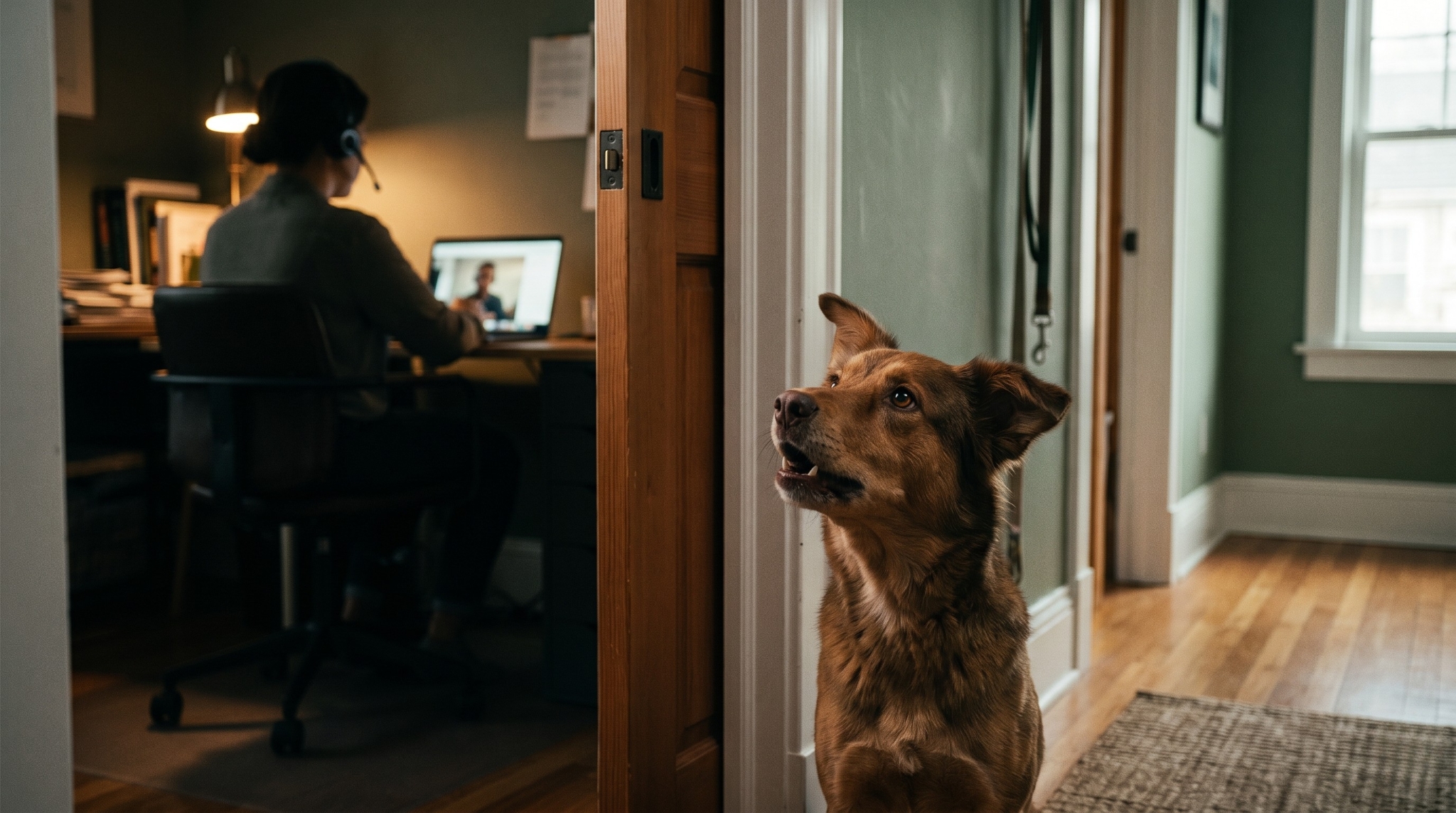
Your dog may bark during work-from-home calls because your laptop, headset, meeting voice, notification sounds, or closed office door have become triggers. Some dogs bark for attention. Some bark because they are bored, frustrated, excited, or reacting to sounds from your call or hallway.
Table of Contents
- Why Dogs Bark During Work-From-Home Calls
- Common Work-From-Home Barking Triggers
- How to Tell What Type of Barking It Is
- Why Your Dog Has Learned Your Work Cues
- Demand Barking During Calls
- Boredom and Low Stimulation
- Tech Sounds and Meeting Voice Triggers
- Closed-Door Frustration
- Real-World Work-From-Home Barking Scenarios
- What to Do Before a Call Starts
- Step-by-Step Training Plan
- 7-Day Work-From-Home Barking Reset Plan
- What Owners Often Misunderstand
- What Not to Do
- When to Contact a Vet or Qualified Professional
- Quick Summary
- FAQs
- Sources Consulted
Why Dogs Bark During Work-From-Home Calls
Dog barking problems can feel especially stressful during work-from-home calls.
One bark during a meeting is annoying. Repeated barking during a client call, boss call, interview, or video meeting can quickly feel embarrassing.
Many owners notice a clear pattern:
- The dog is calm until the laptop opens.
- The barking starts when the headset goes on.
- The dog reacts when the phone rings.
- The dog barks when the owner starts using a “meeting voice.”
- The dog barks outside the office door.
This does not prove your dog is being spiteful or trying to ruin your work.
Dogs bark for many reasons, including communication, excitement, alerting, fear, frustration, boredom, attention-seeking, or blocked access. Cornell University College of Veterinary Medicine explains that dogs usually have a reason for barking, even when that reason is not obvious to the owner.
During work-from-home calls, your dog may have learned that your work routine predicts something important.
That “something” may be:
- Less attention
- A closed door
- Strange voices from the laptop
- Boredom
- Frustration
- Sound triggers
- Blocked access to you
Barking is a normal way dogs communicate. The important part is finding out why the barking happens in that exact moment.
Common Work-From-Home Barking Triggers
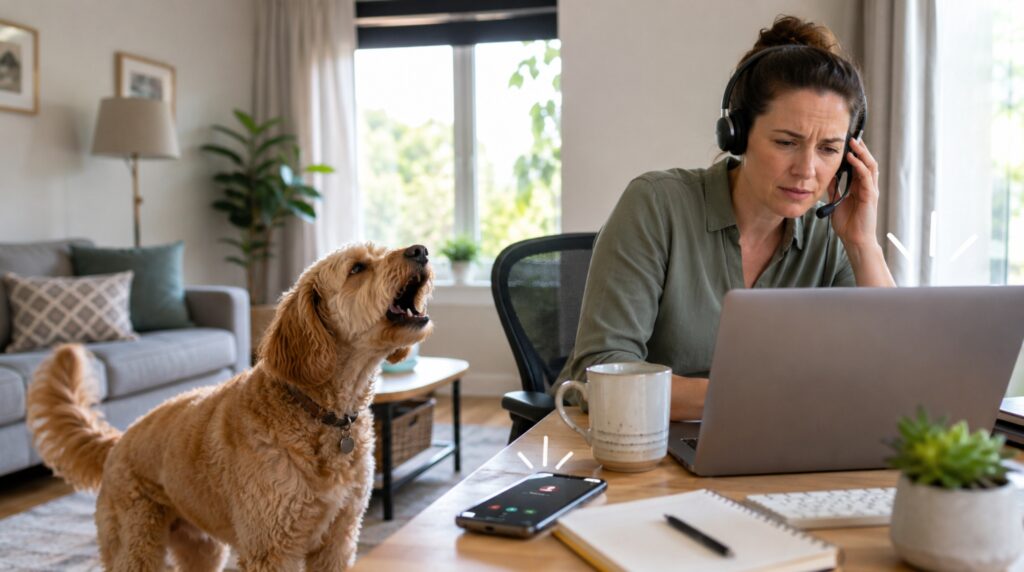
Your dog may bark during work time because one or more of these things has become a trigger:
- Laptop opening
- Headset going on
- Phone ringing
- Zoom, Teams, or Google Meet sounds
- Slack or notification pings
- Keyboard typing
- Your meeting voice
- Closed office door
- Baby gate or blocked access
- Hallway sounds
- Street noise
- Doorbell sounds
- Lack of activity before the call
- Wanting food, play, or attention
- Boredom during long focus blocks
A common pattern is this:
- Your dog barks.
- You look at them.
- You talk to them.
- You give a treat.
- You open the door.
- You let them near you.
Over time, your dog may learn:
“Barking gets a result.”
The treat is not always the problem. The timing is usually the problem.
Reward-based training works best when the reward is linked to the behavior you want, not the behavior you are trying to reduce. PDSA explains reward-based training as a method that rewards the behavior you want your dog to repeat.
How to Tell What Type of Barking It Is
Use the pattern, trigger, and body language together. Do not judge the bark by sound alone.
| Barking Pattern | Possible Meaning | What to Try First |
|---|---|---|
| Barking starts when the headset goes on | Learned work cue or demand barking | Give a calm activity before the headset appears |
| Barking starts when you speak on calls | Attention, excitement, confusion, or sound sensitivity | Practice short speaking sessions and reward calm behavior |
| Barking happens outside the office door | Frustration or blocked access | Use gradual door practice, a baby gate, or a mat routine |
| Barking starts after notification pings | Sound trigger | Lower volume and pair the sound with calm rewards |
| Barking starts after you give treats | Bark-and-treat loop | Reward calm before barking starts |
| Barking happens during long focus blocks | Boredom or low stimulation | Add a sniff walk, food puzzle, chew, or rest routine before work |
| Barking is sudden or unusual | Possible pain, fear, anxiety, or health change | Contact a veterinarian |
| Barking includes panic, shaking, or destructive behavior | Distress or separation-related issue may be possible | Contact a veterinarian or qualified reward-based trainer |
This table does not diagnose your dog. It helps you choose the safest first step.
Why Your Dog Has Learned Your Work Cues
Dogs are good at noticing routines.
Your dog may learn that these things mean you are about to become unavailable:
- Opening your laptop
- Sitting at the desk
- Putting on a headset
- Closing the office door
- Starting a Zoom, Teams, or phone call
- Speaking in a different tone
- Hearing notification sounds
To your dog, these cues may mean:
“My person is here, but I cannot get their attention.”
That can lead to barking, especially if barking has worked before.
For example, if your dog barks when your headset goes on and you immediately give them a chew, they may learn that the headset predicts the bark-reward routine.
A better approach is to give the chew or calm activity before barking begins.
Demand Barking During Calls
Demand barking means your dog barks to get something they want.
That may include:
- Attention
- Food
- Play
- Access to a room
- A walk
- A chew
- Eye contact
- You saying “quiet”
- You leaving the call to deal with them
This is one of the most common work-from-home barking problems.
ASPCA describes attention-seeking barking as barking that can happen when dogs want attention, food, toys, or play. This is why timing matters so much.
If your dog barks and then gets a treat, chew, or attention, your dog may learn:
“Barking starts the reward routine.”
This is why some owners feel like treats “made the barking worse.”
The treat itself is not bad. The reward may simply be arriving after the wrong behavior.
Better approach
Reward these moments instead:
- Your dog lies down before the call.
- Your dog looks at you but does not bark.
- Your dog hears a notification sound and stays quiet.
- Your dog rests while you speak.
- Your dog stays calm when the laptop opens.
Boredom and Low Stimulation
Some dogs bark during focus time because they have nothing clear to do.
You are home, but you are not available. You are sitting still. You are not playing. You are not moving around the house.
This can be hard for some dogs, especially:
- Puppies
- Young dogs
- High-energy breeds
- Dogs used to frequent attention
- Dogs with little morning activity
- Dogs without a clear settle routine
Your dog may be asking for:
- Movement
- Interaction
- Food activity
- A toilet break
- Play
- Access to you
- A predictable routine
This is common when the owner is physically home but mentally busy.
A dog may not understand why you are present but unavailable.
Tech Sounds and Meeting Voice Triggers
Some dogs react to sudden, novel, or repeated sounds.
Possible triggers include:
- Notification pings
- Keyboard typing
- Phone ringing
- Voices from laptop speakers
- Your louder meeting voice
- Doorbell sounds during calls
- Hallway or street sounds
Your meeting voice may matter more than you think.
During calls, you may sound:
- Louder
- More formal
- More animated
- More repetitive
- Different from your normal voice
Your dog may hear you talking and expect interaction. But because you are not talking to them, they may become confused, excited, or frustrated.
If you are unsure whether the barking is excitement, alert barking, fear, or demand barking, compare the sound with your dog’s body language in our guide: Different Types of Dog Barks and Meanings.
Some dogs also react to laptop speakers because the voice is unusual. It sounds like a person is present, but the dog cannot find them.
VCA Animal Hospitals explains that some dogs may react to noises, places, or unusual triggers with fear-related behavior. If your dog seems fearful rather than simply attention-seeking, go slowly and speak with a professional if needed.
Closed-Door Frustration
A dog barking outside your office door does not automatically have separation anxiety.
If you are still home, your dog may be frustrated because they can hear you but cannot reach you.
This can happen in:
- Apartments
- Flats
- Terraced homes
- Shared homes
- Basement offices
- Small home offices
The dog knows you are nearby. The door is the problem.
This is sometimes called barrier frustration or blocked-access frustration.
Your dog may bark because:
- They want to enter the room.
- They hear your voice.
- They are used to following you.
- The closed door is unusual.
- The door predicts being ignored.
A baby gate, open-door mat routine, or gradual door practice may work better than suddenly locking the dog away during important calls.
Real-World Work-From-Home Barking Scenarios
These are not medical diagnoses. They are common owner-observed patterns that can help you think through the trigger.
Scenario 1: Barking starts when the headset goes on
Your dog stays calm in the morning until you put on your headset.
The headset may have become a cue that you will stop responding.
What to try: Put the headset on for a few seconds outside meeting time and reward calm behavior before barking starts.
Scenario 2: Barking happens when you speak on calls
Your dog lets you type quietly, but starts barking when you talk on Zoom, Teams, or the phone.
This may be linked with attention, sound sensitivity, excitement, or confusion about your meeting voice.
What to try: Practice short fake calls. Speak for 5–10 seconds, reward calm behavior, then stop before your dog gets worked up.
Scenario 3: The dog barks at the office door
You close the office door during meetings, and your dog barks outside it.
This may be frustration or wanting access. It does not automatically mean separation anxiety.
What to try: Start with very short door-closing practice when you are not in a real meeting.
Scenario 4: Treats made the barking worse
You give a treat to stop barking during a call. Your dog is quiet for a moment, then barks again.
This can happen when barking becomes the first step in getting the treat.
What to try: Give the chew, food toy, or mat reward before the call starts, not after the barking starts.
Scenario 5: Barking feels worse in apartments or flats
In apartments, flats, terraced homes, or shared housing, barking may feel more urgent because other people can hear it.
That pressure can lead to rushed choices like yelling, over-feeding treats, or trying quick-fix devices.
What to try: Use management first: white noise, covered windows, pre-call enrichment, and a predictable settle spot.
What to Do Before a Call Starts
Do not wait until barking starts.
Set your dog up before the meeting.
Before an important call, check:
- Has your dog had a toilet break?
- Do they have water?
- Have they eaten at the normal time?
- Have they had a short sniff walk or calm activity?
- Do they have a safe chew or food puzzle?
- Is the window covered if outdoor movement triggers barking?
- Is there white noise if hallway sounds trigger barking?
- Is their bed, mat, crate, or rest area ready?
Good pre-call options may include:
- Stuffed food toy
- Lick mat
- Safe chew
- Scatter feeding
- Snuffle mat
- Mat routine
- Open-door crate rest
- Short sniff walk
- Calm reward-based training
Give the activity before the meeting starts.
This helps your dog learn:
“Work time means I settle with something calm.”
Step-by-Step Training Plan
Step 1: Find the Exact Trigger
For 3–5 workdays, write down what happens right before barking.
Track:
- Time of day
- What you were doing
- Whether the laptop was open
- Whether the headset was on
- Whether you were speaking
- Whether the door was closed
- Whether a notification sound played
- Whether someone passed the hallway
- Whether your dog had exercise, food, water, or toilet time
Do this before changing the training plan.
If you do not know the trigger, you may accidentally reward the wrong behavior.
Step 2: Reward Calm Before Barking Starts
Look for tiny calm moments.
Reward your dog when:
- They lie down
- They look at you quietly
- They hear a sound and stay calm
- They stay on their mat
- They settle while you type
- They remain quiet when you speak
Keep rewards small and calm.
Do not turn it into an exciting event.
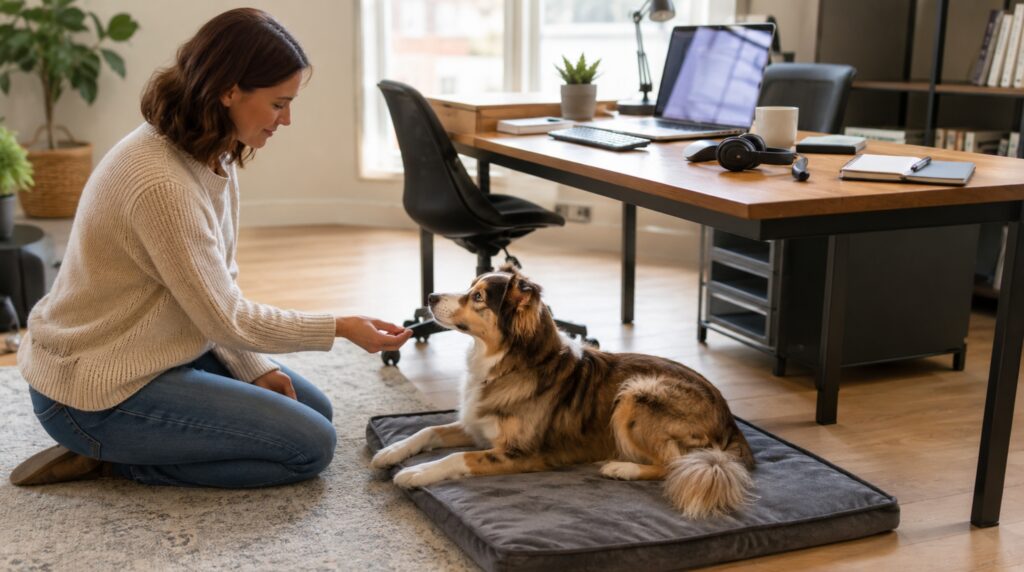
Step 3: Teach a Work Station Routine
Choose one place where your dog can settle.
Good options:
- Dog bed
- Mat
- Open-door crate
- Quiet corner
- Gated area near you
Practice like this:
- Toss a treat onto the mat.
- Calmly praise when your dog steps on it.
- Reward sitting or lying down.
- Touch the laptop, then reward calm behavior.
- Put on the headset briefly, then reward calm behavior.
- End before your dog gets frustrated.
Slowly build the time.
Practice outside real meetings first.
Then use it during low-pressure calls before important meetings.
Step 4: Change the Meaning of Meeting Cues
If your dog barks before the call even starts, the cue itself may be part of the problem.
Practice short sessions:
- Put on the headset for 3 seconds.
- Reward calm behavior.
- Take it off.
- Open the laptop.
- Reward calm behavior.
- Close the laptop.
- Play a low-volume notification sound.
- Reward calm behavior.
- Speak in your meeting voice for a few seconds.
- Reward calm behavior.
Keep sessions short and easy.
The goal is not to test your dog. The goal is to help your dog succeed.
Step 5: Use a Safe Emergency Plan During Calls
For high-stakes meetings, prepare before the call.
Have ready:
- A safe chew
- A filled food toy
- A baby gate
- A calm room setup
- A covered window
- White noise
- A mat or rest spot
- A note to yourself: “Reward quiet before barking.”
If barking starts:
- Mute your mic if needed.
- Avoid shouting.
- Wait for even a small pause if possible.
- Calmly guide your dog to their station.
- Keep your movements boring and predictable.
- Avoid turning barking into a big event.
This is management, not a full training solution. But it can help during client calls, interviews, presentations, or urgent meetings.
7-Day Work-From-Home Barking Reset Plan
Day 1: Track the barking pattern
Write down what happens before barking starts.
Look for:
- Headset
- Laptop
- Meeting voice
- Notification ping
- Closed door
- Hallway sound
- Boredom
- Missed toilet break
- Lack of morning activity
Goal: Find the most likely trigger.
Day 2: Prepare before the call
Before your first work block, give your dog a calm setup.
Use one:
- Sniff walk
- Food puzzle
- Lick mat
- Safe chew
- Scatter feeding
- Rest mat
- Open-door crate
Goal: Give your dog something to do before barking starts.
Day 3: Reward calm moments
Reward your dog when they are already quiet.
Examples:
- Dog lies down before the call
- Dog hears a sound and stays calm
- Dog looks at you without barking
- Dog rests while you type
- Dog stays quiet when you speak briefly
Goal: Teach that calm behavior pays.
Day 4: Practice work cues outside meetings
Do short practice sessions when there is no real meeting.
Try:
- Open laptop, reward calm
- Put on headset, reward calm
- Play low notification sound, reward calm
- Speak in meeting voice, reward calm
Goal: Make work cues less exciting or frustrating.
Day 5: Build the work station routine
Choose a mat, bed, open crate, or quiet corner.
Practice:
- Go to mat
- Sit
- Lie down
- Stay calm for a few seconds
- Release before frustration starts
Goal: Give your dog a clear job during work time.
Day 6: Practice door or baby-gate time
If closed doors trigger barking, start small.
Practice:
- Close door for 1 second
- Open before barking starts
- Reward calm behavior
- Slowly increase time
Or use a baby gate if a fully closed door is too hard.
Goal: Reduce blocked-access frustration.
Day 7: Review and adjust
Look at your notes.
Ask:
- What trigger improved?
- What still causes barking?
- Does barking happen only during calls?
- Does barking happen at other times too?
- Is there panic, pain, confusion, or sudden change?
Goal: Decide whether to keep training, adjust management, or contact a professional.
What Owners Often Misunderstand
“My dog is being spiteful.”
Barking does not prove spite.
It usually has a function. It may get attention, access, food, movement, or relief from frustration.
“I gave a treat, but it got worse.”
The treat may have come too late.
If the treat comes after barking, your dog may learn to bark first.
Reward calm behavior before barking starts.
“My dog cannot have separation anxiety because I am home.”
That may be true, but your dog can still feel frustrated by a closed door or blocked access.
Separation-related barking is usually linked with being left alone or separated from the guardian, often with other distress signs.
“I need to tire my dog out for an hour before every call.”
Not always.
Some dogs need better timing, a clearer routine, and calmer enrichment.
A food puzzle, sniff walk, chew, or mat routine may be more realistic for workdays.
What Not to Do
Avoid yelling “quiet” again and again
This can add more noise and attention.
Some dogs may become more excited or stressed.
Avoid giving treats only after barking starts
This can teach your dog that barking begins the reward routine.
Give the chew, food puzzle, or calm activity before your dog starts barking.
Avoid punishment tools
Avoid using barking as a reason to use harsh punishment.
Aversive tools may increase fear, stress, or confusion for some dogs. They may also fail to address the trigger behind the barking.
The AVSAB Humane Dog Training Position Statement supports humane, reward-based training and warns against methods based on pain, fear, intimidation, or force.
Avoid locking the dog away without preparation
If your dog already struggles with closed doors, suddenly shutting them away during meetings may make barking worse.
Build the routine gradually.
Avoid assuming dominance
Barking during calls is more likely linked with learning, frustration, attention, sound triggers, or unmet needs than “dominance.”
When to Contact a Vet or Qualified Professional
Contact a veterinarian if the barking:
- Starts suddenly
- Gets worse quickly
- Happens with signs of pain
- Happens with confusion or disorientation
- Comes with appetite changes
- Appears with restlessness or sleep changes
- Happens in a senior dog and feels unusual
- Happens with new fear or panic
- Happens alongside other health or behavior changes
University of Illinois College of Veterinary Medicine explains that excessive barking may be linked with different causes and may need veterinary or behavior guidance depending on the situation.
For senior dogs, sudden or unusual barking may also need extra attention. Cornell University College of Veterinary Medicine explains that cognitive dysfunction syndrome in dogs may involve changes such as disorientation, sleep-wake changes, activity changes, anxiety, or learning changes.
Contact a qualified reward-based dog trainer, veterinary behaviorist, or veterinarian if:
- Barking is affecting your work
- Neighbors are complaining
- Your dog cannot settle at all
- Your dog panics when separated by a door
- You feel stuck in a bark-and-treat loop
- Barking includes lunging, snapping, or intense distress
- Your dog seems fearful of call sounds or household noises
This article can help with common work-from-home barking patterns, but it cannot diagnose your dog.
Quick Summary
Dog barking during work-from-home calls often happens because your dog has learned a pattern.
Common triggers include:
- Laptop opening
- Headset cues
- Notification pings
- Meeting voice
- Closed office doors
- Boredom
- Demand barking
- Hallway noises
- Lack of a clear work routine
The best first step is to reward calm behavior before barking starts.
Set your dog up before calls, teach a work station, and avoid giving treats only after barking begins.
FAQs
Why does my dog bark when I talk on the phone?
Your dog may react to your voice, the phone sound, or the fact that you are talking but not engaging with them.
Try practicing short phone-style speaking sessions outside real calls. Reward calm behavior before barking starts.
Why does my dog bark when I put my headset on?
The headset may have become a cue that you are about to stop paying attention.
Practice putting the headset on for a few seconds, reward calm behavior, then take it off. Keep sessions short.
How do I stop demand barking while working?
Avoid rewarding barking directly.
Reward quiet moments before barking starts. Give your dog a calm activity before meetings, not after barking begins.
Should I crate my dog during work calls?
A crate may help some dogs if they already see it as a safe rest space.
Do not suddenly use the crate as punishment during calls. Build a calm crate routine first.
Why does my dog bark when I close my office door?
Your dog may be frustrated because they can hear you but cannot reach you.
Try gradual door practice, a baby gate, or a calm station near your workspace.
Is barking during work calls separation anxiety?
Not always.
If you are home, it may be boredom, demand barking, sound sensitivity, or frustration.
If the barking is intense, sudden, or linked with panic, speak with a veterinarian or qualified reward-based trainer.
Can notification sounds make my dog bark?
Yes, some dogs react to repeated or sudden sounds.
Lower the volume, change the notification tone, or practice playing the sound softly and rewarding calm behavior.
What is the fastest thing I can do before an important meeting?
Before the call, give your dog a toilet break, water, a safe chew or food toy, and a calm rest spot.
Use management first for important meetings. Then train the routine outside high-pressure calls.