
If your dog barking during work calls is making you feel embarrassed, stressed, or worried about your job, the problem can feel urgent.
Many dogs stay calm while their owner works quietly. Then they suddenly bark when a Zoom or Teams call starts.
This can feel confusing.
Your dog may ignore normal talking, the TV, or the vacuum, but react the moment you use your “meeting voice.”
The barking may feel disruptive, but it is often a pattern.
Your dog may be reacting to your voice, speaker sounds, the call routine, boredom, frustration, or the fact that you are home but unavailable.
If your dog barking during work calls happens again and again, the best solution is usually to identify the exact call trigger before trying to stop the barking.
Table of Contents
- Immediate Answer
- Why Dogs Bark During Zoom or Teams Calls
- 1. Your Meeting Voice May Become a Trigger
- 2. Your Dog Has Learned That Barking Gets a Quick Response
- 3. Call Sounds May Be Unusual for Your Dog
- 4. The Chew or Puzzle May End Before the Meeting Ends
- 5. Your Dog Is Present, but You Are Unavailable
- What Owners Often Misunderstand
- The Barking May Start Before the Call
- Common Owner Situations
- Step-by-Step Solutions
- Simple 5-Day Work Call Barking Plan
- What Not to Do
- When to Contact a Vet or Qualified Trainer
- Quick Summary
- FAQs
Immediate Answer
Your dog may bark during Zoom or Teams calls because the call has become a trigger.
Common reasons include:
- Your dog hears your meeting voice and expects attention
- Your dog reacts to voices from speakers
- Your dog has learned that barking gets a fast response
- Your dog is bored or under-stimulated during work hours
- Your dog feels frustrated because you are present but unavailable
- Your dog may find closed doors or barriers difficult
A demand barking dog may bark because barking has worked before. But barking during calls can also be linked with frustration, fear, or distress.
A safer first step is to study the trigger before choosing the solution.
Why Dogs Bark During Zoom or Teams Calls
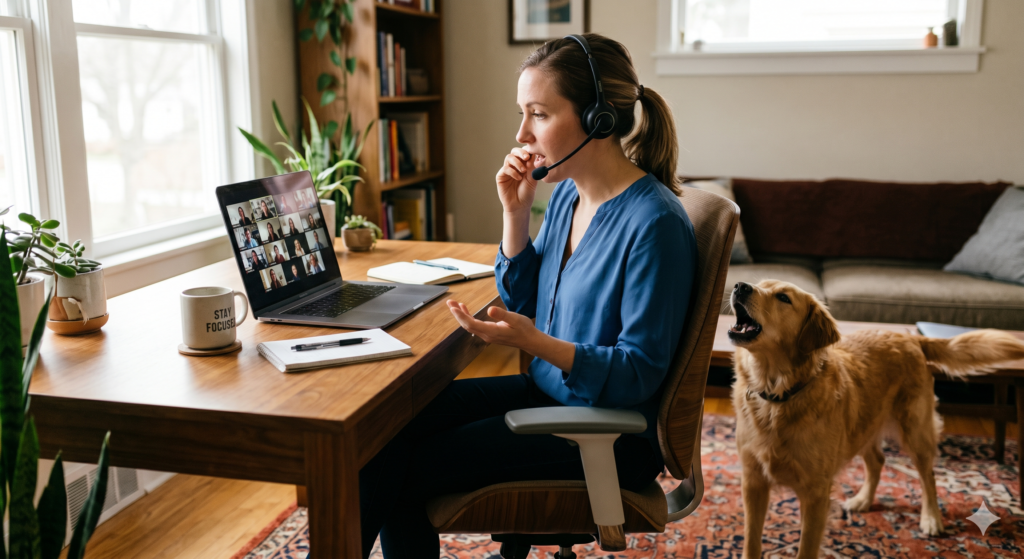
Barking is one way dogs communicate.
The AKC explains that barking can happen for many reasons, including alerting, excitement, boredom, frustration, fear, loneliness, and attention-seeking.
During work calls, your dog may not be reacting to only one thing.
The trigger may be a mix of voice, routine, sound, attention, and timing.
1. Your Meeting Voice May Become a Trigger
Some dogs react when the owner starts speaking in a different tone.
During calls, your voice may become:
- Louder
- Sharper
- More formal
- More animated
- More repeated in short phrases
Your dog may not understand that you are talking to people through a screen.
They may simply notice that your voice and body language changed.
This is why some dogs are calm during silent laptop work but bark as soon as the call begins.
The trigger may not be the laptop. It may be your voice.
2. Your Dog Has Learned That Barking Gets a Quick Response
Work calls create pressure.
Owners often react fast because they need quiet.
You may:
- Say “quiet”
- Look at your dog
- Toss a treat
- Give a chew
- Let them out
- Move rooms
- End the call early
- Put them in another space
From your dog’s view, barking changed what happened.
This can accidentally teach attention barking.
The Merck Veterinary Manual explains that behavior problems can involve learning, fear, anxiety, arousal, medical issues, or environmental events.
To stop dog barking for attention, reward quiet behavior before barking starts, not after barking interrupts the call.
3. Call Sounds May Be Unusual for Your Dog
Some dogs may react to voices coming from speakers.
Others may react more when the owner wears headphones because the dog hears only one side of the conversation.
This does not mean your dog is jealous of the laptop.
A better way to look at it is this:
The call creates odd sounds, changed body language, and a different routine.
Your dog may become alert, excited, or frustrated because the situation feels different from normal conversation.
4. The Chew or Puzzle May End Before the Meeting Ends
Many owners try a chew, lick mat, or food puzzle.
These can help.
The ASPCA describes food puzzles and enrichment activities as ways to provide mental stimulation and encourage natural dog behaviors.
But there is one common problem:
The item ends before the meeting ends.
When your dog finishes it, they may come back with more energy and bark again.
This does not always mean the tool failed.
It may mean the activity did not match the full length of the meeting.
A short distraction is not enough for every long or high-stakes call.
5. Your Dog Is Present, but You Are Unavailable
This is a big work-from-home problem.
Your dog can see you. You are in the room. You are talking. But you are not talking to them.
For some dogs, this can be frustrating.
They may bark, paw, stare, bring toys, or jump because they want access to you.
This may be more noticeable in:
- Small homes
- Apartments
- Flats
- Busy work setups
- Shared rooms
- Homes where the owner cannot fully separate work time from dog time
What Owners Often Misunderstand
Many owners think, “My dog is jealous of my laptop.”
That may be how it feels, but it is usually more useful to think in patterns.
Your dog may be reacting to:
- Your voice
- Your posture
- Your headphones
- The meeting start sound
- Voices from speakers
- The closed office door
- The fact that barking gets a response
- A lack of planned activity before the call
Another misunderstanding is thinking exercise alone should fix it.
Exercise may help some dogs settle, but it may not solve a trigger-based call pattern by itself.
A dog may still bark during a 2 PM meeting if the meeting voice, room setup, or attention pattern is the real trigger.
The Barking May Start Before the Call
Many owners notice the barking when the meeting begins, but the pattern may start earlier.
Your dog may notice:
- You opening your laptop
- You putting on headphones
- You closing the door
- You moving a chair
- You saying “Can you hear me?”
- You sitting more upright
- You ignoring them after being available
These small cues can predict a long period of no attention.
For some dogs, that prediction may be enough to start barking.
Common Owner Situations
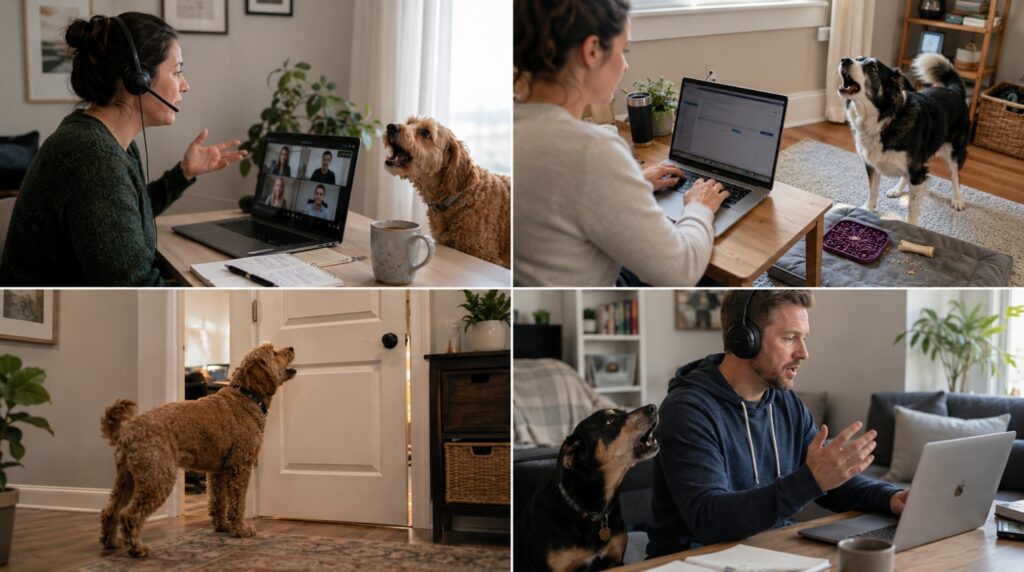
Dog Barks Only When the Owner Speaks on Zoom
An owner notices their dog stays calm during emails but barks when the owner starts speaking in a meeting.
This could point to a voice trigger, attention-seeking, or a learned call routine.
The dog may have learned that the owner’s meeting voice predicts a long period of no attention.
Dog Finishes the Chew and Starts Barking Again
An owner gives a chew before a Teams call.
The dog is quiet for a while, then barks when the chew is finished.
This could point to a management gap.
The chew helped for part of the call, but the dog does not yet have a full settle routine for longer meetings.
Dog Barks When the Office Door Closes
An owner closes the office door before client calls.
The dog starts barking outside the door.
This could point to barrier frustration, attention-seeking, or distress about being separated.
The door may be a stronger trigger than the call itself.
Dog Barks When the Owner Wears Headphones
An owner notices the dog is calmer when voices come through the computer speaker but barks when the owner wears headphones.
This could mean the dog is reacting to the owner speaking without hearing the other person.
The one-sided conversation may feel unusual or exciting to the dog.
Step-by-Step Solutions
Step 1: Find the Exact Call Trigger
What to do: Work out what starts the barking.
How to do it: Test one thing at a time outside a real meeting.
Try:
- Sitting at the desk without speaking
- Opening Zoom or Teams without joining a call
- Wearing headphones for a few minutes
- Saying a few work phrases in your meeting voice
- Playing quiet speaker voices
- Closing and opening the office door
Write down which cue causes barking.
When to apply it: Use this before changing your training plan. It helps you avoid guessing.
Step 2: Practice Fake Calls Before Real Calls
What to do: Teach your dog that your meeting voice predicts calm rewards, not chaos.
How to do it: Sit at your desk. Say one short phrase in your meeting voice. Before your dog barks, drop a treat on their mat or bed.
Pause. Repeat for 2–3 minutes. Slowly build up to longer talking.
Keep it boring and calm.
The Merck Veterinary Manual’s behavior modification guidance discusses gradual behavior-change methods such as reinforcement, shaping, desensitization, and counterconditioning.
These methods work best when the dog stays calm enough to learn.
When to apply it: Use this outside work hours first. Do not start during an important meeting.
Step 3: Build a Work-Call Settle Station
What to do: Create a clear place where your dog rests during calls.
How to do it: Set up a bed, mat, crate, or safe area near your desk or outside the office, depending on what your dog can handle.
Before the call:
- Take your dog for a toilet break if needed
- Give a short sniff walk or calm activity
- Send your dog to the mat
- Give a safe chew, lick mat, or food puzzle
- Reward quiet moments before barking starts
Dogs Trust explains that enrichment activities can help dogs use natural behaviors such as sniffing, chewing, searching, and problem-solving.
When to apply it: Use this before:
- Zoom calls
- Teams calls
- Phone calls
- Interviews
- Client meetings
- Long laptop sessions
This works best when it starts before the barking.
Step 4: Match the Activity to the Meeting Length
What to do: Plan for the full call, not just the first few minutes.
How to do it: For short calls, one chew or food puzzle may be enough.
For longer calls, use a staged setup:
- First part of call: chew or lick mat
- Middle of call: safe puzzle or scatter feeding
- End of call: calm reward for staying settled
You can also prepare two safe activities and switch during a natural pause.
When to apply it: Use this for:
- Long meetings
- Interviews
- Training sessions
- Client presentations
- Back-to-back calls
Do not wait until your dog has already started barking.
Step 5: Stop Rewarding Barking During Calls
What to do: Avoid teaching your dog that barking controls the meeting.
How to do it: If your dog is attention barking and not distressed:
- Stay calm
- Avoid eye contact during the bark
- Avoid talking over the barking
- Wait for a short quiet moment
- Reward the quiet with a treat, mat cue, or calm praise
Use the mute button briefly if needed.
But try not to make barking the cue for treats or attention.
When to apply it: Use this when the barking is attention-seeking and your dog can calm down.
If you are unsure whether the barking is demand barking or distress-related barking, this guide on dog barking for attention or anxiety can help you decide which pattern fits your dog better.
Step 6: Add a Pre-Call Routine
What to do: Make calls predictable.
How to do it: Five to ten minutes before a call:
- Give your dog a toilet break
- Offer a short sniff or training game
- Set up the settle station
- Put your dog on the mat before the call starts
- Reward calm behavior
- Start the call after your dog is already settled
The ASPCA enrichment guide suggests activities that let dogs use natural behaviors such as playing, smelling, chewing, and scavenging.
When to apply it: Use this before meetings you know are coming.
It is especially helpful for dogs that bark at the start of calls.
Step 7: Practice Door Tolerance if the Office Door Is the Problem
What to do: Teach your dog that a closed door is normal and safe.
How to do it: Start very small:
- Touch the door handle
- Reward calm behavior
- Close the door for one second
- Open it before barking starts
- Build slowly over days
Do not jump from an open door to a one-hour meeting behind a closed door.
When to apply it: Use this if barking starts when you close the bathroom, office, or bedroom door.
If your dog panics, damages doors, or cannot settle, speak with a veterinarian or qualified behavior professional.
Step 8: Use Sound Management Carefully
What to do: Reduce call sounds if they seem to trigger barking.
How to do it: You can test:
- Lower speaker volume
- Use headphones
- Switch from headphones to speaker if that works better
- Use white noise in another room
- Close windows during delivery times
- Move your dog farther from the call sound
Test one change at a time outside a real meeting.
When to apply it: Use this when your dog reacts to:
- Speaker voices
- Headset use
- Outside noise
- Delivery sounds
- The call start sound
Simple 5-Day Work Call Barking Plan
Day 1: Find the Trigger
Notice whether your dog barks when you:
- Open the laptop
- Put on headphones
- Start speaking
- Close the door
- Hear speaker voices
- Move into your work position
Write down what happens right before the barking starts.
Day 2: Practice Fake Calls
Outside real work hours, sit at your desk and say short meeting phrases.
For example:
- “Can you hear me?”
- “Let me share my screen.”
- “Thanks, everyone.”
Reward calm behavior before barking starts.
Keep the session short and easy.
Day 3: Build the Settle Station
Set up your dog’s call-time space.
Use:
- A mat
- A bed
- A crate, if your dog is comfortable with it
- A safe area near or outside the office
- A chew, lick mat, or food puzzle
Practice sending your dog there before any real call starts.
Day 4: Match the Activity to the Meeting Length
Do not rely on one short chew for a long meeting.
For longer calls, prepare more than one safe activity.
For example:
- Chew at the start
- Food puzzle in the middle
- Calm reward near the end
The goal is to prevent barking before it starts, not react after it interrupts the call.
Day 5: Practice the Hardest Cue Slowly
Choose the cue that triggers your dog most.
- If the trigger is your voice, practice short speaking sessions.
- If the trigger is the door, practice one-second door closes.
- If the trigger is headphones, wear them briefly while rewarding calm behavior.
Only make it harder if your dog stays relaxed.
If your dog panics, damages doors, refuses food, or cannot settle, contact a veterinarian or qualified behavior professional.
What Not to Do
Do Not Yell “Quiet” During Every Call
This can add more noise and energy.
Some dogs may see it as attention. Others may become more stressed.
Do Not Wait Until the Meeting Starts
If the barking pattern is predictable, prevention matters.
Set up your dog before the call begins.
Do Not Rely Only on One Chew
Chews can help, but they are not a full training plan.
If the chew ends early, the barking may return.
Do Not Punish Fear or Panic
If your dog is barking because they are distressed, punishment is usually not helpful.
It does not teach your dog what to do instead.
The Merck Veterinary Manual explains that behavior modification often uses methods such as reinforcement, desensitization, counterconditioning, and shaping.
Punishment-based methods can be risky when barking is linked with fear, anxiety, or distress.
Do Not Assume the Laptop Is the Real Problem
The trigger may be:
- Your voice
- Your posture
- Your headphones
- The door
- Speaker sound
- The call routine
Look at the full pattern before choosing the solution.
When to Contact a Vet or Qualified Trainer
Speak with a veterinarian if your dog’s barking starts suddenly, gets worse, or appears with:
- Pain
- Confusion
- Appetite changes
- Disorientation
- Sudden fear
- Restlessness at night
- New sensitivity to sound or touch
The Merck Veterinary Manual notes that behavior problems can involve medical issues, fear, anxiety, arousal, learning, and environmental events.
That is why sudden behavior changes should be checked carefully.
Consider a qualified trainer or behavior professional if your dog:
- Barks through most calls
- Cannot settle even after activity
- Panics behind closed doors
- Scratches, chews, or damages doors
- Barks when left alone
- Causes neighbor complaints
- Shows fear, shaking, pacing, or heavy panting
- Makes work feel impossible
Choose someone who looks at:
- Triggers
- Timing
- Body language
- Environment
- What happens after the bark
Quick Summary
- Dogs may bark during Zoom or Teams calls because of your meeting voice, speaker sounds, attention patterns, boredom, frustration, or barrier stress.
- A demand barking dog may bark because barking has worked before.
- Some barking can be linked with distress, especially if it happens around closed doors, leaving cues, pacing, or panic.
- To stop dog barking for attention, reward calm behavior before calls, build a work-call routine, avoid rewarding barking by accident, and match activities to the full meeting length.
- If barking starts suddenly, gets worse, or looks like panic, speak with a veterinarian or qualified behavior professional.
FAQs
Why does my dog bark only when I talk on Zoom?
Your meeting voice may be the trigger.
Your dog may notice your tone, posture, headphones, or the fact that you are talking but not engaging with them.
Does my dog think I am talking to them?
Possibly, but you do not need to know exactly what your dog thinks to help them.
Focus on the pattern: your voice changes, the call starts, and your dog reacts.
How do I keep my dog quiet during Teams calls in an apartment?
Set up a settle station before the call.
Use a toilet break, a safe chew or food puzzle, and calm rewards before barking starts.
If your dog reacts to hallway noise, delivery sounds, or neighbors, also test sound management such as white noise or moving your dog farther from the door.
Should I ignore demand barking while I am on a call?
Sometimes, but only if your dog is not distressed and their basic needs have been checked.
Wait for a quiet moment, then reward calm behavior.
If your dog panics, scratches doors, damages items, or cannot settle, get professional help.
Why does my dog bark after finishing a chew?
The chew may end before the meeting ends.
Use a longer plan with staged activities, a settle mat, and calm rewards throughout the call.