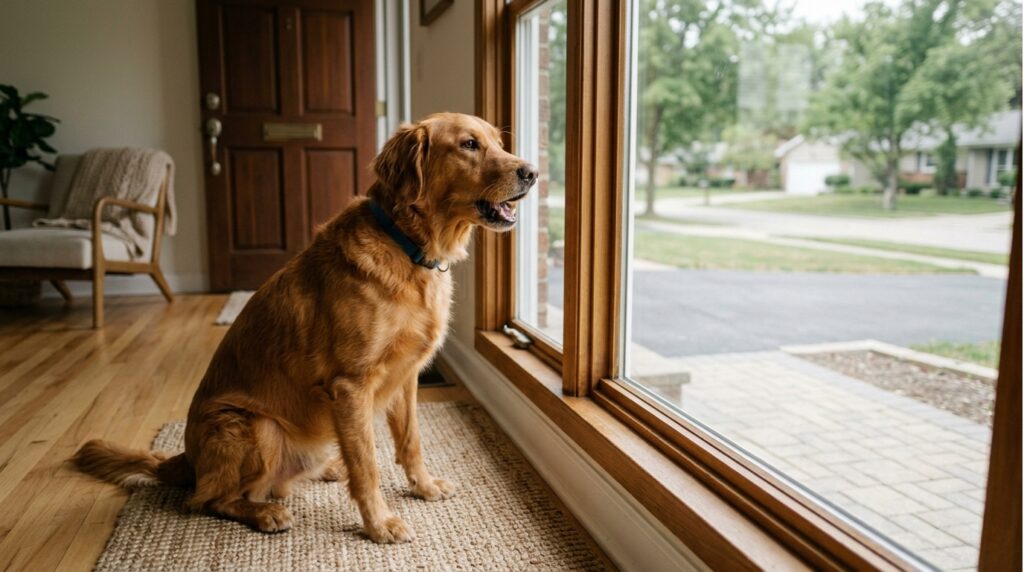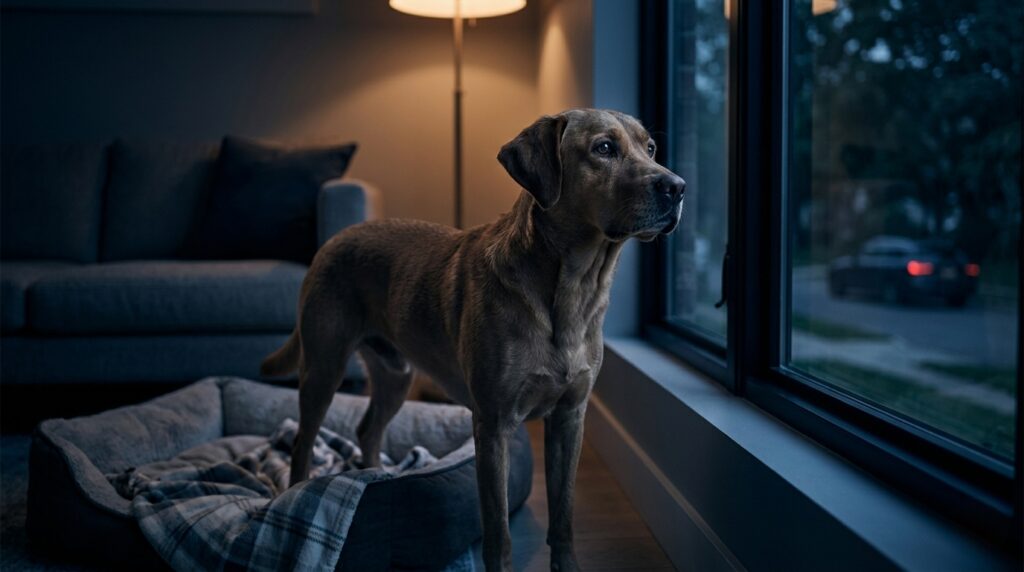

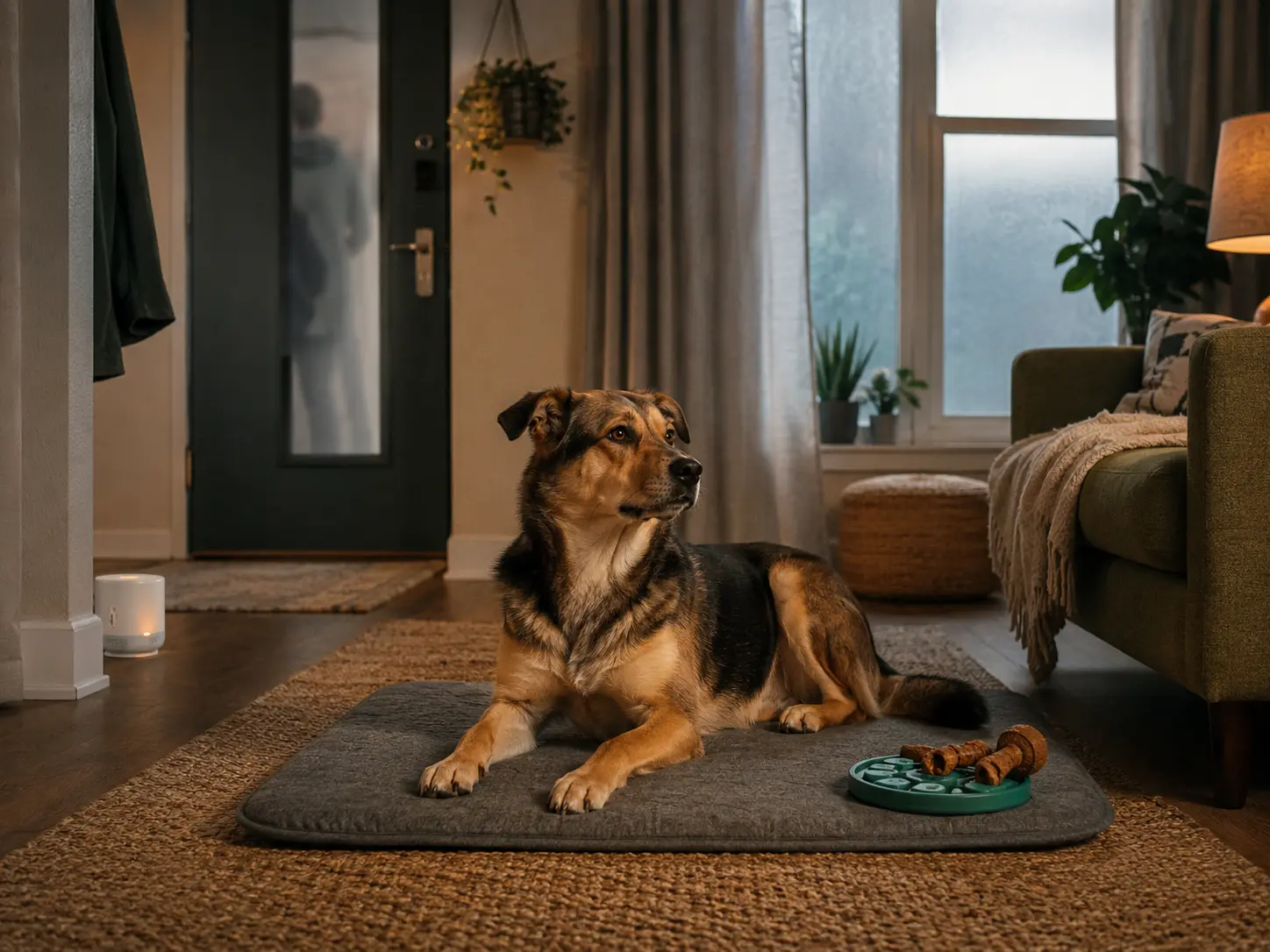
If you need to know how to stop dog barking in an apartment fast, you may be dealing with a neighbor complaint, a lease warning, work calls, or a dog that barks every time someone walks past the door.
The fastest humane plan is not to punish the barking. It is to reduce the trigger first, so your dog can pause, settle, and learn.
Start with this order:
- Block what your dog can see.
- Mask problem sounds.
- Move your dog to a calmer spot.
- Reward quiet pauses.
- Teach a quiet cue during calm moments.
- Use bark-control devices carefully, if at all.
Animal welfare and veterinary behavior sources commonly recommend finding the cause of barking, changing the environment, rewarding quiet behavior, and using reward-based training instead of punishment-first methods.
Who This Guide Is For
This guide is for dog owners in apartments, flats, condos, studios, maisonettes, and shared-wall homes in the US, UK, Canada, and other English-speaking areas.
It is useful if:
- Your dog barks at hallway noise.
- Your dog barks at the window or balcony.
- You got a neighbor complaint.
- You need fast relief but do not want a shock collar.
- You are comparing humane bark control methods.
- Your dog barks while you work from home.
- Your dog barks during short departures.
- “Quiet,” ultrasonic devices, or more exercise have not solved the problem.
This is not a guide for diagnosing illness, treating severe panic, or handling serious aggression.
Immediate Answer
To stop apartment barking fast without shock collars, reduce the trigger before you train the bark.
For window barking, use privacy film, curtains, or furniture changes so your dog cannot watch every person, dog, or delivery pass by.
For hallway barking, use white noise near the door, a draft blocker, rugs, and a calm resting spot away from the entry.
For barking when left alone, use short practice departures, sound masking, safe enrichment, and monitoring if possible. If your dog appears panicked or cannot settle, contact a veterinarian or qualified reward-based trainer.
Dogs Trust specifically recommends closing curtains, using frosted film, blocking window access, moving furniture away from windows, using radio sound to mask outside noise, and rewarding calm behavior.
Quick Decision Table
Why Apartment Barking Happens
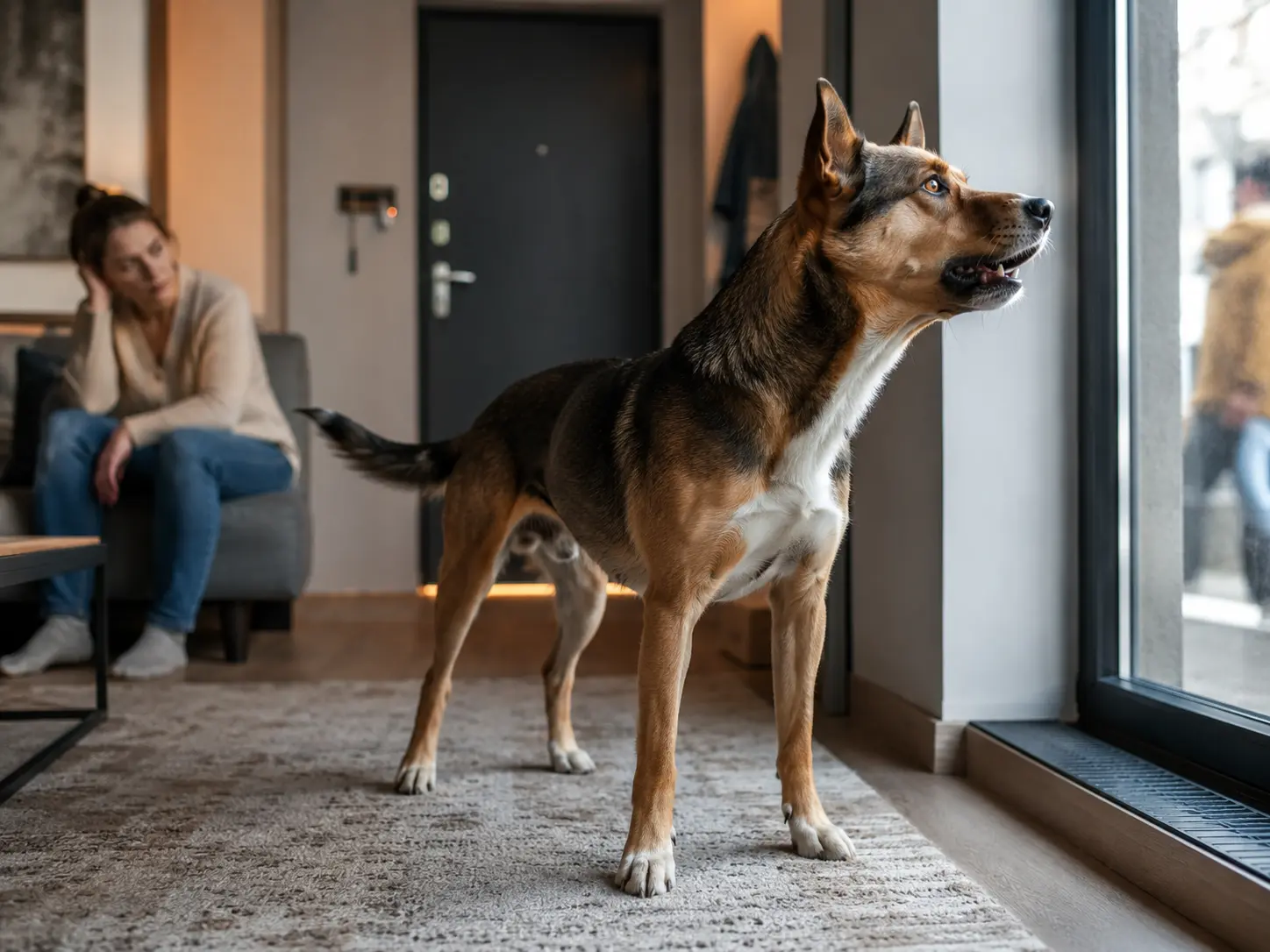
Dogs bark for many reasons, including excitement, frustration, boredom, fear, distress, or wanting something. Barking is also a normal way dogs communicate, but it can become a serious problem in shared-wall homes. RSPCA notes that dogs may bark when excited, frustrated, bored, scared, wanting something, or distressed when left alone.
Apartment barking can feel harder because triggers are close and repeated. Your dog may hear doors, elevators, footsteps, voices, delivery workers, mail slots, other dogs, or balcony sounds many times a day.
1. Hallway Alert Barking
Your dog hears footsteps, keys, doors, voices, or elevator sounds outside the apartment door.
You may see:
- Running to the door
- Barking at small sounds
- Stiff body posture
- Trouble settling after the sound passes
2. Window or Balcony Barking
Your dog sees people, dogs, cars, bikes, wildlife, or delivery workers outside.
If the trigger appears, your dog barks, and then the trigger goes away, the pattern can become stronger over time. This does not mean your dog is “bad.” It means the environment keeps giving your dog a reason to bark.
3. Barking When Left Alone
Barking when left alone can have different causes. Some dogs may be bored. Some may be reacting to outside sounds. Some may be distressed by being alone.
Do not diagnose separation anxiety from barking alone. But if your dog barks, howls, paces, destroys items, toilets indoors, drools, or tries to escape when alone, get help from a veterinarian or qualified behavior professional. RSPCA and Dogs Trust both describe barking when alone as a possible sign of distress or separation-related difficulty.
4. Boredom or Low Mental Stimulation
Some dogs bark more when they have too little to do. Food puzzles, sniffing games, safe chews, short training, and calm enrichment can help many dogs settle. Dogs Trust recommends food-based enrichment such as lick mats, puzzle feeders, treat trails, and safe scent games.
But more activity is not always the full answer. A dog can be physically tired and still bark at hallway sounds or window triggers.
5. High Arousal
If your dog is already very worked up, they may not respond to “quiet,” treats, toys, or devices.
In that moment, reduce the trigger first. Training works better when your dog can still think, eat, and turn back to you.
How to Stop Dog Barking in an Apartment Fast: Best Solutions by Situation
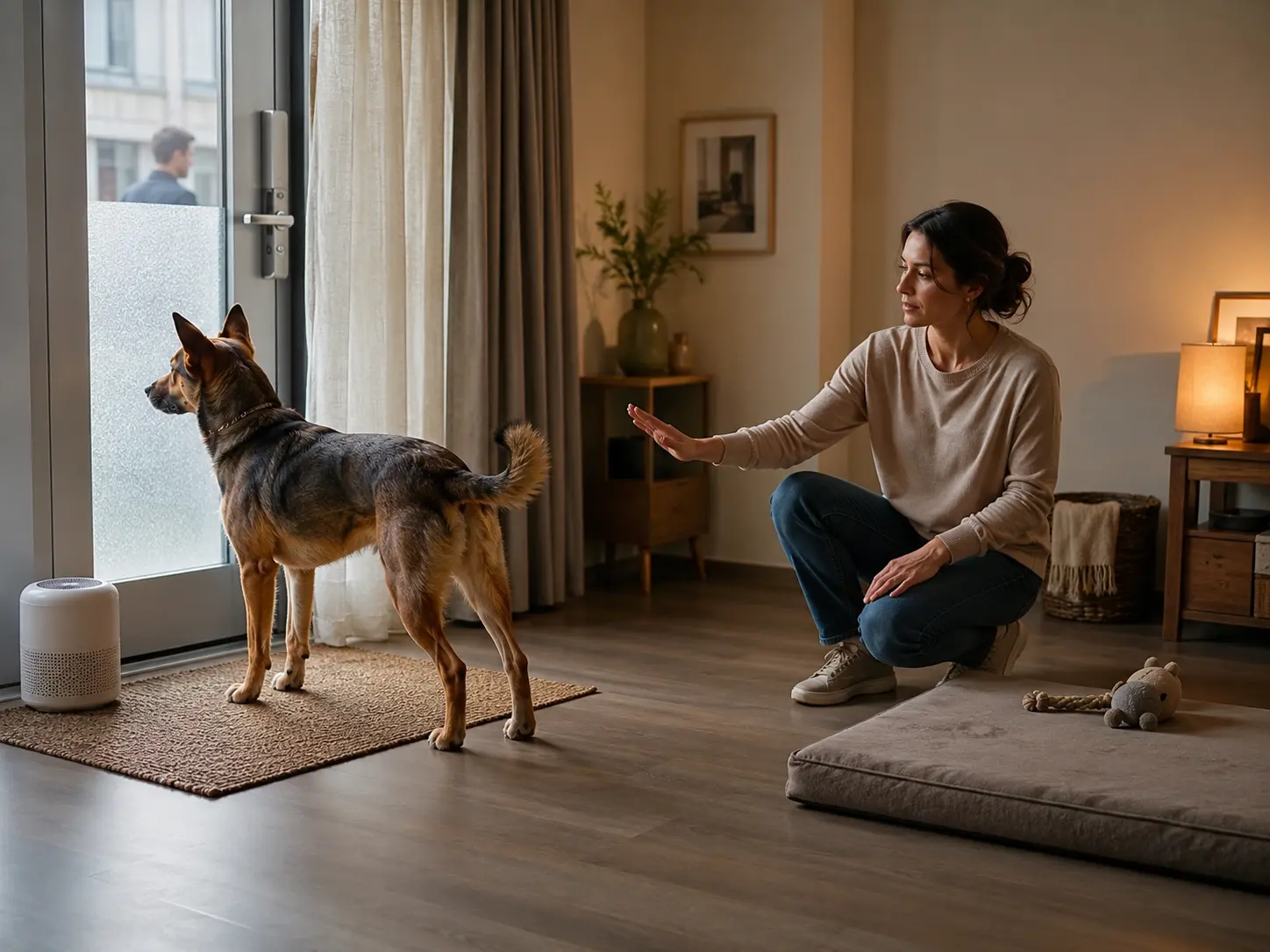
Solution 1: Block the Visual Trigger
This is often the fastest humane first step to stop dog barking at a window without a collar.
What to do
Reduce what your dog can see from windows, glass doors, balconies, or low blinds.
How to do it
Use:
- Removable privacy window film
- Frosted cling film
- Curtains partly closed
- Furniture moved away from the window
- Baby gates to block window access
- A calm mat away from the viewing spot
You do not need to make the room dark. You only need to reduce the moving trigger.
When to use it
Use this when your dog barks at:
- People walking past
- Dogs outside
- Cars
- Delivery workers
- Balcony movement
- Birds or squirrels
Best for: dogs that bark mainly when they see movement outside.
May not be enough for: dogs that bark mostly at sounds.
Dogs Trust recommends closing curtains, lowering blinds, using frosted film, blocking window access, and moving furniture away from windows. PetMD also notes that privacy film can reduce alert barking inside the home.
Solution 2: Use White Noise Near the Door
This is a useful first step for hallway barking.
What to do
Mask hallway sounds so your dog does not hear every small trigger.
How to do it
Place a white noise machine, fan, air purifier, radio, or calm background sound near the apartment door. Keep the volume comfortable.
You can also add:
- Door draft blocker
- Rug near the entry
- Soft furnishings to reduce echo
When to use it
Use this during:
- Busy hallway times
- Delivery hours
- Evening neighbor traffic
- Work calls
- Nap times
- Short departures
Best for: dogs that bark at footsteps, doors, elevators, voices, or hallway noise.
May not be enough for: dogs that bark because they can see outdoor triggers.
Dogs Trust recommends using radio sound to mask outside sounds, and PetMD notes that soothing music or white noise may help with sound-triggered alert barking.
Solution 3: Create a Calm Zone
You do not always need another room. Even in a small apartment, you can create a lower-trigger area.
What to do
Set up a calm spot away from the door or window.
How to do it
Use:
- Dog bed or mat
- Baby gate
- Covered crate only if your dog already likes it
- Curtains or privacy film
- White noise
- Safe chew, lick mat, or food puzzle
- Predictable rest routine
Even moving your dog a few feet away from the door can help if you also reduce sound and sight.
When to use it
Use it before barking starts:
- Before delivery windows
- Before neighbors come home
- Before meetings
- Before short departures
- At night when hallway noise starts
Best for: apartment dogs with repeated triggers.
Use caution if: your dog panics when confined or separated.
Do not use confinement as punishment. If your dog claws, drools, pants heavily, screams, or tries to escape, stop and get professional help.
Solution 4: Reward Quiet Pauses
Many owners worry that treats will reward barking. The timing matters.
What to do
Reward the moment your dog pauses, turns away, softens, looks back at you, or chooses silence.
How to do it
Keep small treats near trigger areas.
When your dog notices a sound or person:
- Stay calm.
- Wait for a small pause.
- Mark it with “yes” or “good.”
- Toss or place the treat away from the trigger.
- Repeat before barking builds again.
If your dog is already barking hard, block the trigger or add distance first.
When to use it
Use this during low or medium trigger moments, such as:
- One quiet hallway sound
- One person passing outside
- Your dog noticing movement but not exploding
- One bark followed by a pause
Best for: dogs that can still eat, turn, and respond.
May not be enough for: dogs that are too stressed to take food or listen.
ASPCA and VCA both describe rewarding quiet behavior as part of quiet-cue or barking training.
Solution 5: Teach “Quiet” Before You Need It
A quiet cue often fails because the dog only hears it during chaos.
What to do
Teach “quiet” as a skill during easier moments.
How to do it
Start when your dog is calm:
- Wait for silence.
- Say “quiet” in a soft voice.
- Mark the silence.
- Reward.
- Repeat in short sessions.
Later, practice with mild triggers, such as a low-volume door sound or a person walking far away outside.
Avoid shouting “quiet” from across the room. VCA explains that loudly telling a dog to be quiet may add noise, anxiety, and conflict instead of teaching the cue clearly.
When to use it
Use it after your dog understands the cue. Do not rely on it as your first emergency tool.
Best for: dogs with calm moments who can learn with rewards.
May not be enough for: dogs in panic, heavy distress, or high arousal.
Solution 6: Plan for Workdays and One-Day Departures
If your dog barks only when you leave, do not test a new bark device for a full workday.
What to do
Prepare the apartment before you leave.
How to do it
Before leaving:
- Close curtains or use privacy film.
- Turn on white noise near the door.
- Give a safe chew or food puzzle.
- Block balcony or window access.
- Practice short departures first.
- Use a camera or audio monitor if possible.
- Ask a sitter, walker, friend, or neighbor to check in if needed.
When to use it
Use this when barking happens mainly during owner absence or schedule changes.
Best for: mild routine-change barking or alert barking when alone.
Not enough for: panic, escape attempts, heavy drooling, long howling, or inability to settle.
Dogs Trust recommends expert support when barking while alone may be linked with worry, especially if the behavior could get worse.
Solution 7: Be Careful With No-Shock Bark Devices
Some owners compare ultrasonic devices, vibration collars, citronella collars, and sound devices because they want fast relief without shock.
These tools are not all the same. But no shock does not automatically mean low-stress.
What to do
Treat devices as support tools, not the main solution.
Ask before buying
- What trigger is causing the barking?
- Could this scare or startle my dog?
- Could it affect another pet?
- Could it activate at the wrong time?
- Would it be used while unsupervised?
- Does it teach my dog what to do instead?
When to use it
Only consider devices after you have tried trigger blocking, sound masking, calm zones, and reward-based training.
May be considered only with caution: supervised cases where the dog is not fearful or noise-sensitive.
Avoid or seek professional help first if: your dog is anxious, elderly, unwell, noise-sensitive, easily startled, or already distressed.
BVA warns that electric shock collars can cause stress, pain, fear, and welfare problems. BVA also raises concern about anti-bark collars that use noise, vibration, ultrasonic sound, water, or citronella spray. RSPCA South Australia warns that anti-barking collars do not address the underlying cause or teach an alternative behavior.
Comparison: Humane Bark Control Methods for Apartments
Which Option Fits Which Situation?
If your dog barks at the apartment door
Start with white noise, a door draft blocker, a rug, and a calm mat away from the door.
Do not start with a collar. The first issue is likely the repeated sound trigger.
If your dog barks at the window
Start with privacy film, curtains, and moving furniture away from the window.
This often helps faster than training alone because it reduces the visual trigger.
If your dog barks at night
Use white noise, reduce hallway sound, and set up a calm sleep zone away from the front door.
Avoid yelling. It can add more stress and attention.
If your dog barks when you leave
Use a pre-leaving routine, sound masking, visual blocking, safe enrichment, and short practice departures.
If barking is intense or linked with distress signs, do not rely on gadgets. Speak with a veterinarian or qualified reward-based trainer.
If your dog barks even after long walks
Do not assume more exercise is the only answer.
Your dog may be physically tired but still sensitive to hallway sounds or window movement. Use trigger reduction and calm training.
Real-World Scenarios
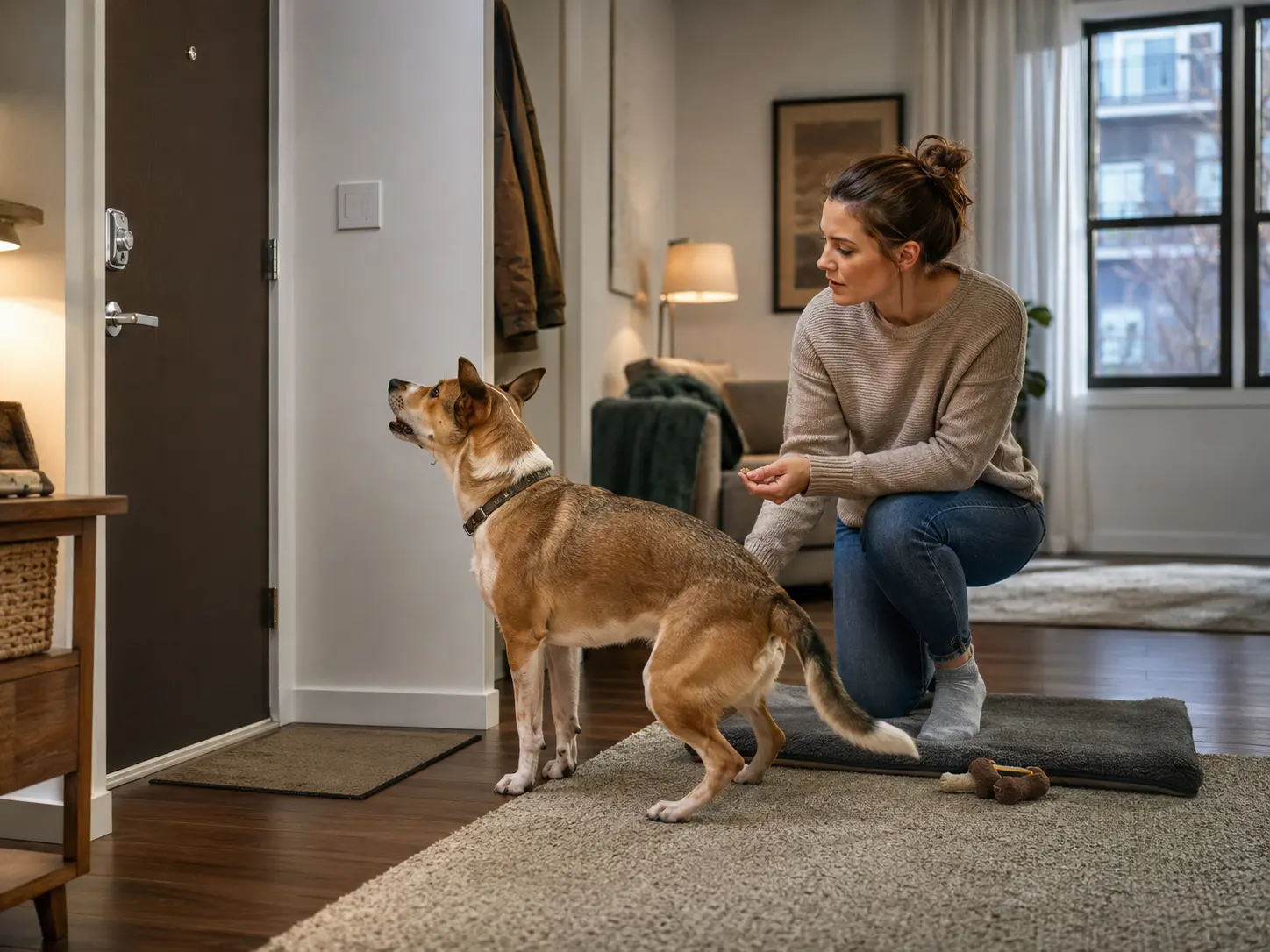
Real-World Scenario: Hallway Watchman
An owner notices their dog barking every time someone walks past the apartment door.
A better first step is not shouting “quiet.” The owner can place white noise near the door, add a draft blocker, and reward the dog for turning away from the door.
Real-World Scenario: Window Barker
An owner sees their dog staring out the window and barking at people, dogs, and delivery workers.
A fast humane step is privacy film on the lower part of the window. Then the owner can reward the dog for resting away from the window.
Real-World Scenario: Once-a-Week Office Day
An owner works from home most days but leaves once a week. The dog barks during that absence.
A safer plan is to practice short departures, block window access, use white noise, and check whether the dog is settling or becoming distressed.
Real-World Scenario: Exercise Did Not Fix It
An owner walks the dog daily, but the dog still barks at every neighbor sound.
This may mean the issue is not only unused energy. The plan should focus on apartment triggers, not just more exercise.
What Owners Often Misunderstand
“Fast” means harsh
Fast can mean changing the environment first. Blocking a window or masking hallway noise can reduce barking without punishment.
“Humane” means slow
Training takes time, but management can help quickly when it reduces the trigger.
“Treats reward barking”
Treats can be used poorly, but they can also be used well. Reward the quiet pause, turn away, or calm behavior. If your dog is barking hard and cannot think, reduce the trigger first.
“More exercise always fixes barking”
Exercise helps many dogs, but it does not remove hallway sounds, window triggers, or distress when alone.
“A collar is easier”
A collar may seem easier, but it can create new problems if it startles the dog, activates at the wrong time, or becomes the only plan.
What Not to Do
Avoid:
- Shouting “quiet” repeatedly
- Using shock collars
- Leaving bark devices as a full-day unsupervised plan
- Letting your dog watch and bark at the window for hours
- Harshly correcting barking or fear signals
- Assuming your dog is stubborn
- Buying a gadget before identifying the trigger
- Ignoring sudden behavior changes
Merck Veterinary Manual warns that confrontation and punishment can heighten arousal, anxiety, and fear, while reward-based training supports behavior change.
When These Solutions May Not Be Enough
DIY management may not be enough if:
- Your dog panics when left alone.
- Barking starts suddenly.
- Barking gets worse quickly.
- Your dog seems confused or disoriented.
- Your dog shows pain signs, appetite changes, sleep changes, or restlessness.
- Your dog cannot settle after triggers are reduced.
- Your building noise is constant and severe.
- Your dog reacts to many triggers at once.
Cornell lists disorientation, sleep pattern changes, restlessness, anxiety, and learning changes as possible clinical signs of cognitive dysfunction in dogs, and notes that a veterinarian should rule out other conditions with similar signs.
When to Contact a Vet or Qualified Trainer
Contact a veterinarian if barking is new, sudden, unusual, or appears with pain, confusion, appetite changes, sleep changes, disorientation, or other health changes.
Contact a qualified reward-based trainer if:
- You have received formal complaints.
- Your housing may be at risk.
- Your dog is highly worked up often.
- Your dog cannot recover after triggers.
- DIY management has not helped.
- You are considering a bark collar or deterrent device.
- Your dog seems scared, shut down, or distressed.
Look for a trainer who can explain the plan clearly, uses positive reinforcement, avoids punishment-first methods, and has relevant credentials or experience. CCPDT warns that dominance-based language and primarily punishment-based methods are red flags. MSD Veterinary Manual also recommends choosing trainers who use positive reinforcement rather than punishment.
Final Recommendation
For most apartment barking, start here:
- Block the trigger.
- Mask the sound.
- Create a calm zone.
- Reward quiet pauses.
- Train “quiet” during calm moments.
- Use devices only as limited support, not the main fix.
- Contact a veterinarian or qualified trainer when barking is sudden, intense, or linked with distress.
If you need relief tonight, start with privacy film or curtains for window barking and white noise near the door for hallway barking. These are low-risk, humane first steps compared with punishment-based bark collars.
The safest fast plan is:
Management first. Training second. Tools last.
Quick Summary
To stop dog barking in an apartment fast without shock collars:
- Block window triggers.
- Mask hallway noise.
- Create a calm zone.
- Reward quiet pauses.
- Teach “quiet” before emergencies.
- Use bark devices carefully, if at all.
- Do not rely on exercise alone.
- Speak with a vet if barking starts suddenly or appears with health changes.
- Speak with a qualified trainer if complaints continue or your dog is highly distressed.
FAQs
What is the fastest humane way to stop apartment barking?
Reduce the trigger first. Use privacy film for window barking and white noise near the door for hallway barking. Then reward quiet pauses.
Can I stop dog barking at a window without a collar?
Yes. Use privacy film, curtains, furniture changes, and reward your dog for moving away from the window.
Do ultrasonic bark devices work in apartments?
They may help some dogs, but they are not a full training plan. They may also bother dogs that are noise-sensitive or already distressed.
Is a vibration collar humane?
Not automatically. A vibration collar does not use electric shock, but it can still startle or worry some dogs.
Will giving treats during barking reward the barking?
It can if the timing is poor. Reward the quiet pause, turn away, or calm behavior. If your dog is barking hard and cannot respond, reduce the trigger first.
What should I do if my neighbor already complained?
Start with the lowest-risk changes today: block window views, use white noise near the door, move your dog’s resting spot, and track when the barking happens. If the complaint is formal or your housing is at risk, contact a qualified reward-based trainer quickly.