

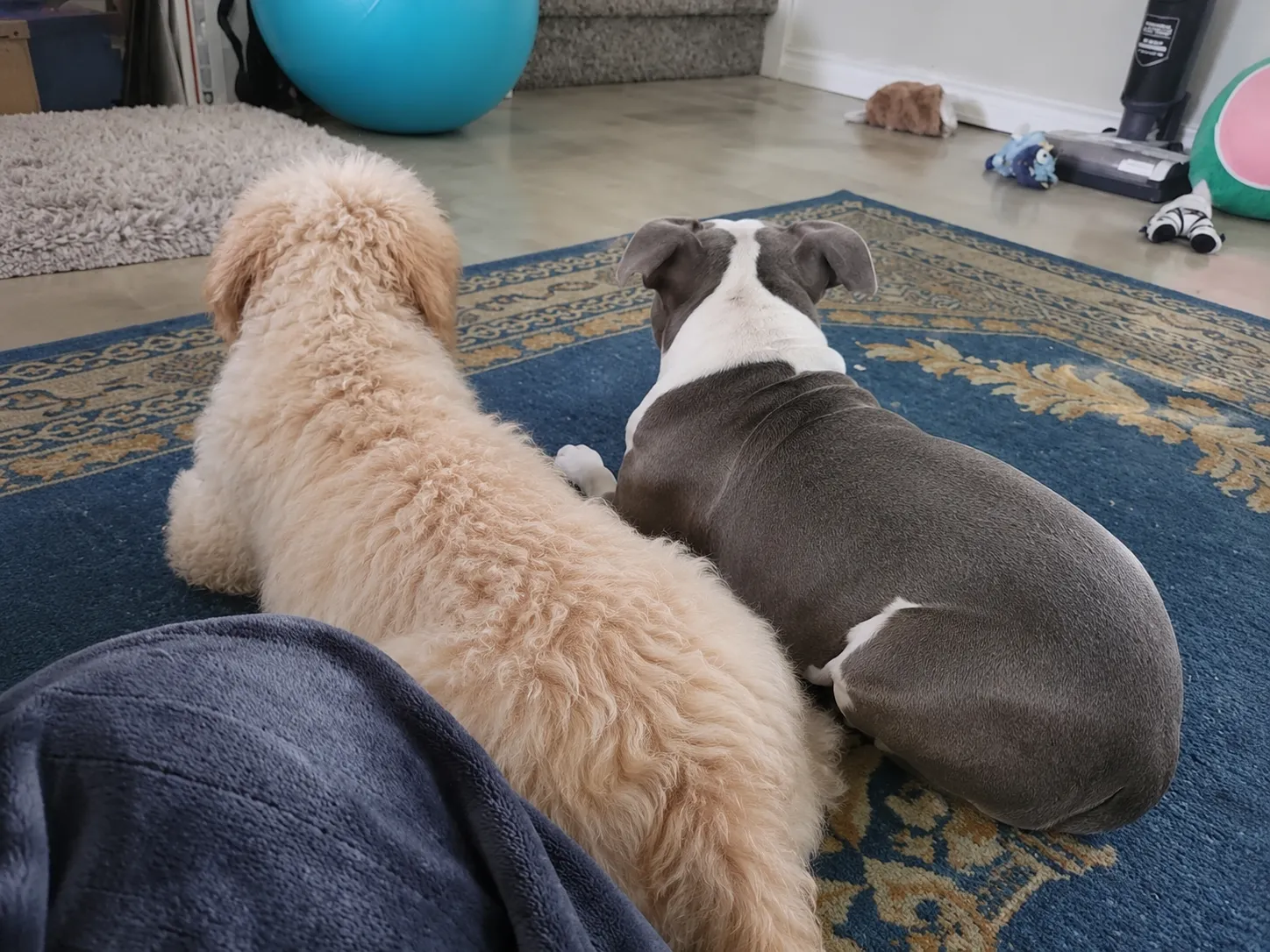
If your surviving dog suddenly follows you everywhere, cries when you leave, or seems unable to settle after losing their companion, the change can be worrying. The first useful question is whether your dog is struggling throughout the day or mainly when you leave.
Quick answerCan a dog develop separation anxiety after another dog dies? Yes, a surviving dog can develop new separation-related distress after losing a companion, but not every behavior change after a loss is separation anxiety.
In a study of 426 dog owners, people reported changes such as increased attention seeking, less play, lower activity, increased fearfulness, eating changes, and more vocalizing after another dog died. These were owner reports, not clinical diagnoses of grief or separation anxiety. [1]
If your dog seems different throughout the day, they may be adjusting more broadly to the loss. If distress repeatedly begins when you prepare to leave or shortly afterward—such as pacing, barking, food refusal, scratching exits, house-soiling, or escape attempts—separation distress becomes more concerning. The separation-anxiety symptoms guide can help you compare the pattern. [3]
What Should I Do Today If This Started After My Other Dog Died?
- Keep meals, walks, bathroom breaks, and sleep routines reasonably familiar. [2]
- Monitor eating, drinking, toileting, sleep, and general activity.
- If being alone seems to trigger the problem, record a short, safe absence to see when distress begins. A pet camera can help you observe the first signs. [3]
- Contact your veterinarian if physical changes, severe panic, self-injury, or dangerous escape behavior appears.
Household routines can change after a loss too. Aim for reasonable consistency rather than expecting everything to remain exactly the same. [2]
Is My Dog Grieving or Developing Separation Anxiety?
Look at when the behavior happens. Changes throughout the day may fit broader adjustment after the loss, while separation distress is more specifically linked to your departure or absence.
| What You Notice | May Fit Broader Adjustment | More Concerning for Separation Distress | Next Step |
|---|---|---|---|
| Following you more | More contact seeking throughout the day. | Your dog cannot settle when you prepare to leave. | Observe a short separation. |
| Vocalizing | Whining occurs at different times around the home. | Barking or howling repeatedly begins around departure. | Use video to identify timing. |
| Eating less | Appetite is generally reduced. | Your dog eats with you home but refuses food when left. | Contact your veterinarian if reduced eating is significant or persistent. |
| Activity changes | Your dog generally plays less or rests more. | Your dog settles when you are home but paces when alone. | Compare home behavior with absence video. |
| House-soiling | It occurs alongside broader routine or health changes. | It repeatedly happens specifically during absences. | Rule out medical and toileting causes. |
| Exit behavior | Your dog spends more time in familiar areas. | Scratching, chewing, or escape attempts begin after departure. | Treat dangerous escape behavior as a safety issue. |
Following you more
Broader adjustment: more contact seeking throughout the day.
Separation concern: your dog cannot settle when departure begins.
Next step: observe a short separation.
Vocalizing
Broader adjustment: whining happens at different times.
Separation concern: barking or howling repeatedly starts around departure.
Next step: use video to identify timing.
Eating less
Broader adjustment: appetite is generally reduced.
Separation concern: your dog eats while you are home but refuses food when alone.
Next step: contact your veterinarian if the change is significant or persistent.
Exit behavior
Broader adjustment: your dog spends more time in familiar areas.
Separation concern: scratching, chewing, or escape attempts begin after you leave.
Next step: treat dangerous escape behavior as a safety issue.
Practical comparison only—not a diagnostic test: no individual behavior can diagnose grief or separation anxiety. [1] [2] [3]
What If I Have to Go to Work and Cannot Stay Home With My Dog?
Do not use an unavoidable full workday as a separation-training exercise if your dog is already panicking. Where practical, use temporary support while practicing shorter, manageable absences separately.
For day-to-day coverage, our guide to working full time with a dog who has separation anxiety compares daycare and pet-sitter options, while the boarding vs in-home sitter guide is more useful for travel or overnight care.
Possible temporary options include:
- a trusted family member or friend
- a pet sitter
- a dog walker where appropriate
- suitable daycare if your dog is comfortable there
- staggered household schedules
- temporary work-from-home flexibility where available
- a camera to monitor necessary absences
Veterinary behavior guidance recommends that simulated absences initially remain short enough that they do not trigger significant anxiety. [3]
When Should I Call My Veterinarian, and When Is It Urgent?
Contact your regular veterinarian for persistent or concerning changes. Seek urgent veterinary care for serious injury or another immediate medical emergency.
Call your veterinarian if:
- appetite or drinking changes are significant or persistent
- urination, bowel movements, or house-soiling patterns change
- your dog’s behavior continues to worsen
- your dog cannot tolerate even very short absences
- an older dog develops new confusion or major sleep changes
- you suspect pain, illness, or another medical contributor
Seek urgent veterinary care if:
- your dog has a serious injury from an escape attempt
- there is significant bleeding
- your dog has another immediate medical emergency
Persistent behavior changes should not automatically be attributed to grief because medical problems can produce overlapping signs. [2]
How Is Separation Anxiety Treated After the Loss of Another Dog?
Treatment focuses on reducing severe distress and gradually rebuilding the dog’s ability to tolerate being alone. Moderate or severe cases may require veterinary treatment alongside behavior modification. [3] [4]
- Record a short absence.
Identify the earliest point when your dog stops settling normally. - Reduce repeated severe episodes where practical.
Temporary support can help prevent every unavoidable absence from becoming another intense episode. - Restart at an easier duration.
Begin with separations short enough that your dog remains below the point of significant distress. [3] - Increase time according to your dog’s response.
Progress based on behavior rather than a fixed schedule. - Involve your veterinarian when anxiety is moderate or severe.
A veterinarian may discuss behavior modification together with prescription medication when appropriate. Medication should be selected and monitored by the treating veterinarian. [3] [4]
Who Can Help With Severe Separation Anxiety?
Start with your regular veterinarian. Complicated or persistent cases may also benefit from a veterinary behavior specialist or a qualified behavior professional experienced with separation-related problems.
- Regular veterinarian: medical assessment, treatment discussion, and referral when needed.
- Veterinary behavior specialist: severe or complicated behavior cases.
- Qualified behavior professional: structured behavior-modification support, coordinated with veterinary care when appropriate.
What Should I Avoid Doing?
Avoid strategies that repeatedly push your dog into severe distress or delay needed medical care.
- Do not suddenly test your dog with a long absence to see whether they eventually settle.
- Do not assume major appetite, drinking, or toileting changes are simply grief.
- Do not adopt another dog solely as treatment for the current problem.
- Avoid unnecessary major routine changes while your household is already adjusting.
- Do not keep using confinement that leads to frantic escape attempts or injury. [4]
How Can I Tell Whether My Dog Is Starting to Adjust?
Track gradual changes in everyday behavior rather than looking for one exact recovery date.
- appetite returning toward the dog’s usual pattern
- more interest in familiar walks, play, or enrichment
- more normal rest and sleep
- shorter or less intense distress around departures
- ability to settle during gradually longer practice absences
How Should I Track My Dog’s Alone-Time Progress?
Use the same few measures after each planned practice absence so you can compare sessions instead of relying on memory.
| Time Alone | First Stress Sign | Ate? | Barking/Pacing? | Recovery |
|---|---|---|---|---|
| Example: 2 min | Watched door at 1:20 | Yes | No | Settled quickly |
This tracker is a practical monitoring tool, not a validated diagnostic scale.
Is My Dog’s Behavior After the Loss Normal? What Did Research Find?
Behavior changes after another dog dies are commonly reported, but research cannot tell us exactly what every surviving dog is feeling.
A 2022 Scientific Reports study collected reports from 426 Italian dog owners. [1]
Owner-reported behavioral changes [1]
These percentages are owner reports, not veterinary diagnoses.
The study found associations between the quality of the relationship between the dogs and some reported changes. The researchers also cautioned that the study could not confirm that the surviving dogs were experiencing grief. [1]
How Long Can My Dog Act Differently After the Other Dog Dies?
There is no fixed recovery timeline for an individual dog. Owners in the study reported very different durations. [1]
| Owner-Reported Outcome | Percentage |
|---|---|
| No reported behavioral change | 13.4% |
| Changes under 2 months | 29.4% |
| Changes lasting 2–6 months | 32.2% |
| Changes lasting more than 6 months | 24.9% |
These figures describe reports from one study. They should not be used as a recovery timetable for an individual dog.
Should I Give My Dog More Attention After the Loss?
Yes. You can comfort your dog while keeping daily life as predictable as practical. Cornell recommends comfort and routine for surviving pets. [2]
Provide comfort without feeling that you must remain in constant physical contact. When your dog is able, continue normal opportunities to rest and settle independently.
Should I Get Another Dog So My Surviving Dog Is Not Alone?
Do not rush into another adoption solely to treat the current distress. Another dog may eventually be right for your household, but there is no guarantee that a new companion will solve separation anxiety. For the research and decision factors, see whether getting a second dog helps separation anxiety.
If your surviving dog’s anxiety stayed exactly the same, would you still want and be able to care for another dog?
- Can your household comfortably care for another dog?
- Do you have time to manage both dogs individually?
- Is your surviving dog ready for introductions?
- Can you find a compatible dog?
- Is your household emotionally ready for another dog?
What Is the Bottom Line?
A surviving dog can show meaningful changes after another dog dies, including new separation-related distress, but one behavior cannot tell you whether the cause is grief, anxiety, adjustment, or a medical problem.
- Look at whether changes happen throughout the day or mainly around departures.
- Keep routines reasonably predictable. [2]
- Use video when being alone appears to trigger the problem. [3]
- Do not repeatedly force long absences when your dog is clearly distressed. [3]
- Contact your veterinarian for persistent physical or behavioral changes.
Frequently Asked Questions
Can dogs get separation anxiety after another dog dies?
Yes, a surviving dog can develop new separation-related distress after a companion dies. Research documents owner-reported behavioral changes after companion loss, but those reports do not diagnose every dog with grief or separation anxiety. [1]
How can I tell if my dog is grieving or has separation anxiety?
Look at timing. General changes in appetite, play, sleep, or social behavior may happen throughout the day. Separation distress is more specifically linked to departure or absence and may involve pacing, barking, food refusal, destruction, or escape behavior. [3]
What should I do if I have to leave my dog alone for work?
If your dog is panicking, do not use a full workday as a training exercise. Where practical, temporary support may include family help, a sitter, suitable daycare, schedule adjustments, or another safe arrangement while shorter practice absences are trained separately.
Should I crate my dog if they panic when I leave?
Not automatically. If a dog already rests calmly in a crate, it may be an appropriate setup. If confinement causes frantic scratching, escape attempts, or injury risk, review when a crate can make separation anxiety worse and discuss unsafe behavior with your veterinarian or behavior professional. [4]
Should I get another dog to help my surviving dog?
Do not adopt another dog solely as treatment. Consider another dog only when the decision makes sense for your household even if the surviving dog’s current behavior does not improve.
When should I call the vet after my dog loses a companion?
Contact your veterinarian for persistent appetite or drinking changes, toileting problems, worsening behavior, severe anxiety, inability to tolerate brief absences, or possible pain or illness. Seek urgent care for serious injury or another immediate medical emergency.
Sources & references
Sources and Research
- Uccheddu S, Ronconi L, Albertini M, et al. (2022). Domestic dogs (Canis familiaris) grieve over the loss of a conspecific. Scientific Reports, 12, 1920.Open source ↗
- Cornell University College of Veterinary Medicine. Pet Loss Resources and Support.Open source ↗
- Merck Veterinary Manual. Behavior Problems of Dogs — Separation Distress Disorder.Open source ↗
- American Animal Hospital Association (AAHA). Separation Anxiety in Pets: Signs, Causes, and Solutions.Open source ↗
Evidence note: research directly distinguishing canine grief from separation anxiety after the death of another dog remains limited. Owner-reported behavior should not be treated as proof of a specific emotional state or diagnosis.
Transparency: comparison tables, progress tracking, and decision checks in this article are practical editorial frameworks, not validated diagnostic tools.
This article provides general educational information and does not claim veterinary review.
 ✓
✓