

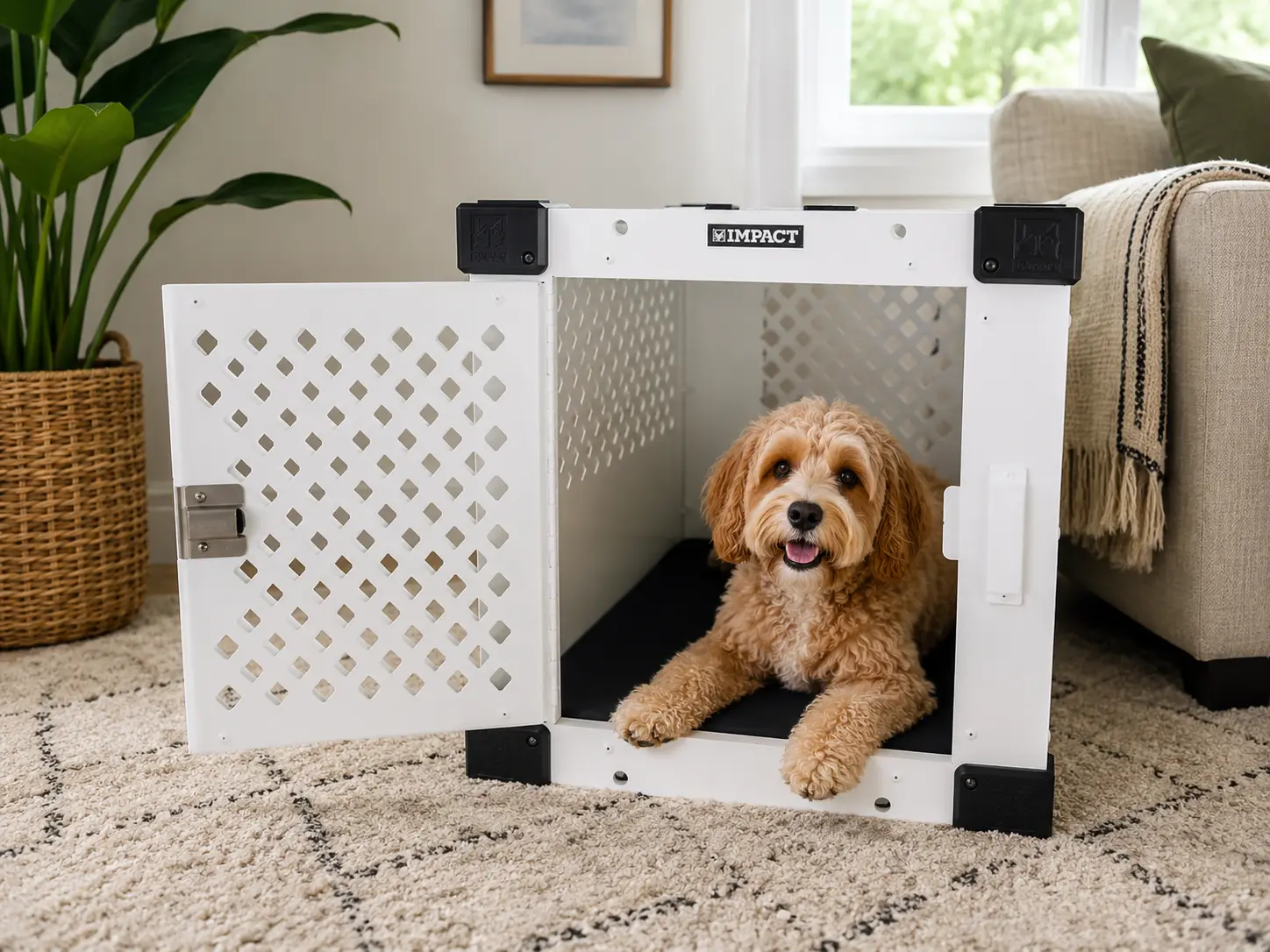
Puppy barking in crate during the day is often caused by daytime activity, confinement frustration, discomfort, overstimulation, or difficulty being alone. A puppy may still sleep quietly in the crate at night because nighttime conditions are usually calmer and more supportive of sleep.
Start by identifying exactly when the barking begins. Then adjust the crate location, pre-nap routine, session length or alone-time training based on your puppy’s specific trigger.
What to Do Before the Next Crate Session
- Take your puppy out for a potty break.
- Offer a short sniffing or age-appropriate activity session.
- Use a calm wind-down before closing the crate door.
- Keep the session shorter than the puppy’s current barking threshold.
- Use a camera and note the time of the first bark.
- If behavior escalates toward panic, reduce the duration and make the next session easier.
Your puppy may sleep peacefully in the crate all night but start barking within minutes during the day. This usually does not mean your puppy has forgotten crate training.
Daytime sessions may be harder because the puppy is awake, distracted by household activity, frustrated by confinement, worried about your absence or physically uncomfortable.
The right solution depends on when the barking starts and whether it decreases or escalates.
Identify When the Barking Starts Before Changing the Routine
The timing of the barking can help you identify the most likely cause and choose the right first adjustment.
| Barking pattern | Possible cause | First adjustment |
|---|---|---|
| Starts when the crate door closes | Confinement frustration | Practice very short door closures while staying nearby |
| Starts when you leave the room | Difficulty being alone | Train brief absences separately from crate time |
| Starts when a chew or food toy ends | The item may be occupying the puppy without yet teaching calm after it ends | Stay nearby, observe the response and practice a very brief calm pause after the toy is empty |
| Starts when people or pets move nearby | Visual stimulation or fear of missing out | Reduce the view or move the crate away from busy areas |
| Starts after a short nap | The puppy may be awake, uncomfortable or need the bathroom | Review camera footage before extending the nap |
| Starts mildly and becomes frantic | Possible fear or confinement distress | End the session safely and make the next session easier |
| Begins suddenly after previous success | A routine, health or environmental change | Identify what changed before adjusting the training |
A puppy that enters the crate for food but panics when the door closes may enjoy the food without being comfortable with confinement.
Similarly, a puppy that sleeps only after becoming exhausted has not necessarily learned how to relax in the crate while awake.
Daytime Crate Barking Usually Has One of These Six Causes
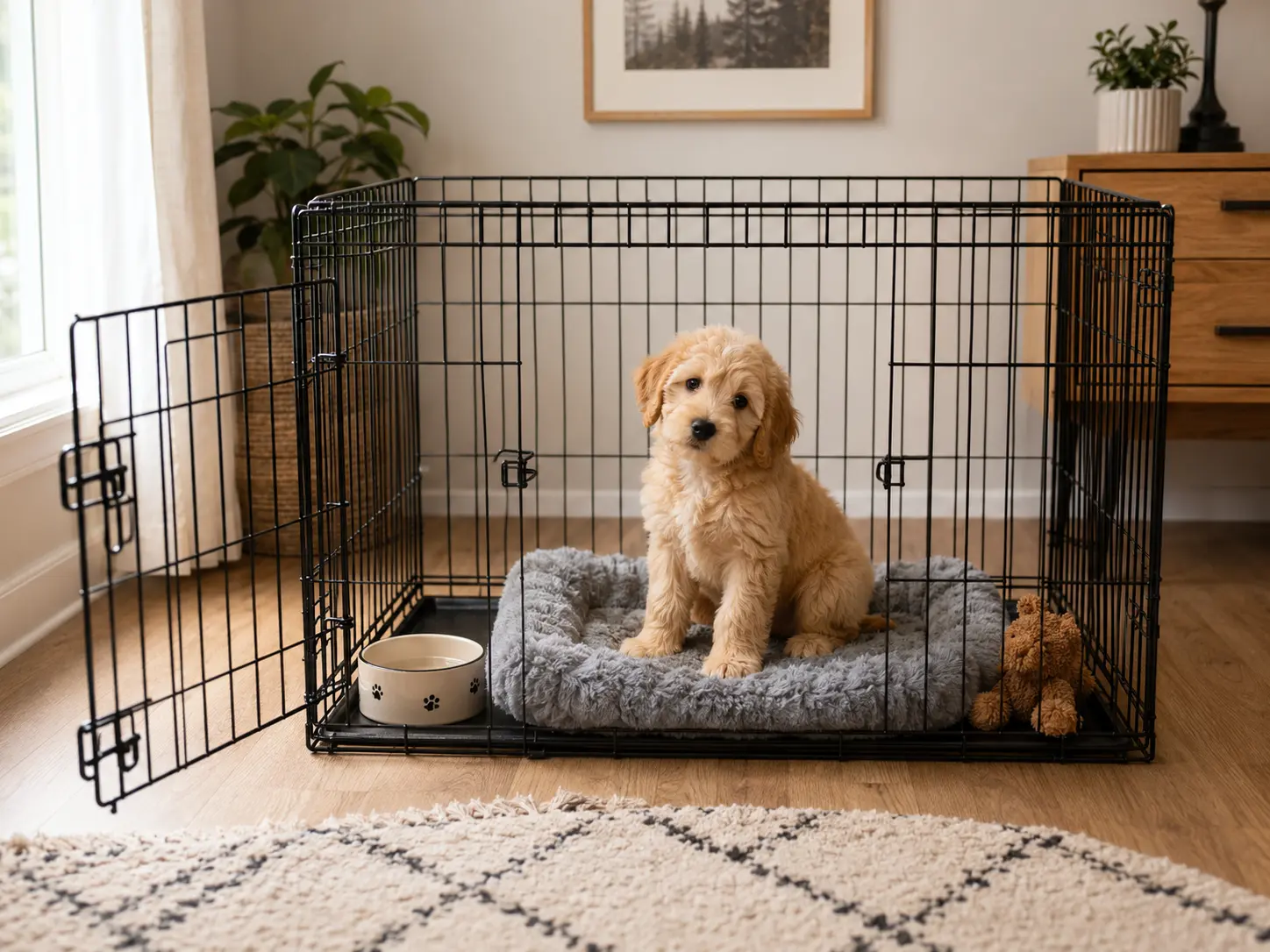
More than one cause may be present, so change one variable at a time and watch what happens.
1. Your Puppy Is Not Ready to Sleep
A puppy that recently woke up or has had little chance to move and explore may not be ready for another nap. Offer a short sniff walk, gentle play, food search or reward-based training, followed by a calm transition. Avoid trying to exhaust the puppy with intense activity.
2. Your Puppy May Be Overtired
Overtired puppies may become bitey, frantic, noisy or unable to stay with one toy. More excitement can make settling harder. Try an earlier nap, lower stimulation and a predictable wind-down routine.
3. Household Activity Is Keeping Your Puppy Alert
Children, pets, doors, traffic and people moving nearby can keep a puppy watching instead of resting. Test one adjustment at a time:
- Move the crate away from heavy foot traffic.
- Use a partial cover or quieter room to reduce stimulation.
- Move the crate closer if distance increases worry.
- Use steady background noise when sudden sounds are the trigger.
Important: Keep airflow open when using a cover, and remove it if the puppy appears more worried or frustrated.
4. The Crate Predicts That You Are Leaving
If barking starts when you pick up keys, put on shoes or disappear, practice those cues without always leaving. Build out-of-sight time in very small steps that end before distress begins.
If the barking is mostly tied to your departure rather than the crate itself, compare the wider pattern in dog barking when left alone: separation vs. habit.
5. Barking Has Previously Opened the Door
Barking may continue when it regularly brings attention, another chew, release or play. Mild learned frustration often includes pauses and changing intensity. Barking that keeps escalating or appears with panting, drooling or escape attempts is more concerning.
6. The Crate or Puppy May Be Uncomfortable
Check for a potty need, heat, drafts, wet bedding, thirst, teething discomfort, digestive upset, pain or an incorrectly sized crate. The puppy should be able to stand, turn around and lie down comfortably.
Safety note: Remove collars, tags or equipment that could catch on the crate. Contact a veterinarian when sudden barking appears with pain, vomiting, diarrhea, appetite change, unusual thirst, lethargy or difficulty lying down.
Nighttime Is Easier Because the Environment Supports Sleep
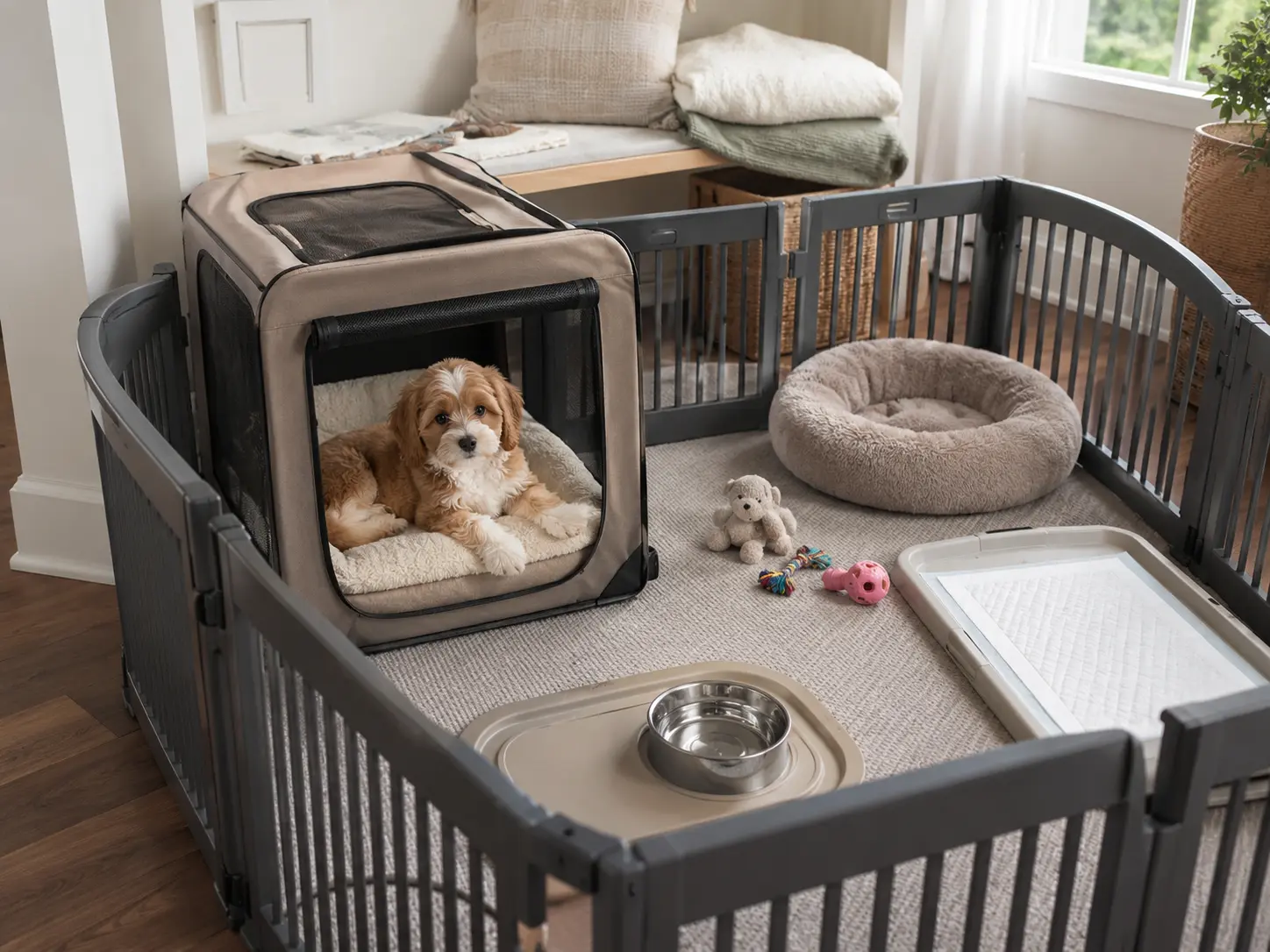
Sleeping quietly at night shows that your puppy can rest in the crate under nighttime conditions. It does not necessarily mean the puppy is comfortable with daytime confinement or being left alone.
The crate may be easier at night because:
- The puppy is naturally ready for a longer sleep period.
- The room is quieter and darker.
- The owner may be sleeping nearby.
- Fewer people, animals and vehicles are moving.
- Bedtime follows a predictable routine.
- The puppy is not expecting play, food or attention.
- The nighttime crate may be in a different location.
Moving the daytime crate into the bedroom may help some puppies, but it will not automatically solve separation difficulty, excess energy or fear of missing household activity.
How to Tell Mild Frustration From Possible Distress
No single behavior can confirm whether a puppy is frustrated or distressed. Consider the complete pattern.
| Clue to observe | May occur with mild frustration | May occur with distress |
|---|---|---|
| Pauses to listen or look around | Common | Possible, especially early in the session |
| Alternates barking with resting | Possible | Less reassuring if arousal keeps increasing |
| Gradually becomes quieter | More reassuring | Less typical of escalating distress |
| Takes food | May eat normally | Some stressed puppies still take food, so this does not prove relaxation |
| Pants in a comfortable temperature, drools heavily or shakes | Less typical | Concerning, especially when combined |
| Bites bars, injures paws or repeatedly attempts escape | Not typical | Urgent safety concern |
| Becomes louder, faster or more frantic | Less typical | Concerning escalation |
These signs are clues, not a diagnosis. Look at the puppy’s full behavior pattern. Food acceptance alone does not show that a puppy is relaxed because some stressed puppies still eat.
Brief barking with pauses and decreasing intensity is different from barking that becomes more frantic or is combined with shaking, heavy panting, drooling, bar biting or escape attempts.
Do not use prolonged “cry it out” when the puppy is showing signs of escalating fear, panic or possible self-injury.
Why this matters: RSPCA guidance recommends reducing crate duration when distress signs appear, the ASPCA notes that crates can increase stress for some dogs, and AVSAB supports reward-based behavior modification.
Check These Six Things Before Every Daytime Crate Nap
1. Potty
Give the puppy enough time outside to eliminate. A rushed, distracting trip may not be enough.
2. Appropriate Activity
Offer brief sniffing, gentle play, simple training or calm exploration. Avoid highly stimulating exercise immediately before confinement.
3. Calm Transition
Move from activity to licking, chewing, sniffing or quiet time near you. Five to ten minutes is only an example; use the amount your puppy needs to settle.
4. Crate Environment
Check temperature, airflow, bedding, crate size, direct sunlight, nearby noise and visual stimulation.
5. Crate Items
Use only items previously tested under supervision and appropriate for the puppy’s size and chewing style. Do not rely on a food toy as the only settling strategy.
6. Realistic Duration
Young puppies need frequent bathroom breaks, movement, water, social contact and exploration. For longer management, a secure pen or puppy-safe room may be more appropriate than a small crate.
Teach Daytime Crate Settling in Four Gradual Steps
Practice when you do not need to leave. Crate entry, door closure and alone time are related but separate skills.
Step 1: Build Voluntary Entry
- Toss a treat into the crate and allow the puppy to enter.
- Let the puppy come back out without closing the door.
- Repeat a small number of times for example, three to five repetitions.
- Stop while the puppy is still interested.
Step 2: Add Brief Door Closures
Sit beside the crate. Close and reopen the door, then build to a brief closure for example, one or two seconds. Next, stand up, take a step away, turn briefly or step out of sight for a moment.
Increase only one challenge at a time: duration, distance or distraction.
Timing examples are not fixed rules: One or two seconds, five to ten minutes and three to five repetitions are starting examples only. Every puppy has a different threshold.
Step 3: Reward Calm Before Barking
Quietly reinforce lying down, sitting calmly, chewing softly or remaining relaxed after the door closes. Do not wait for barking before offering all attention or food.
Step 4: Train Alone Time Separately
- Begin with the puppy calm while you remain nearby.
- Step out of sight very briefly and return before distress begins.
- Repeat until the puppy shows little concern.
- Increase in tiny steps only while the puppy remains comfortable.
If barking begins at a particular duration, shorten the next repetition rather than forcing a longer absence.
Match the Solution to Your Puppy’s Barking Pattern
Barking Starts While You Are Still Nearby
Reduce foot traffic or visual stimulation, sit nearby without constant interaction and practice sessions that end before the usual barking point. Reward calm behavior before barking starts.
Barking Starts When You Leave
Train absence separately from crate duration. Practice very brief out-of-sight departures below the puppy’s reaction point, then increase only when the puppy remains comfortable. If this reaction also happens outside crate sessions, use the left-alone barking guide to compare separation distress, habit, outside triggers, and confinement.
Barking Starts When the Food Toy Is Empty
Do not make “release before the toy finishes” a permanent rule. Stay nearby around the time it ends, then practice a tiny calm pause after it is empty for example, one or two seconds. Increase gradually only if the puppy remains settled.
The Puppy Wakes and Then Barks
Review camera footage. The nap may be finished, the puppy may need the bathroom, or noise, heat or your departure may have triggered the barking. Avoid extending confinement only to meet an arbitrary nap target.
The Puppy Suddenly Refuses the Crate
Reduce duration, return to voluntary entry and review recent changes such as a moved crate, frightening sound, accident, longer sessions or a painful experience.
Contact your veterinarian promptly when sudden crate regression occurs with pain, vomiting, diarrhea, appetite change, unusual thirst, lethargy or difficulty lying down. A sudden behavior change can have a medical cause.
Do not force a frightened puppy into the crate. Use a pen or puppy-safe room while rebuilding comfort at an easier level.
Respond Based on Whether the Barking Is Settling or Escalating
Do not follow a fixed rule of always ignoring or always comforting the puppy.
Use these three questions.
Does the Puppy Have an Unmet Need?
Respond to a likely:
- Potty need
- Temperature problem
- Thirst
- Illness
- Pain
- Physical discomfort
Keep potty trips neutral. Take the puppy outside, provide an opportunity to eliminate and calmly return indoors.
Is the Barking Mild and Decreasing?
A brief opportunity to settle may be reasonable when the puppy:
- Pauses between barks
- Listens for you
- Accepts food
- Lies down between vocalizations
- Gradually becomes quieter
When opening the crate, wait for a brief pause when safely possible. This avoids opening the door at the exact moment of demand barking.
Is the Barking Escalating?
End the session safely if the puppy begins:
- Drooling heavily
- Throwing their body against the crate
- Biting the bars
- Shaking
- Panting heavily
- Attempting frantic escape
- Injuring their teeth, nose or paws
Use a puppy pen, gated room or another safe management area while rebuilding crate comfort at an easier level.
Use a Pet Camera to Find the Puppy’s Actual Threshold
Use a camera as an observation tool and record:
| What to track | Why it matters |
|---|---|
| Time the crate door closes | Establishes the session length |
| Time of the first bark | Shows the puppy’s current threshold |
| What happened before barking | Identifies noise, movement or departure cues |
| Whether barking pauses | Helps distinguish mild frustration from escalation |
| Whether the puppy accepts food | Useful context, but eating does not prove the puppy is relaxed |
| Time the puppy lies down | Measures settling time |
| Whether barking starts after waking | Separates entry problems from short naps |
| Panting, drooling or escape attempts | Identifies concerning distress |
A camera may show that the puppy barks briefly and then sleeps, or remains distressed through most of the session.
It may also reveal triggers such as:
- Hallway noise
- Delivery vehicles
- Another pet
- Sunlight or heat
- The owner leaving
- The food toy becoming empty
If bark timing is the main thing you need to track, see whether a pet camera with bark alerts is worth it before choosing extra monitoring features.
Avoid repeatedly speaking through two-way audio unless it reliably calms the puppy. Hearing your voice without being able to find you may frustrate some puppies.
Get Professional Help for Panic, Injury or Sudden Behavior Changes
Stop the current crate session and seek guidance if your puppy:
- Repeatedly attempts to escape
- Bites or bends crate bars
- Injures their teeth, nails, nose or paws
- Produces heavy drool
- Pants or shakes in a comfortable environment
- Refuses food they usually value
- Eliminates during intense distress
- Continues escalating despite gradual training
- Panics specifically when left alone
- Develops a sudden severe behavior change
- Shows pain, illness or appetite changes
Contact your veterinarian when the change is sudden or accompanied by physical symptoms.
For continuing crate or separation distress, consider a qualified reward-based trainer, certified behavior consultant or veterinary behaviorist.
Remember: A crate is a management tool, not a requirement that every puppy must tolerate regardless of distress. A puppy pen or gated puppy-safe room may be a better temporary option.
Follow This Plan for the Next Three Crate Sessions
Do not test the maximum duration. Aim for three easier, successful sessions.
Before
- Potty, brief activity and a calm wind-down
- Reduce obvious noise or visual triggers
- Prepare an appropriate, previously tested chew if needed
During
- Stay closer and end before the usual barking threshold
- Reward calm behavior and record the session
After
- Note the first bark, triggers and whether arousal rose or fell
- Record how the puppy ate; food acceptance alone does not prove relaxation
- Decide what to make easier next time
Progress means comfortable calm lasts slightly longer not that the puppy becomes too exhausted to bark.
Authoritative Sources and Further Reading
Frequently Asked Questions
1. How Long Should I Let My Puppy Bark in the Crate During the Day?
Use the puppy’s behavior rather than a fixed number of minutes. Brief barking with pauses that gradually decreases may be mild frustration.
Continuous or escalating barking combined with panting, drooling, shaking or escape attempts should not be allowed to continue.
2. Should I Cover My Puppy’s Crate During Daytime Naps?
A partial cover may reduce visual stimulation for some puppies. Other puppies become more worried when they cannot see the room.
Maintain airflow and compare covered and uncovered sessions using a camera.
3. Are Scheduled Crate Naps Bad for Puppies?
Scheduled rest can help puppies that struggle to settle, but the schedule must match the individual puppy’s sleep, bathroom and activity needs.
A nap routine should support rest rather than require the puppy to remain confined through prolonged distress.
4. Should the Daytime Crate Be Near the Family or in a Quiet Room?
Choose the location based on the puppy’s trigger. A puppy worried about social separation may settle better near you.
A puppy reacting to every movement may benefit from a quieter location or reduced visual access. Test one setup change at a time.
5. Why Does My Puppy Bark After Finishing a Kong or Chew?
The item may have distracted the puppy without teaching them to remain calm after it ends.
Shorten the session so it finishes before the food runs out, then gradually practice a few seconds of calm crate time after the item is empty.
6. Will My Puppy Eventually Grow Out of Daytime Crate Barking?
Mild adjustment barking may improve as routines and training become more consistent.
Repeated panic, self-injury or long escalating episodes should not be treated as something the puppy will automatically outgrow. Identify the cause and adjust the training early.
 ✓
✓