


Dog barking in an apartment when left alone can become both a welfare concern and a housing problem. The first useful step is to identify the timing, trigger, intensity, and recovery pattern rather than trying to silence the barking before you know what is driving it.
Barking may be linked to separation-related distress, hallway or window triggers, frustration, insufficient activity, confinement stress, pain, or several factors at once. This guide helps you compare those patterns, make low-risk changes, and recognise when veterinary or qualified behaviour support is needed.
What Should You Do First?
Record a normal absence, look for signs beyond barking, remove obvious environmental triggers, and keep practice departures shorter than the point where your dog becomes distressed.
Separation-related distress is more likely when vocalising begins before departure or within minutes of leaving and appears with pacing, panting, drooling, scratching, destruction near exits, indoor toileting, refusal of familiar food, or escape attempts. The American Society for the Prevention of Cruelty to Animals (ASPCA) describes this timing and combination of behaviours as useful clues, but a recording cannot diagnose the cause by itself.
- Record the full absence when practical, prioritising the first 30–60 minutes.
- Note the first trigger, the first bark, other body-language signs, and whether your dog settles.
- Block one obvious hallway or window trigger and record again.
- Practise departures shorter than the earliest sign of escalating distress.
- Contact a veterinarian promptly if the change is sudden, severe, painful, confusing, or physically unsafe.
Article limitation: This guide supports observation and safer next steps. It cannot diagnose separation anxiety or replace an individual veterinary or behaviour assessment.
Go to the step-by-step planWhy Can Apartment Barking Feel Worse?
Shared walls and common areas make barking easier for neighbours to hear, while lifts, doors, footsteps, deliveries, and voices can repeatedly trigger a dog who is already alert or worried.
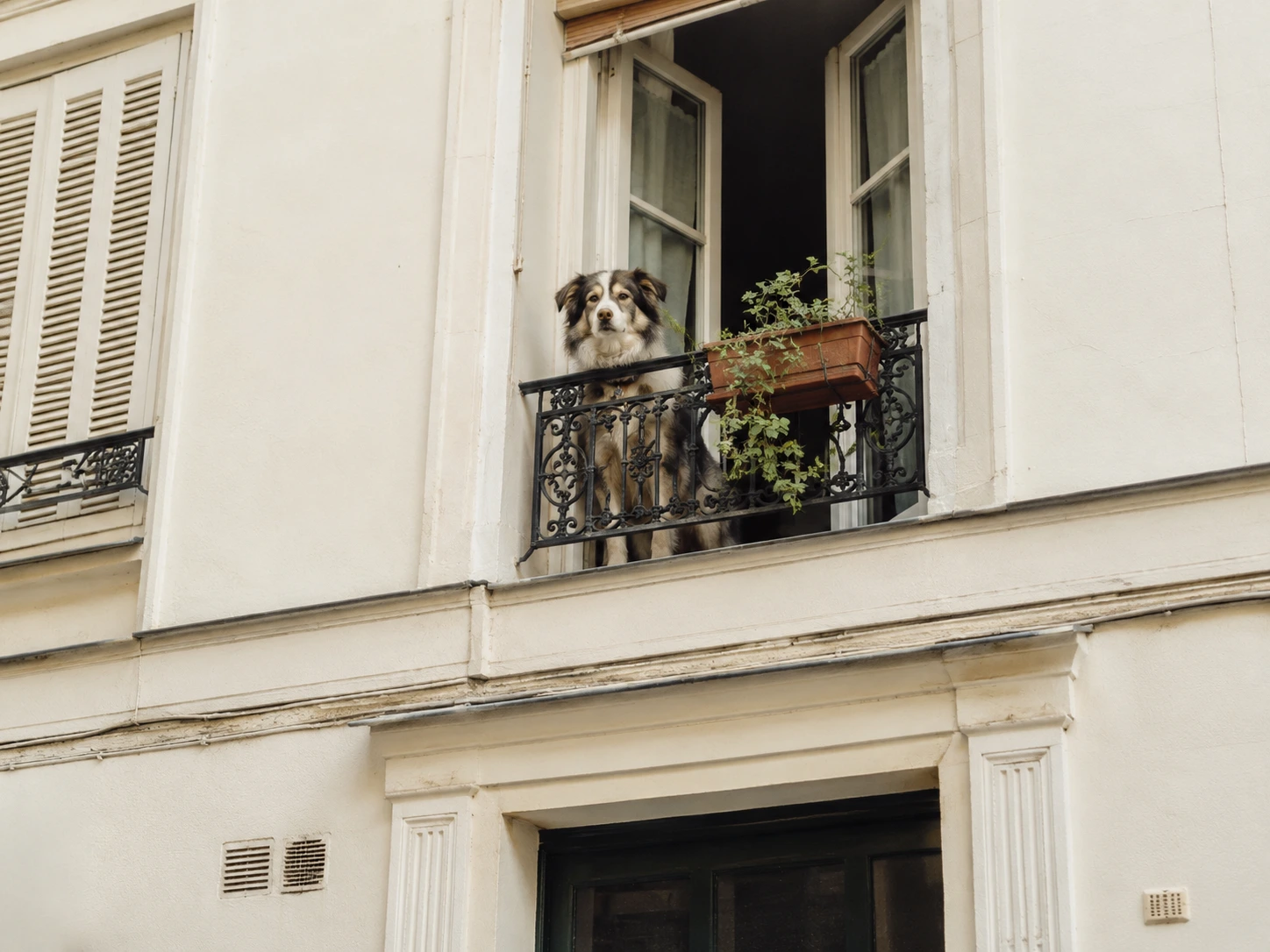
The sound level matters, but the more useful question is why the dog is vocalising. Apartment or flat barking may come from separation-related distress, alert barking at hallway sounds, frustration at a window, insufficient activity, confinement stress, fear, discomfort, or a recent routine change.
The VCA Animal Hospitals barking guide explains that barking has different motivations. A plan that helps an under-stimulated dog may not help a dog that is panicking or reacting to pain.
A useful distinction: A dog that barks briefly at a hallway sound and then returns to rest may need trigger management. A dog that continues pacing, howling, scratching, or trying to escape after the sound stops may need a broader separation-related assessment.
What Are the 5 Likely Causes of Apartment Barking When Left Alone?
The most useful possibilities to compare are separation-related distress, learned reactions to departure cues, environmental noise, confinement stress, and an alone-time task that is too difficult. More than one cause can occur at the same time.

| Possible cause | Clues to look for | What the pattern may mean | Low-risk first step |
|---|---|---|---|
| Separation-related distress | Barking soon after departure with pacing, panting, drooling, scratching, toileting, or escape behaviour | The absence itself may be emotionally difficult | Shorten absences and discuss severe cases with a vet or qualified behaviour professional |
| Departure-cue sensitivity | Agitation begins when keys, shoes, bags, or work clothes appear | The leaving routine may predict a difficult absence | Practise individual cues without leaving |
| Hallway or window triggers | Barking follows footsteps, doors, deliveries, dogs, or visible movement | Environmental alerting may be a major trigger | Move the resting area, close curtains, and test steady background sound |
| Crate or confinement stress | Bar biting, forceful digging, heavy drooling, or repeated escape attempts | The confinement setup may increase distress or injury risk | Stop unsupervised use if unsafe and ask a professional about alternatives |
| Task is too difficult | The dog can eat or settle while you are present but stops when the door closes | The current absence may exceed the dog’s coping ability | Return to a shorter, easier step |
1. Separation-Related Distress
This is more likely when the dog becomes distressed specifically around separation and shows more than barking alone.
The UK veterinary charity PDSA lists possible signs including barking, whining, howling, panting, trembling, drooling, destructive behaviour, toileting, and self-injury. These signs can have other causes, so track the pattern rather than diagnosing from one behaviour.
Useful questions include:
- Does the behaviour occur only, or mainly, when your dog is alone?
- Does it begin within minutes of departure?
- Does your dog remain distressed rather than settling?
- Is damage concentrated around doors, windows, or other exit points?
2. Departure Cues
If barking or agitation starts before you leave, the dog may be reacting to a predictable sequence rather than only to the closed door.
Common cues include picking up keys, putting on shoes, taking a work bag, changing clothes, switching off lights, or opening the front door. The ASPCA separation-anxiety guide notes that some affected dogs become agitated while their guardians prepare to leave.
Record the five minutes before departure as well as the absence. That can show whether the first trigger is the leaving routine.
3. Hallway Noise
Hallway sounds can cause alert barking on their own or intensify an existing alone-time problem.

Watch whether barking follows neighbours, doors, lifts, stairwells, cleaners, deliveries, or another dog passing the apartment. Test one environmental change at a time so you can see what helps.
For sound fears, VCA Animal Hospitals describes gradual desensitisation and counterconditioning at an intensity low enough to avoid triggering a strong fear response. Playing frightening sounds loudly to force the dog to “get used to them” is not the same process.
4. Crate or Confinement Stress
A crate is only appropriate for unsupervised time when the dog is already calm, comfortable, and physically safe inside it.
Stop and reassess if recording shows bar biting, forceful digging, heavy drooling, repeated escape attempts, broken nails, mouth injury, or escalating vocalisation. Humane World for Animals warns that using a crate as a remedy for separation anxiety does not resolve the underlying problem and can create injury risk for dogs trying to escape.
A dog-proofed room or gated area may be safer for some dogs, but any setup should be tested with recording before a long absence.
5. Food Toy Failure
If a dog normally enjoys a food toy but stops eating when you leave, the absence may be too difficult for that tool to be useful at the current stage.
Food puzzles can support an alone-time plan, but they are not a diagnosis or a complete treatment. Offer only items your dog has previously used safely under supervision, and avoid leaving a new chew or toy unattended.
During practice, shorten the departure until your dog can remain calm enough to eat, explore, or rest. If the dog repeatedly cannot eat during even very short absences, seek individual guidance rather than repeatedly extending the time.
What Do Owners Often Misunderstand About Apartment Barking?
The main misunderstanding is treating every bark as the same problem. Exercise, ignoring, enrichment, confinement, and training tools have different effects depending on why the barking occurs.

“A Tired Dog Will Not Bark”
Appropriate exercise, sniffing, play, and toilet opportunities can help a dog settle, especially when under-stimulation contributes to barking. They do not automatically change fear or distress associated with being alone.
A physically tired dog can still panic after the owner leaves. Use activity as one part of the routine, not as proof that the emotional cause has been addressed.
“If I Ignore the Barking, the Dog Will Stop”
Ignoring can be part of a plan for some attention-maintained barking after health, safety, and basic needs have been considered. It is not an appropriate default when the recording shows panic, pain, confusion, prolonged distress, or unsafe escape behaviour.
The correct response depends on the trigger, intensity, and recovery pattern.
“A Bark Collar Will Fix the Apartment Problem”
An anti-bark device may interrupt vocalisation without changing the underlying emotion. If the barking is driven by distress, suppressing the sound can also make it harder to notice that the dog is still struggling.
The American Veterinary Society of Animal Behavior (AVSAB) recommends reward-based methods for dog training and behaviour modification and advises against aversive methods because of welfare and behavioural risks.
What Can Common Barking Patterns Look Like?
The following are hypothetical examples based on common owner-reported situations. They are not diagnoses, study results, or veterinary evidence.
Example 1: The Dog Ignores the Frozen Treat
An owner leaves a familiar stuffed food toy before work. The dog sniffs it while the owner is present, then barks and ignores it after the door closes.
What this result may mean: The departure may be too difficult for the dog to eat or engage normally.
What to do next: Test a much shorter absence. If the dog still cannot eat, settle, or recover, discuss the recording with a qualified professional.
Example 2: The Dog Is Calm Behind an Internal Door
The dog sleeps while the owner works in another room but starts barking when the owner exits through the front door.
What this result may mean: Physical distance inside the home may be manageable, while the front-door departure predicts a longer separation.
What to do next: Practise front-door cues and very short exits rather than assuming the dog needs more practice being in another room.
Example 3: The Crate Makes Barking Worse
The dog vocalises mildly in a safe room but barks, digs, and bites the bars when crated.
What this result may mean: Confinement may be adding stress and injury risk.
What to do next: Stop using that setup for unsupervised absences until a veterinarian or qualified behaviour professional has helped assess safer management.
What Is a Practical Step-by-Step Plan?
Start with evidence from a recording, remove avoidable triggers, and build alone time in increments the dog can manage. Change one major variable at a time so you can tell what affects the result.
1. Track the Barking Pattern
What to do: Record one or more typical absences before changing the setup.
How to track it: Use a pet camera, phone, or audio recorder and log the first bark, visible trigger, other body-language signs, recovery, and total duration.
| Observation | What to record | Why it matters |
|---|---|---|
| Timing | Before departure, within minutes, after a hallway sound, or later in the absence | Helps separate departure-related and environmental patterns |
| Intensity | Brief alert barks, repeated howling, pacing, panting, drooling, destruction, or escape attempts | Shows whether this is a nuisance pattern or a possible welfare and safety concern |
| Recovery | Settles independently, settles after the trigger stops, or remains distressed | Helps set a realistic practice duration |
| Context | Time of day, exercise, visitors, deliveries, weather, routine changes, or medication changes | May reveal repeatable triggers to discuss with a professional |
2. Choose the Starting Point
Decision framework: Use timing, intensity, and recovery.
- Brief barking with quick recovery: Start with trigger management and reinforcement of calm behaviour.
- Barking that begins at departure but remains mild: Practise shorter exits and departure cues.
- Prolonged distress or inability to settle: Avoid longer practice sessions and seek individual behaviour guidance.
- Self-injury, severe escape attempts, pain, or confusion: Contact a veterinarian promptly.
3. Lower the Alone-Time Difficulty
What to do: Start below the point where your dog shows a strong reaction.
This may mean touching the door, opening and closing it, stepping into the hallway for one second, or walking a few steps away and returning. Increase only when the previous step remains manageable across several repetitions.
VCA Animal Hospitals describes desensitisation as beginning with the trigger at a low enough level that it causes little or no reaction, then increasing gradually. If your dog repeatedly becomes distressed, the step is too difficult or the plan needs professional adjustment.
4. Practise Departure Cues Without Leaving
What to do: Break the leaving routine into small, neutral actions.
- Pick up keys, then sit down.
- Put on shoes, then prepare a drink.
- Carry your bag to another room.
- Open the door, close it, and continue a normal activity.
Keep repetitions calm and brief. Stop if the exercise itself repeatedly increases agitation.
5. Reduce Apartment Triggers
What to do: Test whether the environment changes the pattern.
- Move the resting area away from the front door.
- Close curtains or use privacy film if window activity triggers barking.
- Use steady, moderate background sound near the hallway-facing area.
- Place a note for deliveries only where permitted and practical.
- Use a crate only if the dog is already relaxed and safe inside it.
Record each setup. A change that sounds sensible may not help your individual dog.
6. Use Food Toys as Support
What to do: Pair familiar food enrichment with easy practice rather than introducing it during a long absence.
If your dog stops eating as soon as you leave, shorten the step. Do not leave unfamiliar toys, chews, or items that could splinter, obstruct breathing, or be swallowed.
7. Arrange Help for Unavoidable Absences
What to do: Reduce repeated exposure to absences that exceed the dog’s current ability to cope.
Depending on the dog, options may include a trusted friend, family member, pet sitter, midday walker, or daycare that the dog already enjoys. Daycare is not suitable for every dog, and management should not replace assessment when distress is severe.
8. Communicate With Neighbours or Building Management
What to do: Acknowledge the concern without promising an instant cure.
A practical message is: “I’m aware of the barking and I’m recording the pattern, reducing triggers, and working on a gradual plan. Please let me know the date and time if you hear a longer episode.”
Check your lease, strata, body corporate, council, or building rules separately because noise and pet requirements vary by location.
What Common Mistakes Should You Avoid?
Avoid actions that suppress the noise without identifying the cause or that expose the dog to repeated distress.
- Do not assume the dog is barking out of spite.
- Do not punish behaviour that may be driven by fear, pain, or distress.
- Do not rely on an anti-bark collar as the complete plan.
- Do not repeatedly test long absences when recordings show escalating distress.
- Do not crate a dog that panics, bites bars, or tries to escape.
- Do not change the room, crate, food toy, exercise routine, and sound setup all at once.
- Do not assume exercise alone will resolve separation-related barking.
- Do not ignore sudden new barking, especially in an older dog.
- Do not use online community stories as a substitute for veterinary evidence or an individual assessment.
When Should You Contact a Vet or Qualified Behaviour Professional?
Contact a veterinarian when barking starts suddenly, appears with health changes, or creates an immediate injury risk. Seek qualified behaviour support when the dog cannot tolerate short absences or the problem is affecting housing and daily life.
Contact a veterinarian promptly if you see any of these red flags:
- Broken teeth, bleeding, damaged nails, or wounds from escape attempts
- Repeated bar biting, window impact, or forceful door scratching
- Collapse, breathing difficulty, severe vomiting, or extreme weakness
- New disorientation, night-time distress, or major behaviour change in a senior dog
- Signs of pain, appetite change, sleep change, or unusual toileting
- Rapid worsening after a move, loss, illness, medication change, or other major event
The ASPCA barking guide advises veterinary examination to rule out medical causes before attempting to resolve a barking problem. New behaviour in a senior dog also deserves veterinary attention because pain, sensory change, or cognitive decline may contribute.
For ongoing cases, look for a reward-based professional who can explain methods clearly, review video, work within their qualifications, and refer to a veterinarian when needed. A veterinary behaviourist is a veterinarian with advanced specialist training in behaviour and can assess medical and behavioural factors together. The American College of Veterinary Behaviorists directory can help locate board-certified specialists, including professionals who may offer remote consultation where legally permitted.
Avoid anyone who guarantees a cure, refuses to explain their methods, or recommends escalating fear or pain to stop the sound.
What Should You Do Next?
For the next 48 hours, focus on observation and risk reduction rather than trying multiple fixes at once.
- Record a normal departure and write down timing, intensity, trigger, and recovery.
- Remove one likely environmental trigger, then record again.
- Set an alone-time practice duration shorter than the first sign of distress.
- Arrange temporary help for unavoidable long absences if possible.
- Share recordings with your veterinarian or a qualified reward-based behaviour professional if the dog does not settle, cannot eat, or may injure themselves.
The goal is not only quieter behaviour. It is a safer dog who can remain calm enough to rest, eat, and recover when alone.
FAQs
These answers cover common practical questions, but severe, sudden, or unsafe behaviour still needs individual veterinary or qualified behaviour guidance.
How long should I record my dog after leaving?
Record the full absence when practical, with close attention to the first 30–60 minutes because many separation-related signs begin early. Also sample longer absences if neighbours report barking later. Do not lengthen an absence simply to provoke a reaction.
What if my dog barks only when someone passes the apartment door?
That timing may fit alert or noise-triggered barking more closely than distress caused by separation alone. Move the resting area, reduce sound or visual access where practical, and record whether your dog settles after the person passes.
Should I return as soon as my dog barks?
During planned practice, set the step short enough that you can return before escalating distress begins. In an unplanned real-life episode, prioritise safety and return or arrange help if your dog is panicking, trying to escape, or may be injured.
Can a pet camera make separation problems worse?
A camera used only to observe does not interact with the dog. Two-way audio is different: some dogs may settle when they hear a familiar voice, while others may become more alert or confused. Test audio during a short, safe session before using it routinely.
Is medication sometimes used for separation-related distress?
Yes. A veterinarian may consider medication when distress is moderate to severe or prevents the dog from learning during behaviour modification. The ASPCA notes that medication can be useful in severe cases. Never give human medication, supplements, or another pet’s prescription without veterinary advice.
How quickly should apartment barking improve?
There is no reliable universal timeline. Progress depends on the cause, severity, medical factors, environment, unavoidable absences, and how consistently practice stays below the dog’s distress threshold. Be cautious of guaranteed results or fixed deadlines.
Sources and further reading
ASPCA — Separation Anxiety ASPCApro — Preventing Separation Anxiety ASPCA — Barking PDSA — Separation Anxiety in Dogs VCA Animal Hospitals — Introduction to Desensitization and Counterconditioning VCA Animal Hospitals — Barking in Dogs VCA Animal Hospitals — Behavior Counseling: Senior Pet Behavior Problems VCA Animal Hospitals — Fear of Noises and Places in Dogs RSPCA — How to Train Your Dog to Be Left Alone RSPCA — Separation-Related Behaviour in Dogs Humane World for Animals — How to Help a Dog With Separation Anxiety Humane World for Animals — Crate Training 101 American Veterinary Society of Animal Behavior — Position Statements American College of Veterinary Behaviorists — Find a Diplomate ✓
✓