
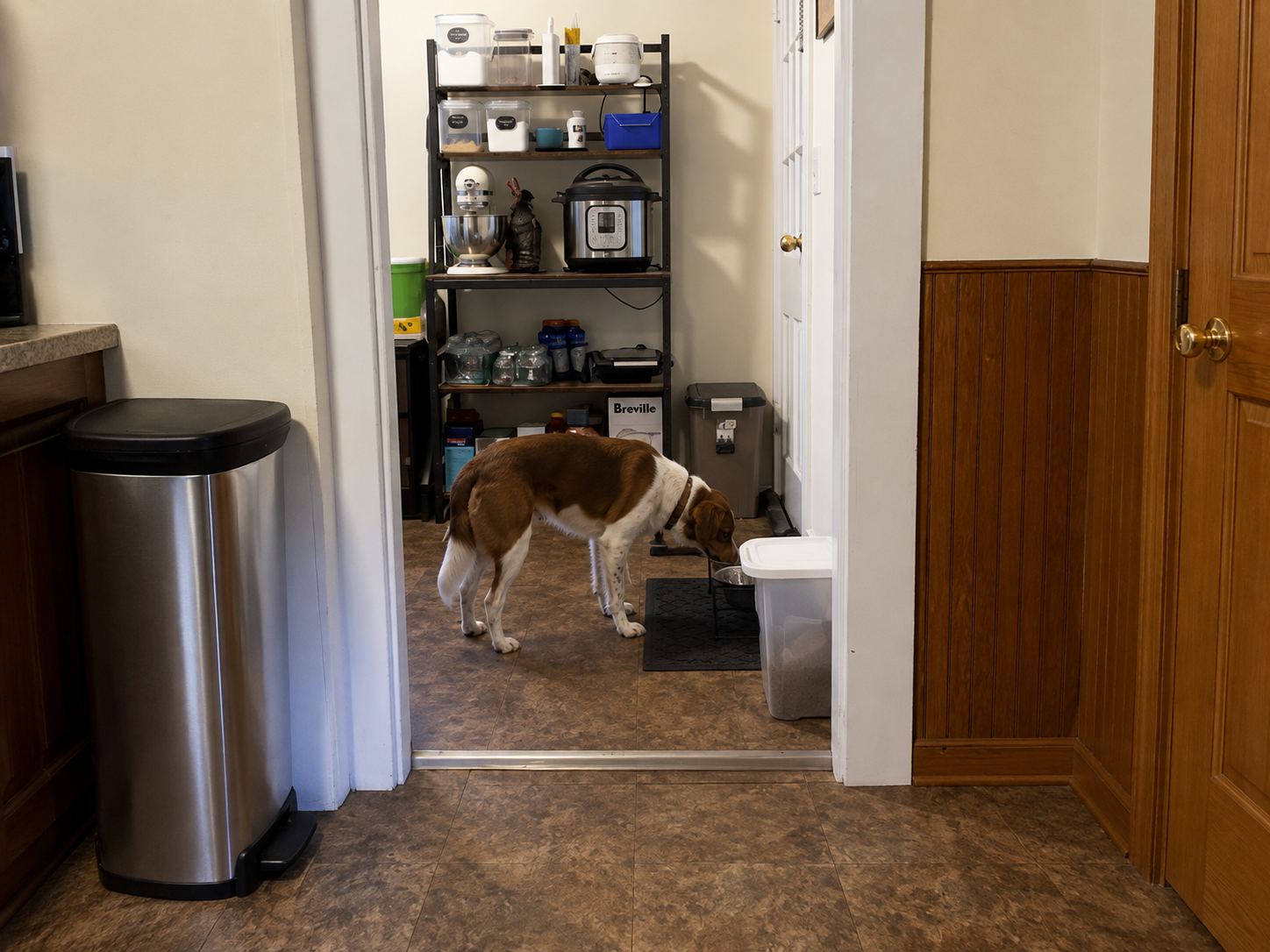
If your dog barks at their food bowl, watch what happens immediately afterward. A dog who barks and then eats comfortably may simply be excited by the meal routine. A dog who barks, backs away, drops food, chews differently, or suddenly hesitates to eat needs a different response. If barking or growling starts mainly when a person or another pet approaches the bowl, treat that as a possible food-guarding safety concern rather than ordinary mealtime excitement.
Quick answer: Barking around food can happen with meal excitement, a learned routine, the feeding environment, possible resource guarding, or difficulty eating. Barking by itself does not tell you which one is happening. Focus on when the barking starts, what your dog does next, and whether eating has changed.
Meal excitement or a learned dinner routine may be contributing. [1]
Eating may be uncomfortable. Look for chewing or mouth changes and contact your veterinarian if the pattern is new. [2][3]
Give your dog space and look for other resource-guarding signs. Do not repeatedly take the bowl away to test them. [4][8]
Do not assume the dog needs more food from barking alone. Look at normal food needs and whether appetite has actually changed. [7]
Important: These are observational clues, not diagnoses. New eating difficulty, pain signs, or aggressive behavior around food may need veterinary or professional behavior help.
What Does My Dog’s Barking Pattern Tell Me?
The sequence around the bark is more useful than the bark alone. Instead of immediately deciding that your dog is hungry, scared, excited, or guarding food, describe what you actually see.
| What You Notice | What It May Suggest | Best Next Step |
|---|---|---|
| Barking starts while you prepare or carry the bowl, then your dog eats normally | Meal excitement or a learned feeding routine | Work on a calmer pre-meal routine. |
| Your dog approaches the bowl, barks, then repeatedly backs away | The eating experience, environment, or physical comfort may need investigation | Watch closely for changes in chewing or eating. |
| Your dog drops food, chews more slowly, drools, or paws at the mouth | Possible oral or dental discomfort | Contact your veterinarian. |
| Barking or growling starts when a person or another pet approaches | Possible resource guarding | Give the dog space and manage the feeding area safely. |
| Your dog suddenly seems much hungrier than usual | A genuine appetite change may need investigation | Look for other changes in weight, thirst, urination, stool, or medication. |
If the behavior comes and goes, record a short meal video from a safe distance. Do not move closer just to trigger barking. A video can help you show your veterinarian or behavior professional exactly what happens before and after the bark.
Is My Dog Just Excited About Dinner?
Possibly—especially if barking happens before the bowl goes down and your dog then eats comfortably. Dogs can vocalize around appealing food, and familiar household actions can become predictable signals that a meal is coming. [1]
Your dog may recognize the routine: the food container opens, the bowl appears, you walk toward the feeding spot, and dinner follows.
What can I do about pre-meal barking?
These are practical reward-based options consistent with AVSAB’s recommendation to use reward-based rather than aversive training methods. [5]
- Choose one simple waiting behavior, such as four paws on the floor, sitting, or standing on a mat.
- Reward that behavior before the barking becomes intense.
- If the bowl itself triggers frantic barking, practise the routine in smaller, easier steps.
- Keep the household rule consistent.
- Avoid shouting, startling, or physically correcting your dog around meals.
Barking before food does not prove your dog is underfed. Food amounts should be based on the dog’s nutritional needs and body condition rather than the barking itself.
Could My Dog Be Barking Because Eating Is Uncomfortable?
It is worth considering if the barking is new and your dog’s eating behavior has also changed. Cornell and VCA list difficulty eating, slower chewing, dropped food, drooling, mouth pawing, reduced appetite, and facial or jaw swelling among signs that can occur with dental or oral problems. [2][3]
- suddenly hesitates to eat;
- repeatedly drops food;
- chews noticeably more slowly;
- drools or paws at the mouth;
- has mouth bleeding or facial/jaw swelling;
- appears painful while eating;
- has a meaningful new change in appetite.
Veterinary evaluation is more appropriate than trying to train through a new eating difficulty. [6]
Do not keep changing foods simply to make your dog eat if eating itself appears difficult. First rule out whether picking up, chewing, or swallowing food has become uncomfortable.
Could the Food Bowl or Feeding Setup Be Part of the Problem?
Yes, the environment may affect how comfortably a dog eats—but avoid assuming your dog is “afraid of the bowl.” Change one simple variable at a time and see whether the behavior changes.
| What to Check | Simple Test |
|---|---|
| Busy or noisy location | Try one meal in a quieter area away from heavy household traffic. |
| Sliding bowl | Place the bowl on a stable, non-slip surface. |
| Another dog nearby | Feed the dogs separately instead of letting them crowd each other. |
| People walking past | Choose a feeding spot with less foot traffic. |
| Only happens in one location | Compare behavior in a calmer location without changing the food at the same time. |
VCA notes that the feeding environment, including nearby noise, can affect eating behavior. [1]
If your dog eats normally alone but becomes tense when another dog approaches, feed them separately rather than forcing shared meals.
If your dog stiffens, growls, or guards food, keep children away while the dog eats. Do not use children in food-bowl training exercises.
If your dog repeatedly leaves the bowl during household activity, compare one meal in a quieter location.
If you do not yet know the dog’s normal meal behavior, give them space and predictability while you observe rather than deliberately testing the bowl.
Could Barking at the Food Bowl Be Resource Guarding?
Barking alone is not enough to call it resource guarding. Concern increases when your dog’s behavior changes specifically as a person or another animal approaches food.
Resource guarding can involve behaviors such as stiffening, freezing, growling, snapping, or trying to keep someone away from a valued resource. [4][8]
If your dog stiffens, growls, snaps, lunges, or has a bite history around food, give them space. Keep children away during meals and seek appropriate professional help if there is a bite risk. [4]
For U.S. dog parents looking for behavior support, the IAABC and CCPDT directories can be useful starting points. Look for someone with relevant experience in resource guarding or aggression rather than relying on a credential alone. [9][10]
When Should Barking Around Food Make Me Call a Veterinarian?
Be more concerned when the barking is new and something about eating has also changed. A long-standing pre-dinner bark followed by comfortable eating is different from suddenly struggling to chew or pick up food.
Your dog barks before the meal but then eats comfortably and has no new physical or behavioral changes.
Your dog suddenly hesitates to eat, appears painful while eating, drops food, chews unusually slowly, drools, paws at the mouth, develops facial/jaw swelling, or has a significant appetite change. [2][3][6]
Difficulty breathing, collapse, blue/purple/pale gums, excessive bleeding, or severe facial swelling should be treated as an emergency rather than a food-bowl behavior problem. [11]
If your dog suddenly becomes much hungrier than usual, tell your veterinarian about any accompanying changes in weight, thirst, urination, vomiting, diarrhea, or medication use. [7]
What Should I Do at My Dog’s Next Meal?
Use the next meal to identify the pattern instead of trying several fixes at once.
Avoid changing the food, bowl, location, and schedule all at once.
Before the bowl appears, when it reaches the floor, during eating, when someone approaches, or after the meal?
Does your dog eat normally, back away, drop food, guard the bowl, or look to you for something else?
Keep other pets and children from crowding the feeding area.
Normal eating plus pre-meal barking → work on the routine. Eating difficulty → veterinarian. Guarding behavior → safety management and appropriate behavior help.
If your dog mainly barks while you prepare human food or sit down to eat, see the separate guide: Why Does My Dog Bark While I’m Cooking or Eating?
Frequently Asked Questions
Why does my dog bark at a full bowl and then eat normally?
Meal excitement or a learned dinner routine may be contributing. If your dog eats comfortably and nothing else has changed, focus on a calmer pre-meal routine. [1]
Why does my dog bark at the bowl and back away?
Why does my dog bark or growl when I walk near the food bowl?
Should I ignore my dog when they bark before meals?
Ignoring alone does not teach a replacement behavior. If your dog is simply excited, reinforce a simple calm behavior such as waiting, sitting, or standing on a mat. [5]
Does barking after eating mean my dog needs more food?
No. Barking alone does not prove the meal was too small. A genuine appetite change is more meaningful when it appears with other changes such as weight loss, increased thirst or urination, vomiting, diarrhea, or medication changes. [7]
What Should I Take Away From This?
Barks, then eats normally? Start with a calmer meal routine.
Barks or growls when someone approaches? Give your dog space and treat it as a possible guarding safety issue.
Backs away, drops food, chews differently, or suddenly struggles to eat? Contact your veterinarian.
+ Sources & Research
Numbered citations in the article jump here so external source links do not interrupt the main reading flow.
-
VCA Animal Hospitals — What Makes a Diet Palatable
Used for food-related eating behavior, vocalization, and feeding-environment context.
View source -
Cornell University College of Veterinary Medicine — Dental Disease and Home Dental Care
Used for eating difficulty, mouth bleeding, facial or jaw swelling, drooling, and appetite changes.
View source -
VCA Animal Hospitals — Dental Pain in Dogs
Used for slower chewing, food dropping, drooling, mouth pawing, and other possible oral-pain signs.
View source -
ASPCA — Food Guarding
Used for resource-guarding behavior, safety precautions, child safety, and professional-help guidance.
View source -
American Veterinary Society of Animal Behavior — Humane Dog Training Position Statement
Used for the recommendation to favor reward-based rather than aversive training methods.
View source -
VCA Animal Hospitals — Loss of Appetite
Used for veterinary evaluation when eating is reduced, refused, or appears painful.
View source -
VCA Animal Hospitals — Testing for Increased Appetite
Used for increased appetite in the context of weight loss, thirst, urination, vomiting, diarrhea, and medication effects.
View source -
Merck Veterinary Manual — Behavior Problems of Dogs
Used for veterinary context on resource guarding and possessive aggression involving valued resources such as food.
View source -
IAABC — Consultant Locator
Directory for finding dog-behavior professionals.
View directory -
CCPDT — Certified Dog Trainer and Behavior Consultant Directory
Directory for finding certified trainers and behavior consultants.
View directory -
Cornell University College of Veterinary Medicine — Emergency and Critical Care
Used for emergency signs including difficulty breathing, collapse, abnormal gum color, excessive bleeding, and facial swelling.
View source
 ✓
✓