

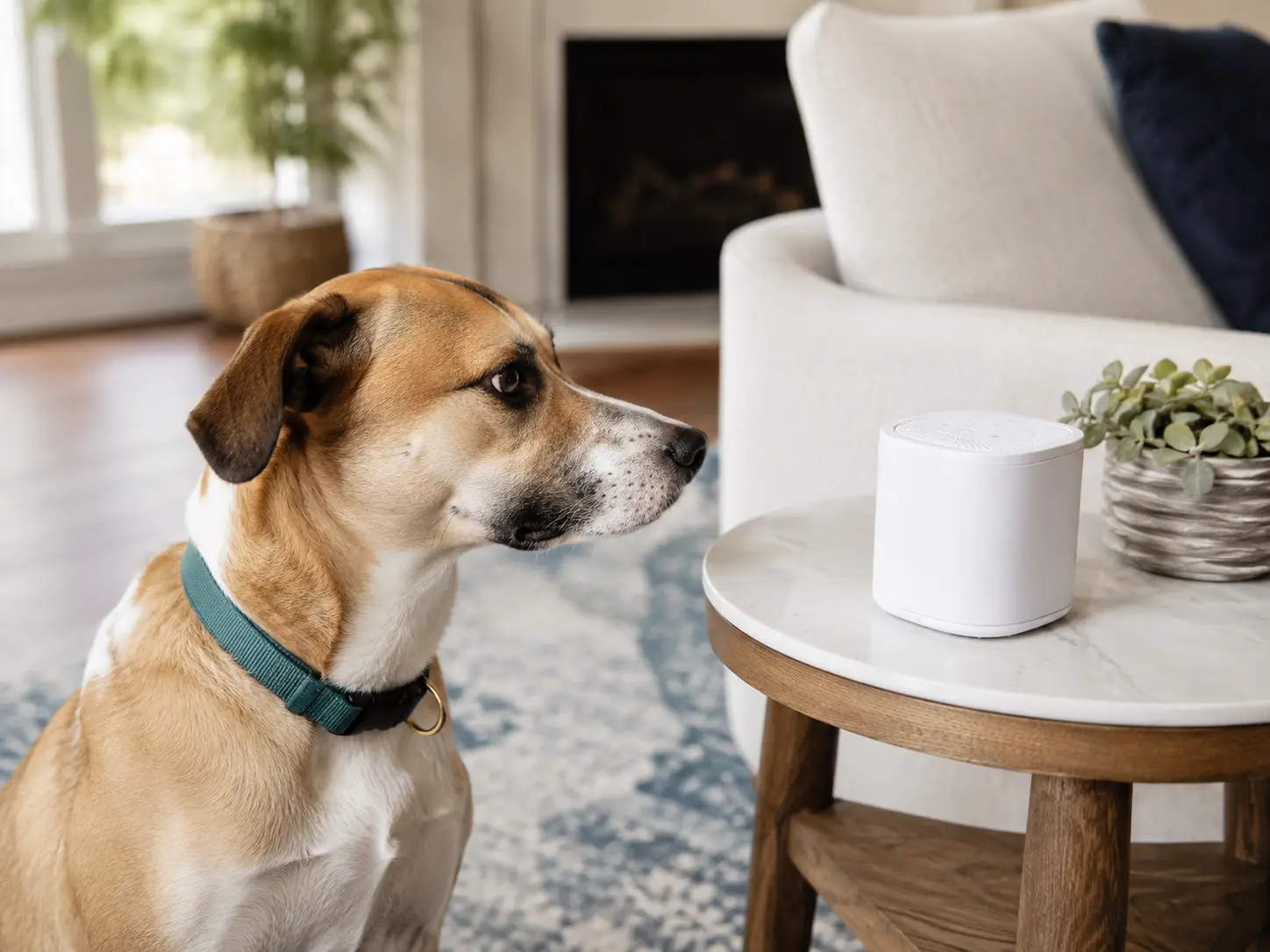
White noise may be worth testing when your dog barks at sounds such as hallway footsteps, apartment doors, elevator noise, neighbors, deliveries, or occasional nighttime sounds. The goal is to make those triggers less noticeable. It is not a direct solution for barking caused mainly by visual triggers, attention seeking, possible discomfort, or serious separation-related distress.
Use white noise as a sound-masking tool, not as a promise that barking will stop. First identify the trigger, then test whether a steady background sound changes your dog’s response.
When Is White Noise Most Likely to Help?
It is most relevant when barking follows a clear environmental sound. Use the table below as a quick decision tool.
| Barking trigger | Fit | What to try first |
|---|---|---|
| Hallway footsteps | Good candidate | Test steady sound near the entry side of the room. |
| Elevator or apartment-door sounds | Good candidate | Start masking sound before predictable busy periods. |
| Neighbor voices | Possible | Test whether steady background sound makes the voices less noticeable. |
| Nighttime outside sounds | Possible | Start one steady sound before bedtime and observe the response. |
| People visible through a window | Limited | Check the visual trigger first. |
| Attention barking | Poor fit | Address the behavior rather than adding background sound. |
| Possible pain or discomfort | Not a solution | Consider veterinary guidance rather than masking the behavior. |
| Severe separation-related distress | Not a treatment | Focus on the underlying distress with appropriate professional support. |
Try White Noise Before Buying a Dedicated Machine
You can test the idea first with a fan or a speaker playing one steady, non-startling sound. If the setup does not change your dog’s response, buying a dedicated machine may not be necessary.
- Choose one recognizable trigger, such as hallway footsteps or a neighboring door.
- Start a steady background sound before that trigger is likely to occur.
- Keep the source away from your dog’s head, bed, or crate.
- Let your dog move away from the sound if desired.
- Compare the response across several similar trigger events.
If you notice fewer reactions, shorter barking, or quicker settling, a dedicated machine may be useful for convenience features such as continuous playback, timers, or portability.
Why Might White Noise Help Sound-Triggered Barking?
A steady background sound can make sudden environmental noises stand out less. That is the practical idea behind sound masking.
White noise should therefore be treated as environmental management rather than a way to “switch off” barking. Some dogs may still notice and react to the trigger.
Continuous Sound vs Bark-Activated Sound
For predictable triggers, continuous sound is the simpler option to test because it can already be running before the noise happens.
Continuous sound
Runs before footsteps, doors, voices, or nighttime noises occur.
Bark-activated masking sound
Starts a masking sound after barking is detected, so the first reaction may already have happened.
What “bark-activated” means here
In this guide, it means a machine that detects barking and starts a masking sound. It does not mean a shock, spray, or ultrasonic correction device.
How Should You Set Up White Noise for Barking?
Start toward the direction of the problem sound rather than directly beside your dog. Then use the lowest practical level that makes the trigger less prominent.
For hallway or apartment-door barking
- Listen from your dog’s usual resting area and identify where footsteps, keys, doors, or elevator sounds are easiest to hear.
- Place the fan or sound machine toward that side of the room.
- Start it before a predictable busy period when possible.
- Begin low and adjust the position before simply increasing volume.
For nighttime barking
Start the steady sound before bedtime rather than waiting for the first bark. If nighttime barking is new, worsening, or has no clear environmental trigger, do not assume a sound machine is the right answer.
How loud should it be?
Use the lowest practical level that makes the problem sound less noticeable. Avoid placing the speaker directly beside your dog’s head, crate, or bed, and allow your dog to move farther away if desired.
- Reduce the level if your dog repeatedly avoids the area.
- Change the setup if your dog becomes more alert or unsettled.
- Do not keep raising the volume when barking continues; the trigger may be something other than sound.
How Can You Tell If White Noise Is Helping?
Look for a smaller or shorter reaction to the same trigger, not perfect silence.
- Fewer barking episodes:
Your dog ignores more of the usual sounds. - Shorter barking:
The reaction ends sooner. - Less door rushing:
Your dog is less likely to race toward the entry. - Less monitoring:
Your dog spends less time staring toward the door or window. - Quicker settling:
Your dog returns to resting sooner. - Comfort with the sound:
Your dog does not appear bothered by the setup.
Compare several similar situations before deciding whether the setup is useful.
Should You Use White, Brown, Pink, or Fan Sound?
Start with one steady sound at a low level and change profiles only if needed. There is no need to assume one sound type is right for every dog.
| Sound type | Simple description | How to use it |
|---|---|---|
| White noise | Broad, steady sound. | A simple starting option. |
| Brown noise | Deeper-sounding background noise. | Try it if you prefer a lower sound profile. |
| Pink noise | Another steady noise profile. | Test it if the first sound is not a good fit. |
| Fan sound | A continuous fan-like hum. | Useful when you want a simple steady background. |
What Should You Do If Your Dog Still Barks?
Recheck the trigger before making the sound louder. If placement, timing, and sound type make little difference, sound masking may not fit the problem.
- Check what happens immediately before the barking.
- Try moving the sound source toward the environmental noise.
- Start the sound earlier for predictable triggers.
- Try another steady profile only if your dog remains comfortable.
- If barking remains intense or unchanged, consider another cause.
When to get additional help
If barking is sudden, worsening, associated with possible pain, or occurs with significant distress, discuss it with your veterinarian. Persistent behavior problems may also warrant guidance from an appropriately qualified behavior professional or veterinary behaviorist.
Which Type of White Noise Machine Should You Consider?
If your test helps, choose a machine based on the setup you actually need rather than looking for a universal “best” model.
- Continuous playback: useful when the sound needs to run through a predictable noisy period.
- Timer or schedule: useful for regular bedtime or hallway routines.
- Power source: choose plug-in or portable power based on where you will use it.
- Offline use: consider whether you want it to work without an app, Wi-Fi, or streaming.
- Sound selection: useful if you want to test more than one steady profile.
The examples below are not ranked. Product specifications are presented as manufacturer-listed features.
LectroFan EVO
Manufacturer-listed: multiple fan and noise sound options.
Source: Sound of Sleep / Adaptive Sound Technologies product information.
Check LectroFan EVOYogasleep Dohm Classic
Manufacturer-listed: a real internal fan with adjustable sound controls.
Source: Yogasleep product information.
Check Dohm ClassicYogasleep Pawzz
Manufacturer-listed: a built-in bark sensor that can activate sound after barking is detected.
Source: Yogasleep product information.
Check Yogasleep PawzzNeed to Compare Specific Models?
If sound masking appears useful for your dog, use the separate buying guide for a fuller model comparison.
Compare White Noise Machines for DogsSources & Product Verification
Behavior guidance and product specifications are kept separate. Manufacturer pages are used for product features, not as proof that a machine will stop barking.
Frequently Asked Questions
1. Does white noise stop dogs from barking?
Not necessarily. It may be worth testing when barking follows environmental sounds, but it does not address every reason a dog barks.
2. Will white noise help a dog barking at night?
It may be useful to test when nighttime barking follows identifiable outside, hallway, traffic, or neighboring sounds. If the behavior is new or worsening without a clear trigger, consider other causes.
3. Does white noise help with hallway barking?
Hallway barking is a practical situation to test because footsteps, doors, voices, and elevator sounds are environmental triggers. Watch for fewer or shorter reactions.
4. Should white noise run before my dog starts barking?
For predictable sound triggers, starting it beforehand makes more sense because the masking sound is already present when the trigger occurs.
5. Where should I place white noise for a barking dog?
Start toward the main noise source, such as the apartment door, shared wall, or window, rather than directly beside your dog.
6. What should I do if my dog still barks with white noise?
Check the trigger, timing, placement, and sound profile. If barking remains intense or appears unrelated to environmental sound, white noise may not be the right tool.
Final Practical Takeaway
Start with the barking trigger, not the product. If environmental sounds reliably start the barking, test a comfortable steady background sound first. Place it toward the noise source, start it before predictable triggers, and look for fewer reactions, shorter barking, or quicker settling.
If the test helps, a dedicated machine can make the setup more convenient. If it does not, reconsider the trigger rather than automatically increasing volume or buying a more expensive device.
 ✓
✓