

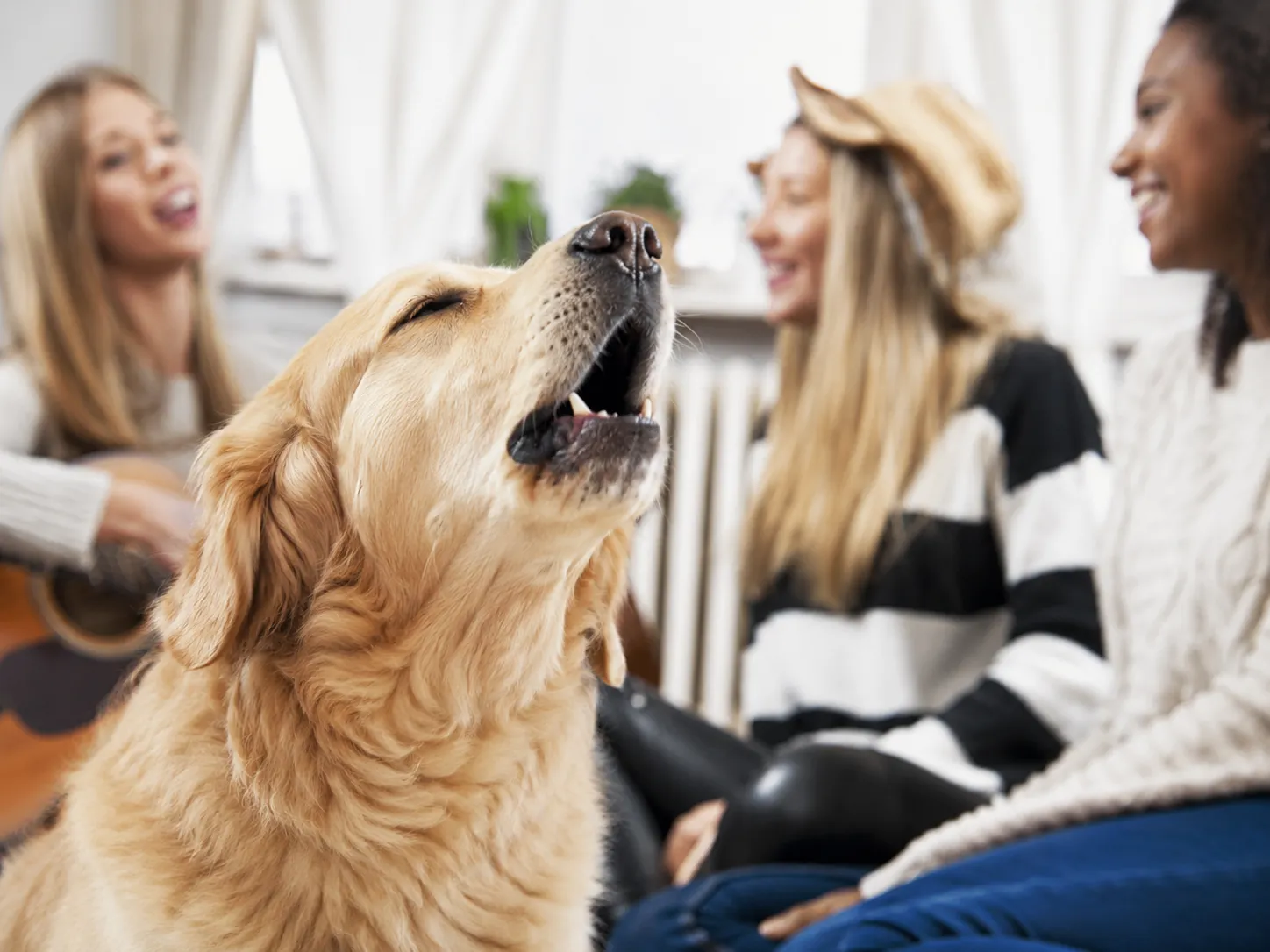
Your dog may still see the guest not the doorbell as the trigger. Once the person is inside, barking may continue because your dog is excited about greeting them, uncomfortable with an unfamiliar person in the home, frustrated by restricted access, or reacting when the visitor moves.
Start by lowering the pressure. Give your dog more distance, ask the guest not to reach toward or crowd them, and reward specific calm behavior such as looking at the visitor without barking, looking away, going to a mat, or staying relaxed when the visitor moves. If barking progresses to lunging, snapping, biting attempts, or intense fear, stop the greeting and separate your dog from the visitor.[1][2]
What should I do if the guest is already here?
- Move your dog away from the doorway and give them more space.
- Ask the guest to ignore your dog at first no reaching, staring, or excited greeting.
- Use a familiar mat, bed, or safe area if your dog already settles there comfortably.
- Reward calm behavior while it is happening, before another barking burst develops.
- Reduce visitor movement if standing or walking restarts the barking.
- Separate your dog if fear, aggression, or arousal keeps increasing.
Your dog does not have to greet every visitor. Keeping a dog comfortably separated for part or all of a visit can be a reasonable management choice when direct interaction is not useful or safe.[5]
Why does my dog keep barking after the guest comes inside?
Because the arrival may be over, but the trigger is still present. The visitor is now talking, moving, looking at your dog, interacting with you, or walking through your dog’s normal space.
VCA describes both overexcited greeting behavior and fearful or frustrated responses around visitors. ASPCA also separates greeting barking, territorial barking, attention-related barking, and frustration-induced barking rather than treating every barking problem as the same behavior.[1][2]
How can I tell why my dog is barking at the guest?
Look at body language, distance, and what happens immediately before each barking burst. The bark alone cannot reliably identify the reason.
| What you notice | What may be contributing | Useful first step |
|---|---|---|
| Loose body, wagging, whining, jumping, pulling toward the guest | Greeting excitement or frustration | Lower greeting intensity and reward calm standing, sitting, or settling.[1] |
| Backing away, freezing, hiding, stiff posture, barking when approached | Fear or uncertainty | Increase distance and stop the visitor from approaching or touching the dog.[1] |
| Dog settles while the guest sits but barks when they stand or walk | Visitor movement may be a separate part of the trigger | Practice smaller, slower movements at greater distance.[3] |
| Barking becomes more intense behind a gate or while restrained | Restricted access may be adding frustration | Change distance or setup rather than assuming tighter restraint will reduce barking.[1][2] |
| Barking repeatedly produces attention, food, access, play, or makes the guest move | The outcome may be helping maintain the barking pattern | Set up and reinforce an alternative behavior before the barking sequence develops.[2] |
| Hard staring, lunging, snapping, biting attempts, or inability to disengage | Higher safety concern | Separate the dog and visitor and seek qualified professional help.[6] |
These patterns are clues, not diagnoses. A dog may show more than one motivation or emotional response in the same situation, so use the whole behavior pattern rather than labeling the dog from one sign.[2]
What exactly should I tell my guest?
Keep the instructions simple and low-pressure. Your guest does not need to actively make friends with your dog.
- “Please ignore him at first.”
- “Don’t reach toward him.”
- “Avoid staring directly at him.”
- “Let him choose whether to come closer.”
- “If he walks away, please don’t follow him.”
If your dog approaches the visitor, that does not automatically mean the dog wants to be touched. Ask the guest to pause, remain calm, and continue watching the dog’s body language rather than immediately reaching for the dog.[4]
What calm behavior should I reward?
Reward the specific behavior you want repeated while it is happening. Do not wait until a major barking episode has already developed.
Reward calm observation.
Reward disengaging from the trigger.
Reward settling in the familiar location.
Reward before making the movement harder.
Reward calm behavior rather than silence alone.
Reward quiet attention.
AVSAB recommends reward-based methods for dog training and behavior modification rather than aversive methods.[5]
What if my dog won’t take treats around guests?
Make the situation easier instead of forcing the food. Add distance, reduce visitor movement, or end the practice session.
VCA notes that when an animal who normally accepts food stops readily taking treats during desensitization work, the exposure may be progressing too quickly. The response is to reduce trigger intensity rather than continue increasing the challenge.[3]
- move farther from the guest
- ask the guest to sit still
- use a quieter room
- reduce visual exposure
- end the session and try an easier setup later
What if the guest is a child?
Use more conservative management and active adult supervision. Do not use a barking or frightened dog to practice greetings with a child.
ASPCA recommends supervising children and dogs and never leaving a baby or young child alone with a dog.[4]
- Do not allow chasing, hugging, climbing on, or cornering the dog.
- Avoid face-to-face interaction.
- Do not ask a child to approach a barking, growling, or frightened dog.
- Give the dog a separate safe area when needed.
- If you cannot safely manage both the child and dog, keep them separated.
What should I do for delivery workers or repair people?
If the visit is brief and your dog does not need to interact with the person, management may be more practical than attempting a greeting.
For a plumber, electrician, delivery worker, cleaner, contractor, or another short household visit, you can place your dog in a familiar comfortable area before the person enters. This can reduce unnecessary exposure while people are carrying tools, moving through rooms, or repeatedly entering and leaving the home.
You do not need to turn every real-world visit into a training session. Management is especially useful when you cannot control the visitor’s movements or stay focused on your dog’s behavior throughout the visit.[5]
How should I train this before the next visit?
Practice the easy parts without a real guest first, then increase difficulty gradually.
Teach a resting place.
Reward your dog for settling on a mat or bed while the house is quiet.
Add normal household movement.
Practice while household members sit, stand, talk, and walk around.
Add an easy visitor cue.
Use a low-intensity knock, door sound, or familiar helper instead of starting with a full exciting arrival.
Practice visitor movement gradually.
Start with small movements and increase them only while your dog remains comfortable enough to respond and take rewards.
VCA describes this type of gradual exposure as desensitization. Trigger intensity can be adjusted through distance, movement, speed, sound, and other components instead of exposing the dog immediately to the hardest version of the situation.[3]
What should I avoid doing when my dog barks at guests?
Avoid forcing interaction or trying to suppress the barking without addressing the situation causing it.
5 things not to do
- Don’t force your dog to greet the visitor.
- Don’t allow the guest to corner, hug, or repeatedly reach toward the dog.
- Don’t rely on punishment or aversive tools to address visitor-related behavior.[5]
- Don’t repeatedly expose your dog to a full-intensity trigger when the reaction is getting stronger.[3]
- Don’t use friends, relatives, or children to test whether your dog might bite.
When should I get professional help?
Get help when visitor barking involves aggression, intense fear, a bite history, or behavior you cannot safely manage.
Separate your dog from visitors and seek professional help if you see:
- lunging
- snapping or biting attempts
- a previous bite
- hard staring with inability to disengage
- intense growling as a visitor approaches
- repeated attempts to break through a barrier
- extreme fear or panic
- redirected aggression toward another person or pet
Start with your veterinarian if the behavior is new, suddenly worse, or raises safety concerns. The American College of Veterinary Behaviorists explains that board-certified veterinary behaviorists are veterinarians with additional behavior training who can assess behavioral problems alongside possible medical contributors.[6]
How can I find qualified behavior help in the US?
When comparing professionals, ask what methods they use and whether they have relevant experience with fear, aggression, or visitor reactivity. AVSAB recommends selecting professionals who use reward-based approaches rather than fear, pain, or physical force.[5]
- ACVB: directory of board-certified veterinary behaviorists.[6]
- IAABC: consultant locator for credentialed behavior consultants and trainers.[7]
- CCPDT: directory for certified dog trainers and behavior consultants.[8]
Frequently Asked Questions
Why does my dog bark at a guest even after sniffing them?
Sniffing does not necessarily mean your dog is comfortable with everything the visitor does next. Watch whether movement, approaching, eye contact, or loud talking causes the barking to restart.
Why is my dog calm while the guest sits but barks when they stand up?
Movement may be the harder part of the situation. Practice smaller movements at a greater distance and increase difficulty gradually while your dog remains comfortable enough to respond.[3]
Should visitors give my dog treats?
Sometimes, but do not lure a worried dog into touching distance. Food can be useful in a structured reward-based plan, but start at a distance where your dog can stay comfortable. A visitor does not need to hand-feed the dog for the exercise to be useful.[3]
Should I put my dog in another room when guests visit?
Yes, if your dog can relax there. Your dog does not need to participate in every visit. Comfortable separation can be a practical management choice when direct interaction would be stressful or difficult to manage safely.
What if I don’t have friends who can practice visitor training with me?
Start with the parts you can control without a guest: mat settling, household movement, low-intensity knocking, door sounds, and calm responses to you moving around. If you later need controlled practice with a person, a qualified reward-based professional can help structure the setup instead of relying on random visitors.
Why does my dog bark again when a guest leaves the room and comes back?
Leaving and re-entering changes the situation and may act like a new movement or arrival trigger. Practice shorter, slower versions of that movement at an easier distance rather than repeatedly having the guest disappear and reappear while your dog is already reacting.[3]
+ Sources used for this guide
Citation numbers in the article jump to this section. External source links are kept here for independent verification.
-
VCA Animal Hospitals Dog Behavior Problems: Barking and Jumping at the Door
Visitor excitement, fear, frustration, territorial responses, and safety guidance.
https://vcahospitals.com/hollywood/primary/know-your-pet/dog-behavior-problems-greeting-behavior-door-charging -
ASPCA Barking
Greeting, territorial, attention-seeking, alarm, and frustration-induced barking.
https://www.aspca.org/pet-care/dog-care/common-dog-behavior-issues/barking -
VCA Animal Hospitals Introduction to Desensitization and Counterconditioning
Gradual exposure, trigger intensity, movement, distance, rewards, and signs that training is progressing too quickly.
https://vcahospitals.com/mainland/know-your-pet/introduction-to-desensitization-and-counterconditioning -
ASPCA Dog Bite Prevention
Dog-body-language safety and child supervision around dogs.
https://www.aspca.org/pet-care/dog-care/dog-bite-prevention -
American Veterinary Society of Animal Behavior Position Statements
Reward-based training, management, trainer-selection guidance, and recommendations against aversive methods.
Position Statements and Handouts (for the public)
-
American College of Veterinary Behaviorists Animal Owners
Veterinary behavior expertise, possible medical contributors, and professional support for complex behavior problems.
https://www.dacvb.org/page/AnimalOwners -
International Association of Animal Behavior Consultants Consultant Locator
Directory for credentialed behavior consultants and trainers.
https://iaabc.org/certs/members -
Certification Council for Professional Dog Trainers Dog Owners
Information and directory resources for certified trainers and behavior consultants.
Dog Owners
 ✓
✓