

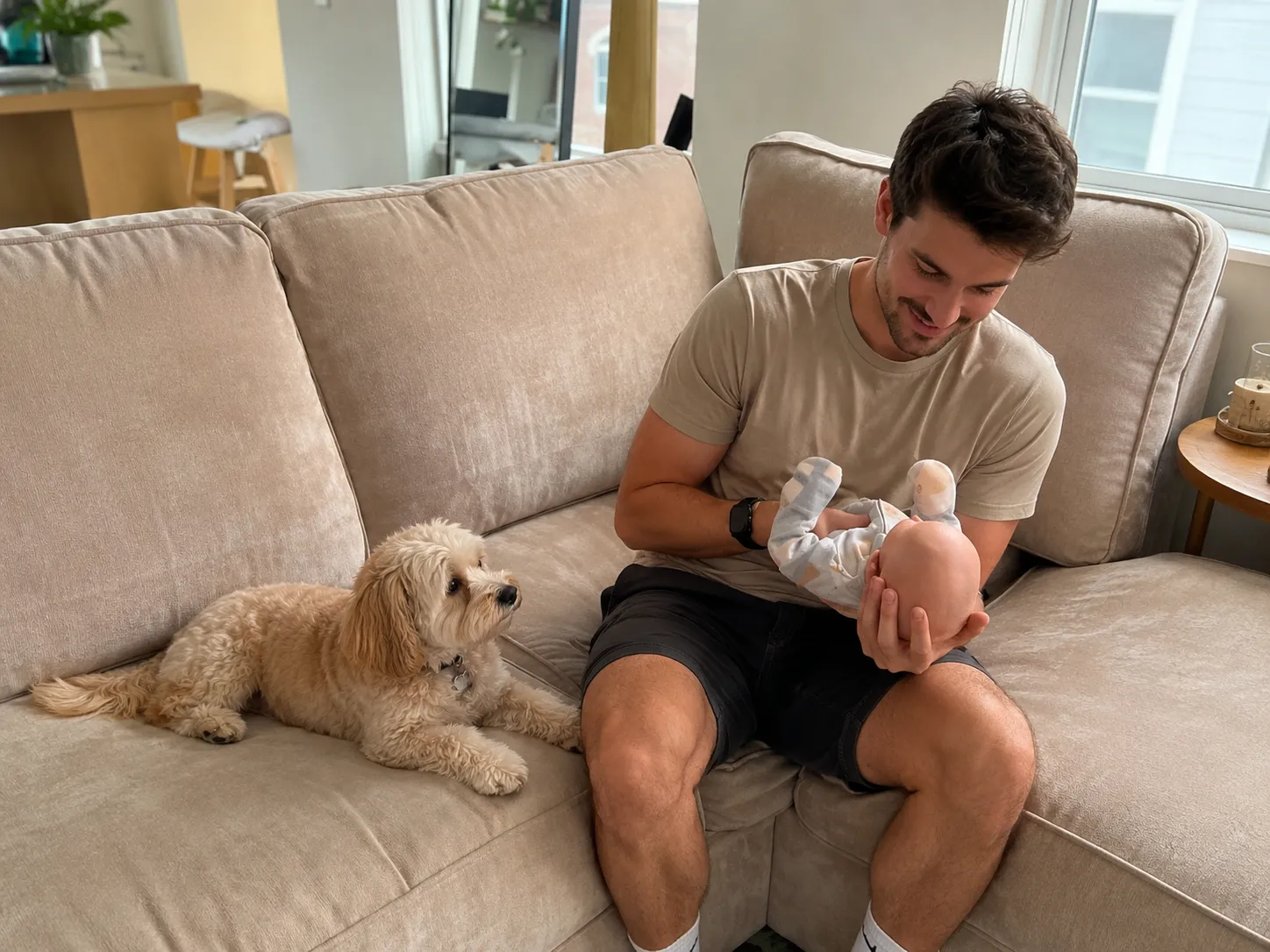
How Do I Stop My Dog From Waking My Baby With Barking?
Protect the nap by preventing your dog’s most predictable barking trigger before your baby falls asleep, then work on that trigger separately when the baby is awake. One bark can ruin a nap, so this is not the best time to test whether your dog can ignore the mail carrier, hallway noise, squirrel, doorbell, or delivery driver. Close the problem blinds, move the dog away from the entryway, choose a familiar lower-trigger resting spot, and keep a reward ready for calm behavior. If the barking starts only when you leave the room to put the baby down, treat that as a different pattern instead of assuming it is ordinary alert barking. Ruined naps are frustrating; the realistic goal is not a perfectly silent dog, but fewer predictable barking episodes during the period when your baby needs quiet.
What Is My 5-Minute Nap Protection Checklist?
Five minutes before the nap, remove the trigger you already know is most likely to cause barking.
What If My Dog Has Already Started Barking?
Move your dog away from the trigger calmly, use a familiar resting place, reward the first useful calm response, and save the actual training for later.
- Interrupt access to the window, door, hallway, or yard trigger.
- Guide or cue your dog to a familiar mat, bed, or quieter area.
- Reward looking away, following you, settling, or becoming quiet.
- Do not turn the middle of the nap into a long training session.
If repeatedly moving behind a gate or into a crate makes your dog pace, whine, scratch, or bark even more, that setup is not functioning as a useful nap-time solution for that dog.
How Do I Figure Out What Keeps Triggering the Barking?
Write down what happened immediately before each nap-ending bark. Do not start with “my dog barks at everything.” A short trigger log usually gives you a more useful starting point: window movement, a delivery, a hallway sound, yard activity, being separated from you, or something else.
| Nap | What Happened Right Before Barking? | What Did I Change? | What Happened Next? |
|---|---|---|---|
| 12:30 PM | Mail carrier passed front window | Nothing | Dog rushed window and barked |
| 3:00 PM | Same window / delivery time | Blind closed before nap | Record what actually happened |
Track your own household rather than trying to reach a predetermined number of “acceptable” barks. Useful progress can include fewer episodes, shorter episodes, or your dog becoming easier to move away from a known trigger.
Behavior source: ASPCA — Barking
What If Windows, Doorbells, or Deliveries Keep Ruining the Nap?
Prevent the predictable trigger during the nap, then teach a better response at another time. If your dog normally watches the sidewalk from one window or runs to the door whenever a package arrives, do not wait until the baby is asleep to practice.
What should I do about window barking?
Reduce the dog’s access to the problem view before the nap starts.
- Close the curtains or blinds at the specific window your dog watches.
- Move a couch or chair if your dog uses it as a lookout platform.
- Move the dog’s resting spot away from the window during nap time.
- If only the lower part of the window creates the problem, a suitable visual barrier may be enough.
During planned training, make the situation easy enough that your dog can notice the person, dog, vehicle, or other movement without immediately exploding into barking. Reward calm watching, looking back at you, or moving away.
Training source: American Kennel Club — Does Your Dog Bark Out the Window?
How can I stop delivery drivers from triggering barking?
Where the delivery service allows instructions, ask the driver not to knock or ring, and consider a clear door sign during naps. This does not train your dog, but it can remove a predictable trigger while you work on door behavior separately.
- Add a delivery note such as “Baby sleeping — please leave package without knocking or ringing.”
- Use a simple temporary sign at the door if deliveries frequently ignore app instructions.
- Mute the indoor doorbell chime during naps if your equipment supports it.
- Keep your dog away from the entryway during the delivery window if that area increases barking.
How do I train the doorbell response later?
Practice when the baby is awake and teach the dog somewhere else to go when the sound happens.
- Use a controlled doorbell press or recording.
- Make the sound quieter or easier if the full version immediately causes intense barking.
- Guide or cue your dog to a familiar mat or bed.
- Reward the dog at that spot.
- Repeat in short sessions rather than waiting for a real delivery.
For the door-specific routine, see how to reduce dog barking at the door without shouting “quiet”.
Training source: American Kennel Club — How to Stop Your Dog From Barking at the Doorbell
What If My Dog Barks When My Baby Cries?
That is a different trigger from a delivery, squirrel, or hallway sound, so do not assume the same plan will solve it. If your baby’s crying makes your dog bark, pace, become restless, or repeatedly approach, create comfortable space and reward calm behavior away from the baby. Do not use your baby’s real distress as a training exercise.
If the baby’s cry itself is the main trigger, use the dedicated guide on why dogs bark when a baby cries and what to do right now for safety signs, barriers, and planned low-intensity practice.
When the baby is calm and cared for, a planned recording can be used at a low volume if your dog can hear it without becoming highly worked up. Pairing an easy version of the sound with something the dog values can help build a calmer response over time.
Behavior source: ASPCA — Dogs and Babies
How Do I Train the Barking Trigger Without Ruining Another Nap?
Make the trigger quiet, distant, or easy enough that your dog can notice it without immediately bursting into barking. Train while the baby is awake, with another caregiver, or at another time when a mistake will not end the nap.
What Does a Simple Practice Session Look Like?
- Pick one trigger. Do not work on the window, doorbell, hallway, and separation at the same time.
- Make it easy. Use a quieter sound, greater distance, shorter exposure, or reduced view.
- Let your dog notice it.
- Reward a useful response. Quiet watching, looking away, coming with you, or settling all count.
- Stop before your dog gets increasingly worked up.
What if my dog is already barking hard during practice?
Make the next repetition easier rather than repeating the same difficult setup. Lower the sound, increase distance, reduce the view, or stop for the day.
If your dog normally accepts food but suddenly cannot take it, cannot settle, or is becoming more worked up, those are practical signs that the exercise may be too difficult at that moment.
Veterinary behavior source: VCA Animal Hospitals — Desensitization and Counterconditioning
Should I yell “quiet” or use a bark collar?
Avoid relying on shouting or aversive tools to solve the problem. Prevent predictable barking during naps and teach an alternative response during planned training.
For a fuller explanation of why corrections can backfire, read Bark Collars, Yelling, and “Stop It”.
The American Veterinary Society of Animal Behavior (AVSAB) recommends reward-based training and advises against aversive methods including electronic collars, prong collars, choke chains, and leash corrections.
Veterinary behavior source: AVSAB — Humane Dog Training Position Statement
What If My Dog Barks When I Leave the Room to Put My Baby Down?
Check whether barking happens during other separations before calling it separation anxiety. If your dog is quiet around windows and deliveries but starts barking when you disappear into the nursery, the trigger may be your absence rather than something outside.
Notice what happens when you:
- go upstairs without the baby;
- close a door between you and your dog;
- step outside briefly;
- leave the home.
If barking repeatedly appears during separation and is accompanied by other concerning behavior such as pacing, destruction, house soiling, or significant distress, compare the pattern with dog barking when left alone: separation vs. habit, then discuss severe or worsening signs with your veterinarian or a qualified behavior professional.
When Should I Call My Veterinarian or a Dog Behavior Professional?
Call your veterinarian when the barking is suddenly new or comes with other health or behavior changes. Look for qualified behavior help when the pattern is persistent, difficult to manage, or you are not making progress with an easier training setup.
| What Is Happening? | Where to Start |
|---|---|
| Sudden increase in barking, new irritability, pain, illness, confusion, appetite or sleep changes | Your veterinarian |
| Predictable window, doorbell, hallway, or other trigger and no obvious medical change | Qualified reward-based trainer or behavior consultant |
| Severe distress, complicated behavior, aggression concerns, or possible medical contribution | Veterinarian and appropriate behavior specialist |
Merck Veterinary Manual notes that meaningful changes in the frequency, duration, intensity, or pattern of behavior are useful information for veterinary assessment and that medical causes should be considered when behavior changes.
Veterinary source: Merck Veterinary Manual — Diagnosing Behavior Problems in Dogs
Where can I find a qualified trainer or behavior consultant in the U.S.?
Use a credentialed professional directory as a starting point, then ask the individual professional about methods and relevant experience.
Find an IAABC consultant
Search the CCPDT directory
A credential is a useful screening tool, not a guarantee of fit. Ask how the professional handles barking, which training methods they use, and whether they have experience working with busy households that include infants.
Frequently Asked Questions
Should I crate my dog during every baby nap?
No, not automatically. If your dog already relaxes comfortably in a crate, it can be one management option. A familiar room, mat, or gated area may work too. If confinement causes more pacing, whining, scratching, or barking, do not assume more crating will solve the nap problem.
Will white noise stop my dog from waking my baby?
White noise may mask some sounds, but it does not train your dog not to bark. If your dog repeatedly reacts to a window, delivery, hallway, or doorbell, work on that trigger directly. For hallway or nighttime sound-triggered barking, see whether white noise can help dog barking and how to use it. If you use a sound machine around your baby, follow the manufacturer’s instructions and guidance from your child’s healthcare professional.
What should I do about Amazon or other deliveries during nap time?
Where delivery instructions are available, request that the driver leave the package without knocking or ringing. A temporary door sign can provide an additional reminder. During the nap, keep your dog away from the entryway if that area triggers barking. Train the doorbell response separately later.
What if one bark is enough to wake my baby?
Put more effort into prevention during the nap itself. If you know the mail carrier, front window, hallway, or doorbell is the usual problem, reduce access to that trigger before your baby goes down. Training can happen later when one mistake will not immediately end the nap.
What if my dog barks only when I go upstairs or into the nursery?
Check whether the same barking happens during other separations. If it consistently appears when you disappear and comes with other signs of distress, discuss the overall pattern with your veterinarian or a qualified behavior professional. One nursery-related barking episode alone is not enough to diagnose separation anxiety.
How long will it take to stop my dog from barking during naps?
There is no reliable universal timeline. A dog reacting to one predictable package delivery has a different problem from a dog reacting to every hallway sound or becoming distressed whenever you leave. Track fewer barking episodes, shorter reactions, easier movement away from the trigger, and better settling rather than expecting instant silence.
Sources and Further Reading
- ASPCA — Dogs and Babies: Baby-related dog preparation, baby sounds, quiet-time skills, and barking during naps
- ASPCA — Barking: Barking causes and separation-related patterns
- American Kennel Club: Window barking management and alternative behavior
- American Kennel Club: Doorbell training and designated-place behavior
- VCA Animal Hospitals: Gradual trigger exposure and counterconditioning
- American Veterinary Society of Animal Behavior: Humane Dog Training Position Statement
- Merck Veterinary Manual: Veterinary assessment of changing behavior
What Should I Do Before the Next Nap?
Choose the one trigger most likely to cause barking and manage that before your baby falls asleep. Block the problem window, prevent the knock or doorbell when possible, choose a resting setup your dog actually relaxes in, and keep rewards ready. Then work on the barking trigger later when your baby’s nap is not depending on a perfect training repetition.
 ✓
✓