

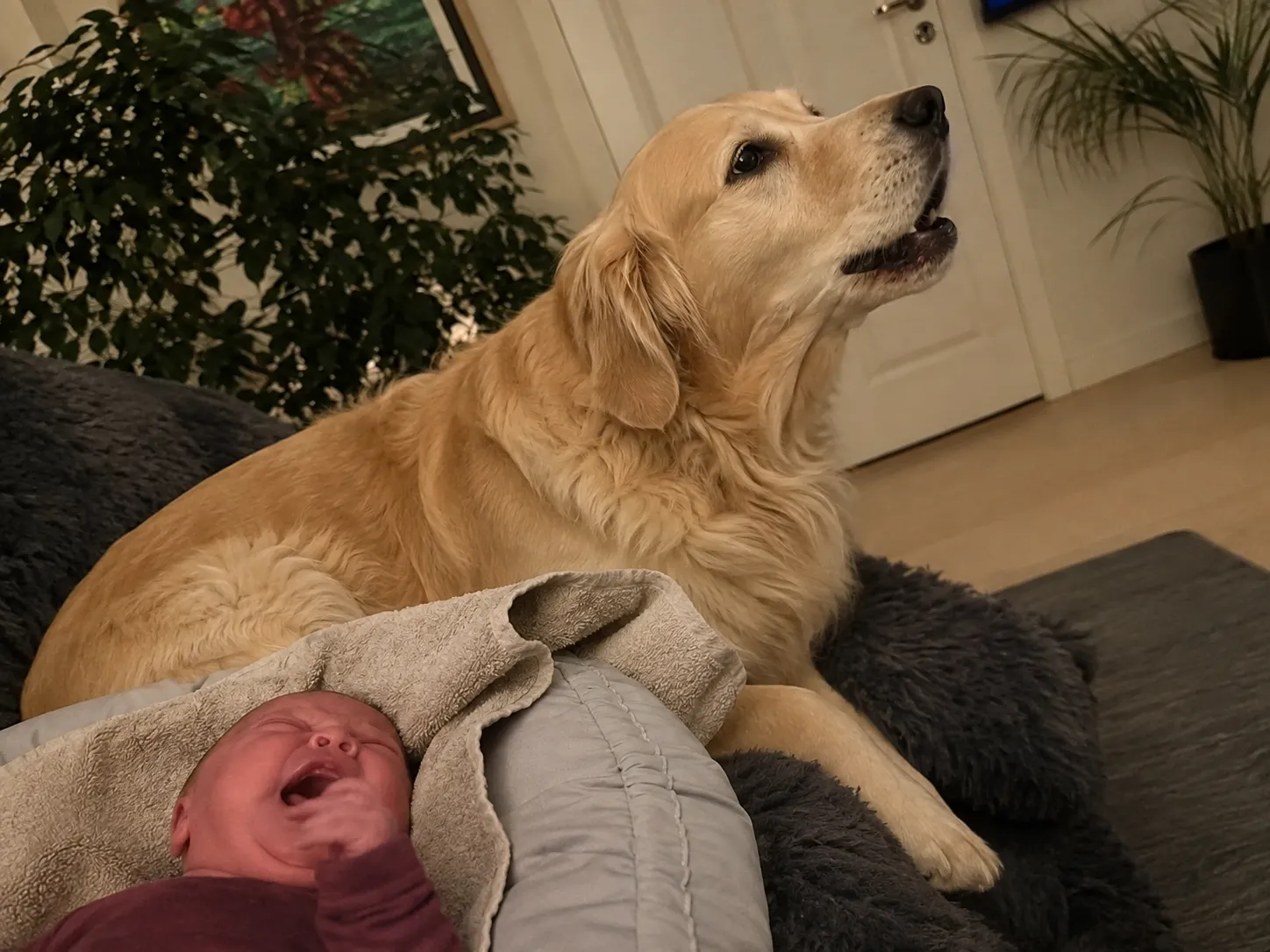
Why does my dog bark when my baby cries?
Your dog may bark because your baby’s crying is a sudden, intense sound that gets the dog’s attention, but barking by itself does not mean your dog is aggressive or wants to hurt the baby. Do not guess that your dog is jealous, protective, scared, or aggressive from the bark alone. Instead, look at what your dog actually does. If the dog can move away, respond to you, and settle, create space and reward that calmer behavior. If your dog freezes, growls, snaps, lunges, repeatedly tries to reach the baby, or becomes difficult to redirect, separate dog and baby and focus on safety rather than trying to train through the crying episode.
What Should I Do Right Now?
Take care of your baby first, then create space between the baby and dog. A simple routine to remember is: Baby → Barrier → Bed → Reward.
Can My Dog Hurt or Bite My Baby?
Barking alone does not mean a bite is about to happen, but you should never rely on a dog’s past friendliness as a guarantee of future safety. What happens with the barking matters more. Growling, freezing, snapping, lunging, repeated attempts to reach the baby, or an inability to move away are reasons to use physical separation and get professional guidance.
The CDC advises adults to supervise young children around dogs, including trusted family pets. The ASPCA likewise advises that babies and young children should not be left alone with dogs.
Sources: CDC — Dogs · ASPCA — Dog Bite Prevention
Does barking mean my dog is aggressive?
No. Barking by itself cannot establish aggression or tell you why the dog is reacting. In a study of 75 dogs, researchers found behavioral and cortisol responses after dogs heard human infant crying. That shows infant crying can affect dogs, but it does not identify the motive behind your individual dog’s barking.
Research: Yong & Ruffman — Dogs’ Responses to Human Infant Crying
How Can I Tell If My Dog’s Reaction Is Becoming Unsafe?
Watch your dog’s whole response, especially whether the dog can look away, move away, respond to you, and settle. The table below is a practical observation guide, not a diagnostic test.
| What You Notice | What to Do |
|---|---|
| Brief barking, dog can look away, move with you, or settle | Create some distance and reward the calmer behavior. |
| Repeated barking, pacing, prolonged staring, or ignoring a cue that usually works | Stop active training and increase separation. |
| Freezing, stiffening, growling, snapping, lunging, or repeated attempts to reach the baby | Fully separate dog and baby and seek qualified behavior help. |
| Sudden new irritability or a major change from your dog’s usual behavior | Contact your veterinarian to discuss whether a health problem could be contributing. |
Should I punish my dog for barking or growling?
Avoid shouting, shock collars, prong collars, leash corrections, or other aversive corrections. Create distance and reinforce safer behavior instead. For more context on why punishment can make barking harder to interpret or manage, see why bark collars, yelling, and “stop it” can backfire. The American Veterinary Society of Animal Behavior (AVSAB) recommends reward-based methods for dog training and behavior modification.
Professional guidance: AVSAB — Humane Dog Training Position Statement
What If I’m Home Alone With My Baby and Dog?
Use physical management instead of trying to care for your baby and train your dog at the same time. Set up a routine that works when you only have one pair of hands.
A Simple 3-Step Routine
- Create separation. Use the established gate, closed door, or familiar dog area if the dog is reacting strongly.
- Care for your baby. Feed, change, hold, or settle your baby without repeatedly approaching an intensely reacting dog while carrying the infant.
- Practice later. Return to dog training when your baby is settled and the household is calm.
Should I pick up my baby while my dog is barking?
Take care of your baby’s needs, but avoid carrying the baby toward a dog who is frozen, growling, lunging, or intensely focused. Create a barrier first when practical.
How Can I Make Future Crying Episodes Easier?
Prepare the same simple setup before the next cry: one safe dog area, one familiar cue, and rewards within reach. This makes the routine easier to follow when everyone is tired or the baby starts crying unexpectedly.
- Keep a baby gate or other appropriate barrier ready to use.
- Give your dog a familiar bed or mat away from the baby’s immediate space.
- Practice “place,” “bed,” or another move-away cue while the baby is calm.
- Keep small rewards near the dog’s resting area.
- If two adults are available, one can handle the baby while the other manages the dog.
When exactly should I reward my dog?
Reward calm or safe behavior when it happens. Ideally, reward before the reaction escalates. If your dog has already barked but then turns away, moves behind the gate, or settles, you can reward that safer next behavior too.
ASPCA guidance recommends preparing useful behaviors such as settling and moving away, creating safe areas, and pairing baby-related sounds and experiences with things the dog likes.
If the bigger problem is that ordinary barking keeps waking a sleeping baby—not that crying triggers the dog—use the separate dog barking and baby naps guide for window, delivery, doorbell, hallway, and nap-protection strategies.
Source: ASPCA — Dogs and Babies
Can I Practice With a Recording of a Baby Crying?
Yes, but only start at a volume where your dog can remain responsive. If the recording immediately causes intense barking, freezing, lunging, or prolonged fixation, stop and make the exercise easier.
A Short Practice Session
- Choose a calm time when your baby does not need you.
- Play a realistic baby-cry recording at low volume.
- Pair the brief sound with something your dog values.
- Stop the sound and give your dog a break.
- Repeat only while your dog stays responsive.
- Increase the volume gradually over later sessions.
ASPCA specifically recommends starting baby-sound recordings quietly when a dog appears worried by them and increasing volume gradually as the dog becomes comfortable.
Professional guidance: ASPCA — Dogs and Babies
What Changes When My Baby Starts Crawling?
Once your baby becomes mobile, movement and physical proximity become part of the safety picture—not just crying. Your dog should have a resting area the child cannot follow them into, and adult supervision remains important.
- Give your dog a child-free resting area.
- Do not allow the baby to follow a dog who is trying to move away.
- Keep the baby away from the dog while the dog is eating or resting.
- Use gates or other barriers when active supervision is not possible.
ASPCA guidance specifically discusses teaching dogs to move away as babies become mobile and using safe zones when a crawling child makes a dog uncomfortable.
Professional guidance: ASPCA — Dogs and Babies
Who Should I Call If I’m Worried About My Dog?
Call your veterinarian first for sudden or unusual behavior changes. Seek qualified behavior help promptly if growling, snapping, lunging, redirected biting, or difficulty maintaining safe separation is involved.
| Situation | Where to Start |
|---|---|
| Sudden behavior change, pain, illness, confusion, or new irritability | Your veterinarian |
| Growling, snapping, lunging, biting risk, or repeated attempts to reach the baby | Veterinarian plus qualified behavior help |
| Serious or complex behavior where medical and behavior issues may overlap | Board-certified veterinary behaviorist, when accessible |
| Training support without an obvious medical concern | Qualified reward-based trainer or behavior consultant |
US owners can search the American College of Veterinary Behaviorists (ACVB), International Association of Animal Behavior Consultants (IAABC), and Certification Council for Professional Dog Trainers (CCPDT) directories. Ask any professional about their methods and experience working with dogs in homes with infants.
Frequently Asked Questions
Will my dog eventually get used to my baby crying?
Some dogs may react less as baby sounds become familiar, but there is no reliable timeline for every dog. If your dog remains highly reactive, use management and planned low-intensity practice instead of depending on repeated uncontrolled exposure.
Does barking at my crying baby mean my dog is aggressive?
No. Barking by itself does not establish aggression. Look at the whole response. Freezing, growling, snapping, lunging, repeated attempts to reach the baby, or difficulty moving away are more important safety concerns than barking alone.
Should I punish my dog for barking when the baby cries?
Avoid shouting, shock collars, prong collars, leash corrections, or other aversive corrections. Create space and reinforce safer behaviors such as moving away, going to a mat, or settling.
Can my dog safely stay in the same room as my baby?
It depends on the individual dog and situation. Do not rely on past friendliness alone. Use active adult supervision and make sure your dog can move away. If the dog is growling, snapping, lunging, or intensely focused on the baby, use physical separation.
Why does my dog bark more when I’m holding the crying baby?
The combination of crying, your movement, and holding the baby may be a more difficult situation for your dog than crying alone. Use more distance and practice your dog’s place or move-away cue when the baby is calm. Do not bring the dog closer while carrying a crying infant just to test the reaction.
What should I do if my dog growls at my baby?
Create physical separation and do not test what will happen next. Keep dog and baby apart while you contact your veterinarian or an appropriately qualified behavior professional. If you cannot maintain reliable separation, treat the situation as a serious safety concern.
Sources and Further Reading
- ASPCA: Dogs and Babies — baby sounds, safe areas, move-away training, rewards, and management.
- ASPCA: Dog Bite Prevention — child supervision and bite-risk guidance.
- Centers for Disease Control and Prevention: Dogs — Healthy Pets, Healthy People — supervision of young children around dogs.
- American Veterinary Society of Animal Behavior: Humane Dog Training Position Statement — reward-based training guidance.
- Yong & Ruffman: Emotional Contagion: Dogs and Humans Show a Similar Physiological Response to Human Infant Crying — experimental research on dogs’ responses to human infant crying.
- Root-Gutteridge et al.: Effect of Pitch Range on Dogs’ Response to Distress Cries
What Should I Remember?
Baby → Barrier → Bed → Reward. Care for your baby, create space, use your dog’s familiar safe area, and reinforce calm behavior. If your dog freezes, growls, snaps, lunges, or cannot be safely separated, stop DIY training and get professional help.
 ✓
✓