

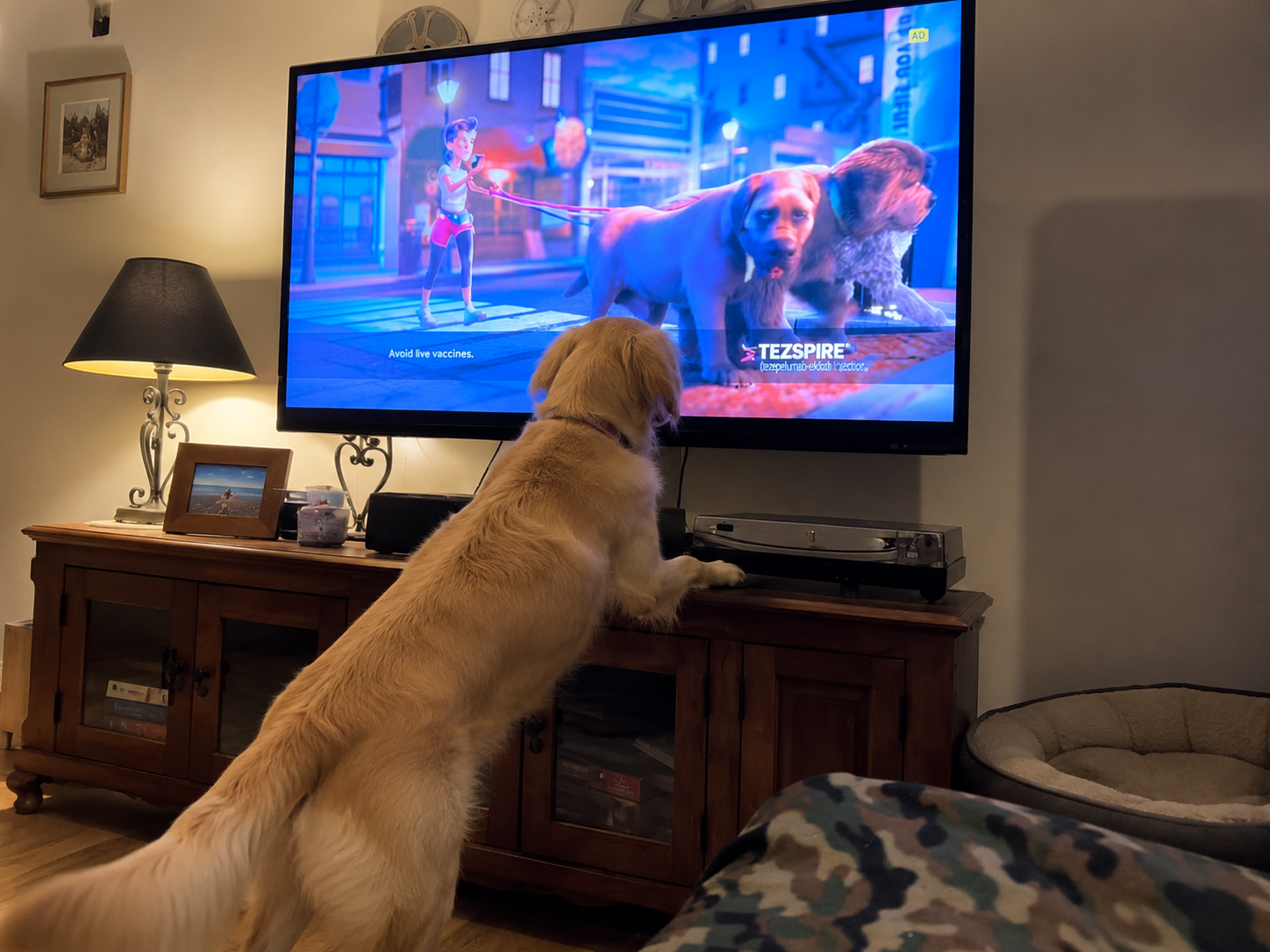
Why does my dog bark at the TV?
Your dog may bark at the TV because something on the screen or in the audio gets their attention strongly enough to trigger a reaction. Dogs, other animals, barking sounds, doorbells, and fast movement can all be triggers for individual dogs. Barking alone does not tell you whether your dog is excited, worried, frustrated, or simply highly interested. Start by making the situation easier instead of shouting over the barking: pause the scene, lower the volume, or move your dog farther from the screen. Then notice whether the picture, sound, or both start the reaction. Once you know the likely trigger, practice with an easier version and reward your dog for staying quiet, looking away, coming with you, or settling before the barking starts.
What Should I Do When My Dog Starts Barking at the TV?
If your dog is barking intensely and ignoring a familiar cue, do not keep repeating it. Reduce the trigger first.
What If I Just Want to Watch TV Tonight?
You do not have to turn every evening into a training session. Management is a reasonable option when you simply want a quieter night.
- Lower the volume if television sounds are a trigger.
- Move your dog’s bed or mat farther from the screen.
- Use a safe barrier if your dog rushes toward the television.
- Choose programming that does not repeatedly show known triggers.
- Offer a familiar chew, food toy, or other suitable activity if your dog normally settles with it.
Is My Dog Reacting to the Picture or the Sound?
Test picture and sound separately instead of assuming the whole television is the problem. Your dog may react mainly to movement, mainly to sound, or to a combination of both.
Studies of companion dogs interacting with television support the idea that both visual and auditory features can affect dogs’ screen-viewing behavior. Animal content also appears to be especially engaging for some screen-watching dogs. These studies describe groups of dogs; they cannot identify why your individual dog barks.
Research evidence: Donohue et al. — Screen Interaction Behavior in Companion Dogs · Montgomery, Krichbaum & Katz — Characterizing TV Viewing Habits in Companion Dogs
Does My Dog Look Excited or Uncomfortable?
Use your dog’s whole-body behavior as a guide, but do not diagnose the emotion from one sign. The most useful question is whether your dog can still respond and settle around the TV trigger.
A useful practical check is whether your dog can still take a familiar reward, respond to an easy cue, look away from the screen, or settle again. If several of those become difficult, reduce the intensity of the trigger.
VCA advises keeping behavior-modification triggers at a level where the pet is not highly distressed and notes that no longer taking treats or settling on cue can be a sign that the exercise has become too difficult.
Professional guidance: VCA Animal Hospitals — Desensitization and Counterconditioning
How Do I Teach My Dog to Stay Calmer Around the TV?
Practice with one predictable trigger at an easier level and reward the calmer response before barking starts. Do not begin with the most exciting wildlife clip at full volume.
A Simple 5-Minute Practice Session
- Pick one trigger. For example, a short clip containing a dog.
- Make it easier. Lower the volume, mute the clip, or move your dog farther away.
- Let your dog notice it. You do not need to force eye contact with you.
- Reward before barking. Reward quiet watching, looking away, or turning back toward you.
- Pause the clip. Give your dog a brief break.
- Repeat a few successful times.
- Stop while your dog is still responsive.
When should I give the reward?
Give the reward as soon as the calm behavior happens. For example, your dog notices the TV dog but stays quiet, or looks at the screen and then turns back toward you. During easy early practice, rewarding each successful response can make the pattern clearer.
Use something your dog actually values. A small training treat may work well, but food is not the only possible reward. The important part is timing the reward with the behavior you want repeated.
The basic idea is to start with an easier version of the trigger and pair manageable exposure with something positive. This is the plain-English version of desensitization and counterconditioning. AKC also recommends rewarding quiet behavior around TV triggers rather than relying only on repeated verbal corrections.
Professional guidance: VCA Animal Hospitals · American Kennel Club — How to Stop a Dog From Barking at the TV
Why Does My Dog Bark Only at Animals on TV?
Animals may simply be a stronger screen trigger for your dog than people or ordinary scenes. Research has found that animal content attracts the attention of many dogs that regularly interact with screens, but the barking itself does not tell you whether your dog is excited, worried, frustrated, or simply interested.
What should I track?
- Dogs versus cats, horses, or wildlife
- Real animals versus cartoons
- Moving animals versus still images
- Animal sounds versus silent scenes
- Whether your dog stays in place or moves toward the screen
Research evidence: Screen Interaction Behavior in Companion Dogs
Why Does My Dog Bark at TV Doorbells or Dog Sounds?
Your dog may react to the television sound even when the real event is not happening in your home. Dog noises, doorbells, vehicles, and other sounds have been included among the kinds of TV audio that researchers have studied in companion dogs.
You do not need a completely different training system for TV sounds. Use the same basic routine: begin at an easier volume, reward the response you want, pause, and increase difficulty gradually.
If the real doorbell or visitors trigger the same reaction, use the dedicated guide on how to stop dog barking at the door without shouting “quiet”.
Research evidence: Characterizing TV Viewing Habits in Companion Dogs
What If My Dog Runs at or Jumps on the TV?
Prevent access to the television before working on the barking. A dog rushing or jumping at a screen creates a physical-management problem in addition to a training problem.
- Prevent your dog from reaching a television that could tip or be damaged.
- Move the dog’s bed or mat farther from the screen.
- Use an appropriate baby gate, exercise pen, or furniture arrangement when needed.
- Do not deliberately replay animals to encourage screen chasing.
- Use calmer content during training.
- Manage access when you cannot supervise.
In the 2024 owner survey, some dogs described as screen watchers were reported to approach and physically investigate screens, supporting the need to consider physical access when a dog interacts intensely with television content.
Research evidence: Screen Interaction Behavior in Companion Dogs
What Should Everyone in the House Do?
Keep the response simple and as consistent as practical. Choose the same calm cue and the same general plan so the dog is not getting a different response from every person.
- Use one familiar cue such as “come,” “place,” or “mat.”
- Avoid shouting over the barking.
- Reward the same quiet or turn-away behaviors.
- Reduce the TV trigger when the dog cannot respond.
- Do not encourage screen chasing for entertainment.
If shouting or corrections have become part of the routine, see why bark collars, yelling, and punishment can backfire with dog barking.
What if one dog makes the other dog start barking?
If one dog reacts first and the second dog joins in, try short practice sessions separately if that is practical. This makes it easier to see which dog is responding directly to the television and to reward each dog clearly. Once both dogs can handle easier situations individually, you can test calmer sessions together.
When Should I Get Professional Help?
Talk to your veterinarian if the TV barking is a new behavior, becomes much more intense, or appears alongside other changes in your dog’s normal behavior.
Start with your veterinarian if:
- a dog that previously ignored television suddenly reacts strongly;
- you notice pain, unusual irritability, confusion, or other behavior changes;
- you are concerned about hearing or vision changes;
- an older dog develops several new behaviors at the same time.
Merck Veterinary Manual recommends ruling out medical problems when meaningful behavior changes are evaluated and identifies pain as an important possible contributor to behavior problems.
Consider behavior support if:
- your dog repeatedly charges the television;
- your dog redirects snapping or biting toward people or other pets;
- you cannot find an easier TV setup where your dog remains responsive;
- TV barking is part of a broader fear or reactivity problem.
Look for a veterinarian or appropriately credentialed behavior professional who can explain their methods and experience with the specific problem.
Professional guidance: Merck Veterinary Manual — Behavior Problems of Dogs
Frequently Asked Questions
Why does my dog bark at dogs on TV but not dogs outside?
Television and real-life encounters are different situations. Screen movement, sound, framing, and the dog’s ability to investigate the situation all differ. Treat TV barking as its own trigger pattern rather than assuming your dog feels the same way about real dogs.
Should I say “quiet” when my dog barks at the TV?
A trained quiet cue can help, but repeatedly shouting “quiet” during intense barking does not teach an alternative behavior by itself. Use a cue your dog already understands and reward the quiet or turn-away response.
Why does my dog bark at commercials more than regular shows?
Look for the specific feature in those commercials. Animals, dog sounds, doorbells, or fast movement may be stronger triggers than ordinary programming. Track what happens immediately before the barking begins.
Should I leave the TV on when my dog is home alone?
Test the content while you are home first. If a channel repeatedly triggers barking, screen rushing, animals, doorbells, or other reactions, it may not be a good unsupervised choice. The 2024 screen-interaction study also notes that owners should consider whether video content is suitable for their individual dog when left alone.
What if my dog refuses treats when an animal appears on TV?
If your dog normally accepts that food but stops taking it during the TV trigger, make the exercise easier. Lower the volume, use a calmer clip, or create more distance. Food refusal should be considered alongside staring, body tension, responsiveness, and recovery rather than used alone.
How long does it take to stop a dog barking at the TV?
There is no reliable universal timeline. Look for practical progress:
- fewer barking episodes;
- shorter reactions;
- faster response to a familiar cue;
- less rushing toward the screen;
- quicker settling after the trigger ends.
Sources and Further Reading
- Donohue et al.: Screen Interaction Behavior in Companion Dogs
- Montgomery, Krichbaum & Katz: Characterizing TV Viewing Habits in Companion Dogs
- American Kennel Club: How Do I Stop My Dog From Barking at the TV?
- VCA Animal Hospitals: Introduction to Desensitization and Counterconditioning
- American Veterinary Society of Animal Behavior: Humane Dog Training Position Statement
- Merck Veterinary Manual: Behavior Problems of Dogs
What Are the 3 Things to Remember?
- Find the trigger: picture, sound, or both.
- Make practice easier: reward calm behavior before barking starts.
- Use management when needed: you do not have to train during every movie or TV show.
 ✓
✓