
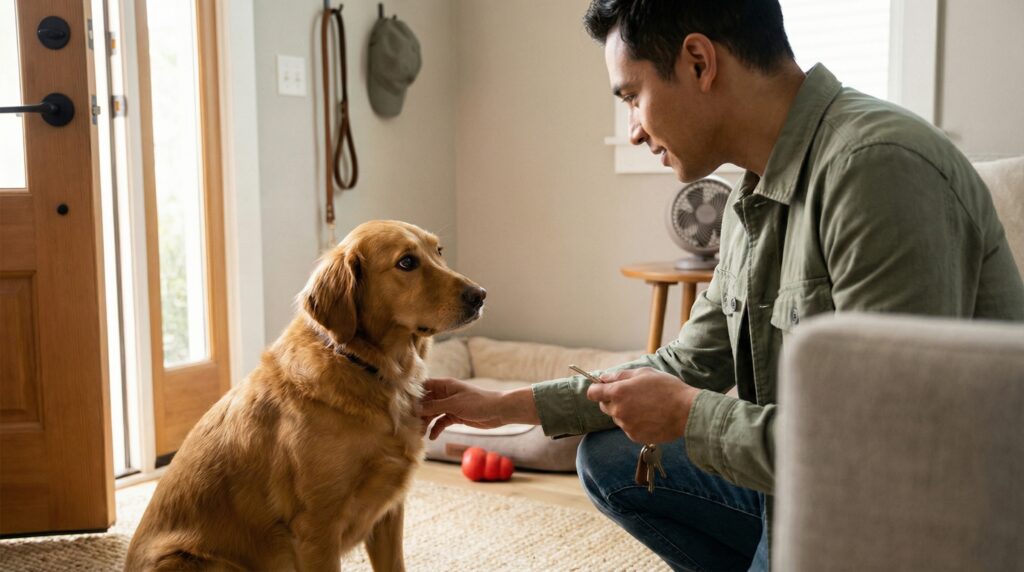
Dog separation anxiety is not “misbehavior.” Your dog panics when you leave.
If you treat it like disobedience, it gets worse. If you treat it like a nervous-system skill problem, it improves.
This guide gives you a clear plan you can actually follow.
Quick note: This content is educational. If your dog self-injures, breaks teeth/claws, collapses, or shows sudden behavior change, talk to your vet.
Do This Today (10–15 minutes)
If you want a fast, safe start, do these three steps today:
- Sniff walk (10 minutes): slow pace, let your dog explore.
- Set one safe zone: one consistent rest spot (bed/crate corner).
- Micro exits (3 reps): step outside for 5–10 seconds, return calmly.
Small reps done daily create real change.
Quick Check: Separation Anxiety or Boredom?
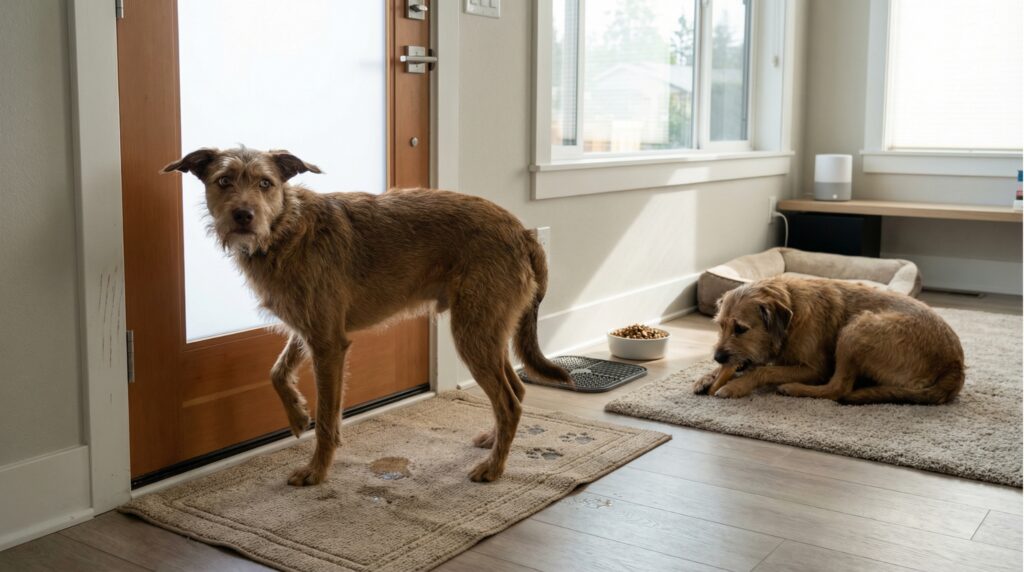
It’s likely separation anxiety if you see:
- Panic starts within minutes of you leaving
- Destruction happens near doors/windows
- Nonstop barking/howling, drooling, pacing
- Your dog refuses food when alone
- Escape attempts or self-injury
It’s more likely boredom if you see:
- Chewing happens later, not immediately
- Your dog eats normally while alone
- Destruction looks random, not focused on exits
- Your dog can settle and nap alone sometimes
If your dog panics quickly, focus on separation anxiety training, not “more toys.”
Common Separation Anxiety Symptoms (Early vs Severe)
Early signs
- Pacing, panting (not heat-related)
- Trembling, whining
- Following you closely before you leave
- Lip licking, yawning, whale eye
- Won’t eat when alone
Severe signs
- Destruction at exits (doors, windows)
- Escape attempts
- Continuous vocalization
- Accidents despite being house-trained
- Self-chewing or injured paws from frantic behavior
Pattern matters more than one bad day. If it repeats around your departure, treat it as anxiety.
What Causes Separation Anxiety in Dogs?
Common drivers include:Common Separation
- Sudden routine changes (new job hours, travel, moving)
- Rehoming history or shelter background
- Lack of alone-time practice during puppy stage
- Hyper-attachment and constant togetherness
- Trigger stacking (noise stress + change + lack of sleep)
Your dog is not trying to “get back at you.” Your dog is trying to survive being alone.
Rule Out Medical Causes First (Important)
Some medical issues look like anxiety:
- Pain (arthritis, dental pain)
- GI upset or nausea (can cause pacing and distress)
- Urinary issues (accidents)
- Cognitive changes in seniors
- Hearing/vision loss (increased startle response)
If symptoms start suddenly or escalate fast, start with a vet check.
The 4-Pillar Treatment System That Actually Works
Real improvement usually comes from four pillars:
- Lower baseline stress
- Create predictability + a safe zone
- Train alone-time skills (core solution)
- Use support tools when needed (management, supplements, vet meds)
You don’t need perfection. You need consistency.
Pillar 1: Lower Baseline Stress (Daily)
A stressed dog has a shorter fuse. Lower baseline stress first.
Do this daily:
- Structured walk(s) + 10 minutes sniff time
- Food enrichment: puzzle feeder, lick mat, scatter feeding
- A predictable routine (same walk/meal/rest rhythm)
This step reduces overall arousal and makes training easier.
Pillar 2: Create a Safe Zone (One Consistent Place)
Pick one calm rest area and keep it consistent.
- Same location every day
- Calm background (fan/white noise if helpful)
- Comfort item (bed + chew/lick mat)
Dogs relax faster in predictable environments.
Pillar 3: Dog Separation Anxiety Training (The Core Fix)
Separation anxiety training uses:
- Systematic desensitization: tiny exposures that stay below panic
- Counter-conditioning: leaving cues predict good things, not fear
The golden rule
Return before panic starts.
If your dog panics, the session was too hard. Reduce the difficulty next time.
Step-by-Step Separation Anxiety Training Plan
Step 1: Neutralize leaving cues (5–10 reps/day)
Practice cues without leaving:
- Pick up keys → sit down
- Put on shoes → make tea
- Grab bag → scroll your phone
This breaks the “keys = panic” pattern.
Step 2: Start micro exits (daily)
Do 3–10 reps/day:
- Touch door handle → treat → sit
- Open door → close door → treat
- Step out 5–10 seconds → return calmly
- Increase slowly: 10s → 20s → 40s → 1 min → 2 min → 3 min
Keep your dog under threshold.
Step 3: Add a calm pre-departure routine
Before micro exits:
- Lick mat (calming)
- “Go to bed” cue
- Quiet room, low stimulation
Step 4: Track progress like a system
Measure:
- Max calm time
- Intensity score (1–10)
- Recovery time after you return
Progress looks like calmer body language and faster settling.
Crate Training a Dog With Separation Anxiety (Do It Safely)
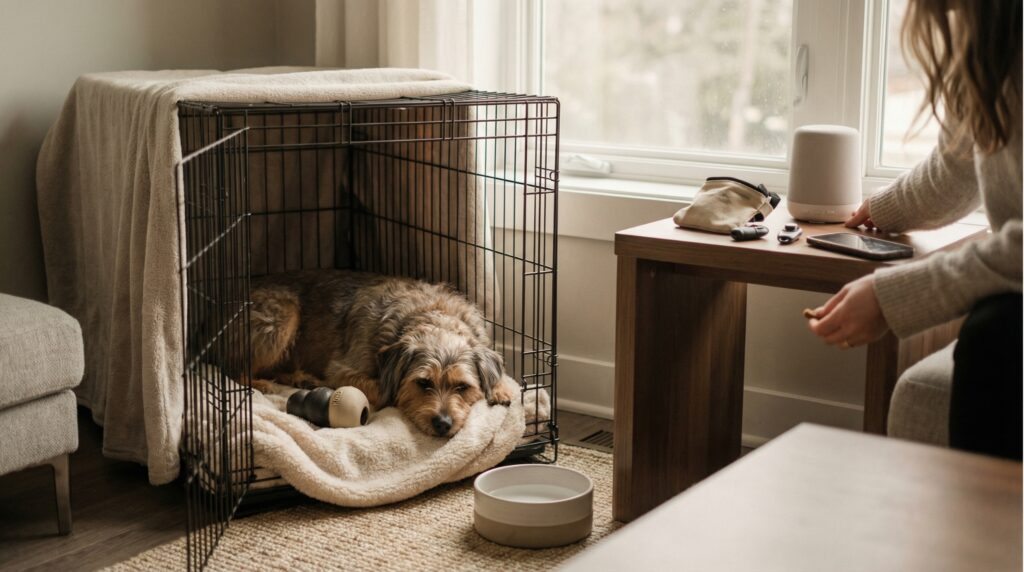
A crate can help, but it never cures separation anxiety by itself.
Use a crate only if it stays calm
Build crate comfort:
- Feed meals inside
- Start with door open
- Short closed-door reps while calm
- Release only when calm
Do not crate a panicking dog
If your dog thrashes, screams, or tries to escape, stop crating. Confinement can amplify panic and cause injury.
When Medication Helps (And What It’s For)
Medication can be useful when panic blocks training.
Consider vet help if:
- Your dog self-injures or breaks crates/doors
- Panic stays intense despite consistent training
- Fear triggers aggression
- Your dog cannot stay under threshold long enough to learn
Medication can reduce intensity so behavior modification works. It should support training, not replace it.
Natural Support (Safe, Realistic)
Natural options may help mild cases or situational stress. They do not replace training.
Common vet-discussed ingredients in dog-formulated products:
- L-theanine
- Chamomile
- Valerian (dog-safe formulation)
- Melatonin (often discussed for situational stress)
Safety rule: Ask your vet first especially if your dog takes other meds, has health conditions, or is very small. Avoid random human blends.
What Not to Do (These Backfire)
Avoid:
- Punishment for anxiety behaviors
- “Cry it out” flooding (long absences too soon)
- Overexcited greetings and goodbyes
- Inconsistent practice
- Crating a panicking dog
- Jumping difficulty too fast
Anxiety improves with skill-building, not pressure.
30-Day Improvement Plan (Simple + Structured)
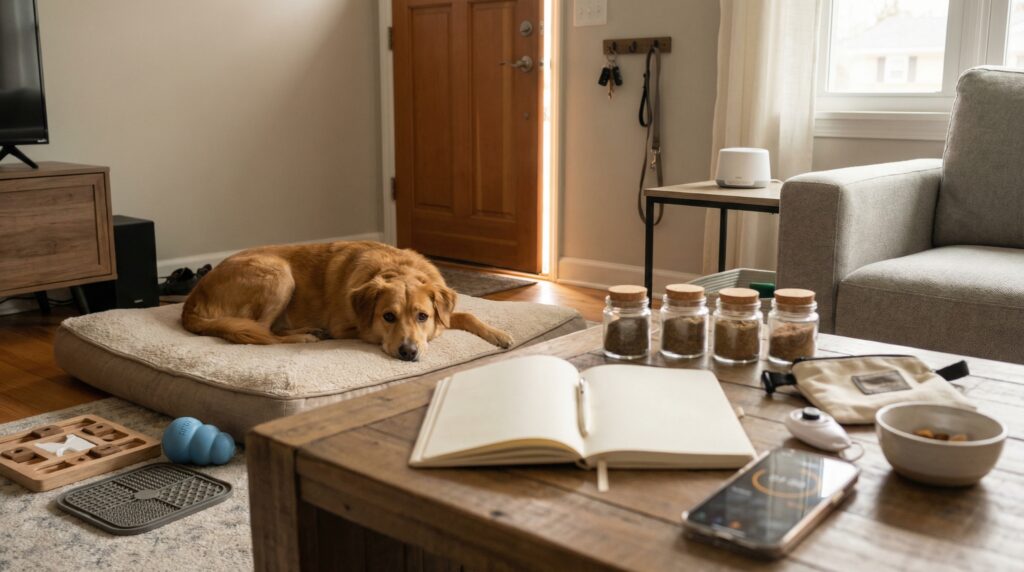
Week 1: Stabilize
- Identify triggers and patterns
- Add sniff walks + enrichment
- Create safe zone
- Practice leaving cues without leaving
Week 2: Micro exits
- Daily micro exits (seconds)
- Track intensity (1–10)
- Keep sessions below panic
Week 3: Build duration
- Extend time slowly (seconds → minutes)
- Add calm pre-departure routine
- Avoid long absences that reset progress
Week 4: Real-life practice
- Increase real durations gradually
- Maintain routine stability
- Reduce support tools only after stability
Consistency beats intensity.
Tracker (Use This Daily)
| Date | Alone-Time Goal | Max Calm Time | Intensity (1–10) | Recovery Time | Notes |
If intensity stays 7–10 for weeks, get vet + qualified trainer support.
FAQs
How do I calm separation anxiety fast?
Lower arousal first (sniff walk + safe zone), then do micro exits. Avoid long absences until your dog builds tolerance.
Separation anxiety vs boredom what’s the difference?
Separation anxiety causes early panic and exit-focused destruction. Boredom causes later mischief and your dog can still eat and settle.
How long does separation anxiety training take?
Mild cases improve in weeks. Moderate-to-severe cases can take months. Daily micro sessions speed progress.
Should I crate a dog with separation anxiety?
Only if the crate already feels safe. Never crate a panicking dog.
When should I talk to a vet or behaviorist?
If your dog self-injures, shows nonstop panic, or cannot stay under threshold during training, ask for professional help.
Final Takeaway
Separation anxiety is a panic response. When you lower baseline stress and train alone-time skills in small steps, most dogs improve.
Punishment increases anxiety.
Consistency builds confidence.